Matisse and a Picture Post

I’m prefacing this post by saying that it’s about 85 degrees in my apartment right now. My brain is being slowly over-cooked. Also, the bugs have taken this warm weather as an opportunity to crawl around. I don’t mind them, but I do.
Maddie and I are switching back and forth between “Say Yes to the Dress” and “SportsCenter.” That very much sums up our lives.

Today I joined my friends Greg and Carolyn at the Art Institute downtown. The city was hot and muggy, but full of energy because this morning was the Blackhawks’ Stanley Cup celebration parade. The streets were full of people dressed in bright red, hot but happy. We spent a pleasant afternoon perusing parts of the museum; we saw an exhibit featuring many Chicago artists trained at the Art Institute (SAIC). Then we went and saw the Matisse exhibit. I generally stay away from modern art, so I don’t know a whole lot about it, but having Greg as a tour guide added to my experience.
I’m in the middle of attempting to upload my photos of Matisse (only one, since photography was prohibited and I had to sneak it) and also of my one true love, the Impressionists.
                                      
                                                                   Below, Lake Michigan.

If you quint, you can see me! I’m wearing a blue Oxford and brown shorts in the bottom right, below! 
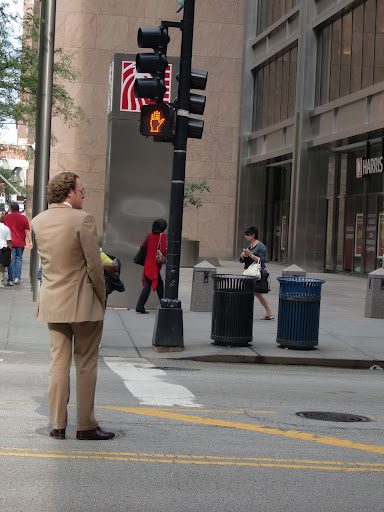
Above, a man whose suit was tremendously horrible. It was part chartreuse and part rust, and when he walked, it seemed to change color in the light. And he has Gene Wilder hair circa the “Charlie and the Chocolate Factory” era. Scary.


Above, the Art Institute lions wearing hockey helmets.
I’ve been thus unable to retrieve my pictures from today, so be sure to check back because I’m going to post them tomorrow (or whenever I get them…apparently my 3G isn’t so hot right now, or the fact that I’m trying to simultaneously email 25 pictures from my cell phone may have slowed progress). But I want to talk about Matisse a bit, so it might be worth it. 

Au Revoir, Chicago. You’ve been but a dream.

June 15 until July 1st is going to be a very interesting time for me.
And by interesting, I mean the exact opposite.
It’s going to be very lonely, but I’m sure that I won’t mind just removing myself from the world and being. Perhaps it shall be me and my beloved city and that damn cat, all alone in our strange apartment or all alone on the train or at the beach or in line at the grocery store.

And I’l hate to see it go, as I slip away for the last time (of course, it’s never the last time, but symbolically, it is and that’s crushing). I’ll cry, just like I’m doing now, and that will be the end of it.

I hadn’t thought how to say to goodbye. I still haven’t.
I’ll stand in the middle of Michigan Ave and look south, toward the river and the buildings and I’ll say goodbye.
I’ll wander by the lake and look out and pretend it goes on forever.
I’ll walk west past Ashland and be surrounded by concrete and chaos and brick and history and I won’t forget the ways that I’ve felt here.
Summer lies to me, though, I must remember. In the winter, I am dreadfully cold.

And then I’ll drive down Lake Shore, reminiscent of Ferris Bueller taking his day off, and I’ll see the city and my heart will break. The glint of steel and glass in the sun will call to me, reflecting scattered bits of colored light through my windshield and it will be like the shattered bits of my heart, which finally thought she might have arrived.
Ah, Chicago, like a siren. So much to take in. Nearly too much to survive. But just enough to keep the adrenaline alive.

"Their Dangerous Swagger" by Maureen Dowd

From The New York Times:
It was set up like a fantasy football league draft. The height, weight and performance statistics of the draftees were offered to decide who would make the cut and who would emerge as the No. 1 pick.
But the players in this predatory game were not famous N.F.L. stars. They were unwitting girls about to start high school.
A group of soon-to-be freshmen boys at Landon, an elite private grade school and high school for boys in the wealthy Washington suburb of Montgomery County, Md., was drafting local girls.
One team was called “The Southside Slampigs,” and one boy dubbed his team with crude street slang for drug-addicted prostitutes.
The young woman who was the “top pick” was described by one of the boys in a team profile he put up online as “sweet, outgoing, friendly, willing to get down and dirty and [expletive] party. Coming in at 90 pounds, 5’2 and a bra size 34d.” She would be a special asset to the team, he noted, because her mother “is quite the cougar herself.”
Before they got caught last summer, the boys had planned an “opening day party,” complete with T-shirts, where the mission was to invite the drafted girls and, unbeknownst to them, score points by trying to rack up as many sexual encounters with the young women as possible.
“They evidently got points for first, second and third base,” said one outraged father of a drafted girl. “They were going to have parties and tally up the points, and money was going to be exchanged at the end of the season.” He said that the boys would also have earned points for “schmoozing with the parents.”
His daughter, he said, “was very upset about it. She thought these guys were her friends. This is the way we teach boys to treat women, young ladies? You have enough to worry about as a 14- or 15-year-old girl without having to worry about guys who are doing it as sport.”
Another parent was equally appalled: “I think the girls felt like they were getting targeted, that this was some big game. Talk about using people. It doesn’t get much worse than that.”
Landon is where the sons of many prominent members of the community are sent to learn “the code of character,” where “a Landon man” is part of a “true Brotherhood” and is known for his good word, respect and honesty. The school’s Web site boasts about the Landon Civility Code; boys are expected to “work together to eliminate all forms of disrespect” and “respect one another and our surroundings in our decorum, appearance, and interactions.”
The Washington suburban community of private school parents has also been reeling this spring from the tragedy involving former Landon student George Huguely V, a scion of the family that owned the lumber business that helped build the nation’s capital.
Huguely, who was a University of Virginia lacrosse player, was charged in the brutal death of his sometime girlfriend, Yeardley Love, a lacrosse player on the university’s women’s team who also hailed from Maryland.
The lovely young woman’s door was kicked in and her head was smashed over and over into the wall.
The awful crime, chronicled on the cover of People with the headline “Could She Have Been Saved?,” raised haunting questions about why Huguely had not already been reported to authorities, even though other lacrosse players had seen him choke Love at a party and his circle knew that the athlete had attacked a sleeping teammate whom he suspected had kissed Love. Huguely had also been so out-of-control drunk, angry and racially abusive with a policewoman in 2008 that she had to Taser him.
In The Washington Post, the sports columnist Sally Jenkins wrote about the swagger of young male athletes and the culture of silence that protects their thuggish locker-room behavior.
“His teammates and friends, the ones who watched him smash up windows and bottles and heard him rant about Love,” she wrote. “Why didn’t they turn him in? … Why did they not treat Yeardley Love as their teammate, too?”
Some of the parents of girls drafted for the Landon sex teams think that the punishment for those culpable should have been greater, and the notification to parents should have been more thorough. Was the macho culture of silence in play?
Jean Erstling, Landon’s director of communications, said she was “aware of the incident” but that “student records including disciplinary infractions are confidential.”
She said that “Landon has an extensive ethics and character education program which includes as its key tenets respect and honesty. Civility toward women is definitely part of that education program.”
Time for a curriculum overhaul. Young men everywhere must be taught, beyond platitudes, that young women are not prey.

American Exceptionalism

Still not about teen pregnancy, my apologies. I’ve managed to convince myself that talking about it will lead me to write about eventually.
However, this article caught my eye this morning. It’s from Feministe, and I thought you might enjoy it. It makes me think of those damn chain emails that always irk me so much and then spark posts where I try to say something like what is written below but fail miserably in my attempt.
And thus, written by guest blogger S.E. Smith, is “American Exceptionalism and You.”
Enjoy:
Talking with a lovely Canadian the other day, we were discussing a really common problem we encounter on the Internet: The assumption that all readers are from the United States, and thus have a detailed understanding of issues that pertain to the United States and are deeply interested in these issues.
There’s a term, ‘American exceptionalism,’ that is used to describe some of the interesting social and political attitudes that surround the United States. Officially, it has to do with the idea that the United States is somehow exceptional or special, occupies a special position on the global stage by virtue of its accomplishments, deserves a special place in history because it’s just so darn unique. None of these things are true, but they directly contribute to the way the United States engages in foreign policy and interacts with other nations, behaving as the self appointed playground monitor that can do no wrong.
And this plays out in the way that people in the United States interact with the rest of the world as well. There’s a dominance that happens; US English is assumed to be the primary mode of communication, for example. Sites assume that readers can access Hulu videos (only available in the United States, but you already knew that, right?). Or that all readers are up on current political events in the United States. There’s also an implication that everyone from the United States has shared values and life experiences that acts to erase many people.
This very term, ‘American exceptionalism,’ speaks to the special place that the US thinks it occupies. Did you know that there are 36 countries in the Americas? That the Americas span two whole continents and the Caribbean? That US English is not the only language spoken in the Americas? Yet, the United States has coopted this term, ‘American,’ all for itself. Some people have even taken special care to weaponise this term in the immigration debate, demanding that the United States should be closed to people who aren’t ‘American.’
Assuming that everyone is from the United States doesn’t just erase the identities, interests, and concerns of people who are not from the United States. It also makes it fundamentally challenging for people to engage with content on US-centric sites. The assumptions that they will know about things slung about quite casually with no context or background get really frustrating; who wants to Wikipedia their way through a blog post to understand what in the hell is going on? Not I, that is for sure.
And I note that when people who are not from the United States write, they often do so with a global audience in mind. They explain things as they go along. They provide context and information so that people can understand what they are reading. They add insight and commentary. They do not assume that readers will understand the ins and outs of their political systems or will know the titles of laws by heart or will understand coded references to historical events. As a reader in the United States, I still sometimes feel a little bit lost, in part because of the ignorance cultivated by the way I engage with media, but at least I am not completely at sea.
When I go to the front page of overseas newspapers, often it’s US news that dominates the headlines. The 2008 election was covered in exhaustive detail in publications all over the world. Yet, Britain recently had an election, and it received barely any coverage here in the United States. Many US readers couldn’t tell you what a ‘coalition government’ is, let alone why it matters. Australia has an election coming up this year, but you probably wouldn’t know that if you read the news in the US exclusively.
US newspapers report news in the context of ‘how this pertains to the interests of people in the United States.’ Foreign newspapers don’t do this. They assume that readers might actually want to know about things that are going on in the world, even if they do not directly related to events going on at home.
There’s an othering that happens here too. When I read news stories about things that happen in other countries, it’s all about the Other. Over There. Those People. And The Horrible Things They Do. No matter that the same horrible things happen here in the United States, no matter that the United States might actually have some culpability in those horrible things, some involvement in a history of colonialism and exploitation.
That othering crosses over to interactions online as well, with people regarding nations outside the United States as abstract, exotic places. A certain amount of patronising seems to develop. Even on sites that supposedly have an international bent, the assumption is that everyone is from the United States, as though people from other regions of the world can’t access the site, or are perfectly happy to remain on the margins, to allow other people to write about their nations and their experiences. Sometimes it seems like everything must be filtered through the US lens.
Considering what happened the last time someone at Feministe tried to point out that the United States is not the centre of the world, I’m sure this will be tragic to hear, but, folks? The United States is not the centre of the world. And the widespread insistence on centreing experiences and concerns that are primarily relevant to people in the United States, and to referring to these things as ‘American,’ effectively ignoring the existence of the 35 other countries in the Americas, is really a significant barrier to conversation, not just here, but on many sites across the Internet.

South Africa: Preliminary Information

I’m sidetracking off of teen pregnancy, although I’m coming back to it after I post info about South Africa.
WE’RE GOING TO SOUTH AFRICA!

Coinciding with this wonderful news, The Economist has been so kind as to publish a special report about South Africa (just for me, of course. It has very little to do with the upcoming World Cup being held there later this month).
However, I’m going to link you to it, because hopefully this will be the start of a very wonderful journey for all of us. (I’m contemplating starting another blog to focus solely on my experience because I’m hoping to do some actual analysis and writing while I’m there….but we can get to that later.)
Click on the words below for links to the individual stories.
When the whistle blows (not part of the special report published this week)

"Money can’t buy you class" and other assorted random things

Two posts in a day, be sure to scroll down for pictures of the Mustache Bash bar crawl from Saturday.

I’ve been getting back into fiction lately. I went to the local library (where I’m not yet banned and don’t owe them large sums of money. Going to miss that small freedom once I get back to Denver) and got some books last week. Ah, the oppressive stacks of the cramped space reminded me of my youth, when I was quite a bit smaller and not as tall. I made an effort to look at the titles near the floor, but it was impossible to do. But I ended up picking out four hardcover books. Hardcover to remind myself what literature really is. The crinkle of that plastic wrap is a magical, comforting sound to my over-auto-tune-subjected ears. Two murder mysteries (um, because that is what I do best), a book by John Connelly called The Gates, and then Clinton Kelly’s fabulous etiquette book. Thus far, I’ve consumed The Gates and the fabulous book about being fabulous, which I enjoyed, but was thoroughly relieved I’d not spent any actual money on it. I enjoyed The Gates immensely. It was light-hearted, even though it was about Hell.

But it’s been making me realize that I should be writing. Seriously. I need to up the English levels on my blog. I need to stop writing such melodramatic trash so that you’re convinced you’re not following some sort of soap opera. Instead, I shall focus on social issues that I care about and whatever else I can drum up. Hence the teen pregnancy allusion in the last post. I will get to it. And when I do, you will come away astounded. (Not by teen pregnancy, hopefully. There’s really not much about it that might astound.) But I’m going to be a real (and by real, I mean completely amateur, un-official, writing from my apartment) journalist about this and do some research. You know, get the real facts before I spout off about stuff that no one really needs  to know.

I finally took the cover off of my laptop because I’m convinced it’s scratching my laptop more than it would be scratched had it remained uncovered. I’m in the market for a new case as of tomorrow, so perhaps a stop off at the Apple store is in order. I’d also like to check out the iPad, in case we do end up going to South Africa.

Um, did I mention the applications and deposits have been submitted? WE ARE GOING TO SOUTH AFRICA (most likely)! I couldn’t be more thrilled. I’m terrified, obviously, as I am about to embark on a mission deep into the unknown, however, I think that when it’s all said and done, my life will have been irrevocably changed. For the better, hopefully. Unless I’m not. But we can deal with that at some later point. But The Economist seems to be on my side. My mailbox today was full of a fourteen-page special report on South Africa, which I will read on the train tomorrow and report back on. I enjoy their coverage. I am keeping my subscription to their magazine, partially because I think the British spellings are cute.

Also, it’s not “for all intensive purposes.” It’s “for all intents and purposes.” I feel like an idiot. I want to issue an open apology to anyone I may have grammatically offended over the years. Just so you know.

The title of this post is in reference to a song, if it can be called that, sung by an over-privileged woman from New York (she’s on the Real Housewives, a show I can’t get enough of). It’s a horrible mess of song but it’s hilarious and catchy but not in a good way. Catchy in that it’ll be stuck in your head all day and you’ll be wishing for anything else. Even a Rickroll would be nice about now.
And on that note: a really bad song sung by a really annoying woman

I’ve realized that one of the things I love about my cat is the way he sighs. It’s so adorable. One thing I wildly disapprove of is his need to go bolting out the front door when I open it. Lame. Chasing him down the stairs seems to be his favorite game.

Post-bar crawl

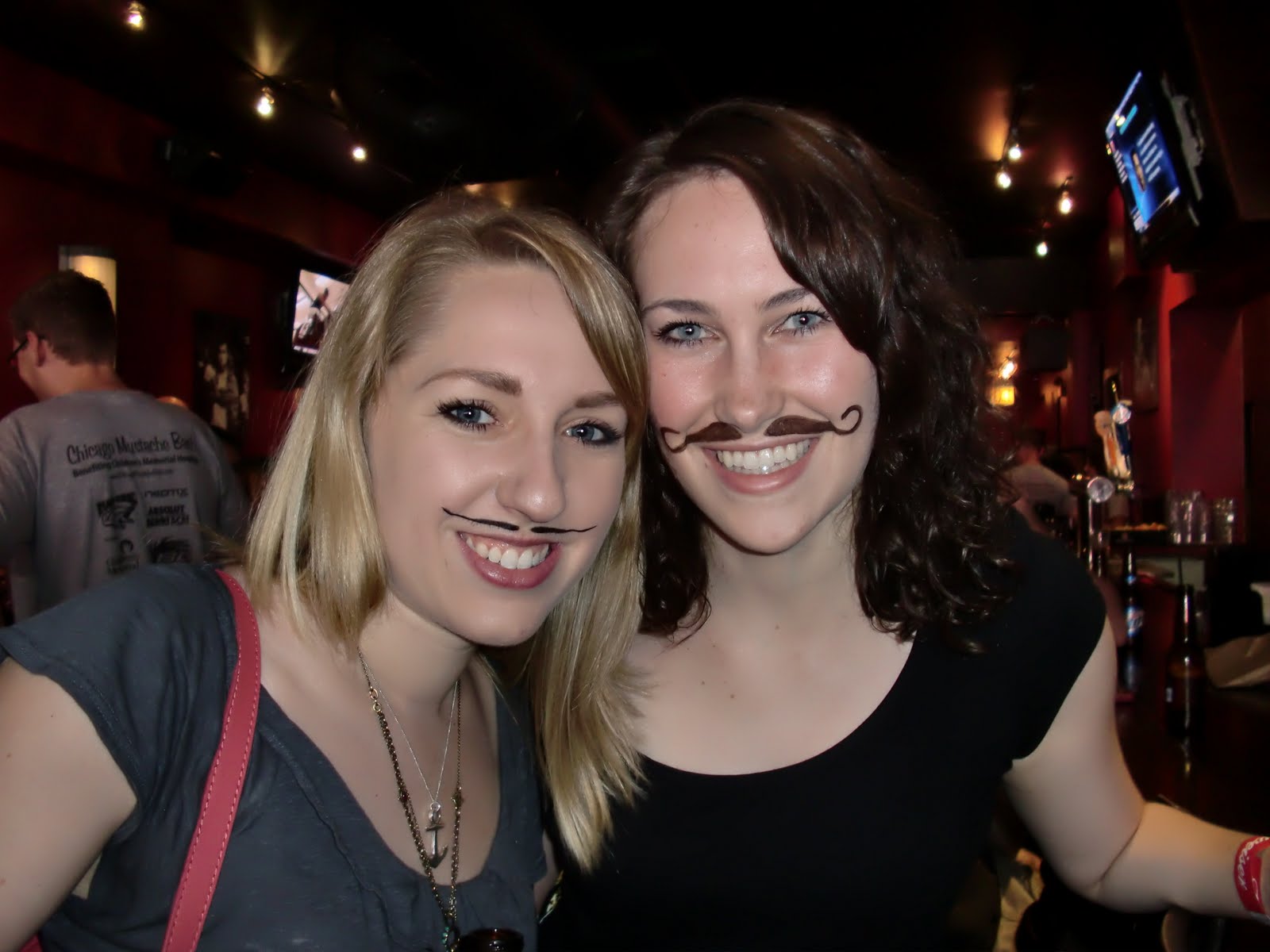
The bar crawl benefitting the Chicago Children’s Hospital was a wild success. Madeline and I drew on mustaches with liquid eyeliner. Hers was small and possibly French and mine was a wild handlebar-curved-sort-of-ordeal.

We had a great time. Our friend Patrick brought his friend Duane and we went around to the bars. It was crowded, and we were glad that we’d been able to bring side beers with us. It definitely softened the financial blow and allowed us to add a little bit more, uh, refreshment to our afternoon. We made it through about half the ones on the list before we were sidetracked by a group of Irish/other people we met. And that’s where things got interesting.
Maddie walked off to go the bathroom and I didn’t see her for the rest of the night. She was on her way to get a cheeseburger when she decided to head home. (I heard from her, though, don’t think I’d ever let her just walk away unattended.) I stayed with the boys and we stayed with our new friends, abandoning the bar crawl for pitchers at a bar next to Wrigley, or “the cubs stadium,” as the Irish tweeted from my phone.
Somehow, we ended up on the train and then a bus and then the South Side on our way to a party,  which was not a great plan in that I was not as patient as I could have been, so we ended up heading back up north. I came out of yesterday with a twelve-pack of Bud Light that some guy bought and then left, so I feel like it was a success.
Today was understandably a very relaxed day. I lounged. I made sun tea. I ate strawberries. I drank Vitamin Water. I snuggled the cat.
Tonight, Maddie and I are ordering Chinese food and watching the MTV movie awards because a comedian that we love, Aziz Ansari, is hosting.
Expect a post about teen pregnancy at some point soon. (Obviously not my own teen pregnancy….but teen pregnancy in general.)

Sex and the City 2: A Defense

I was reading a post on Feministe.com about Sex and the City 2 and I got upset.
The original article can be found here: http://www.feministe.us/blog/archives/2010/06/01/defending-sex-and-the-city-sort-of-not-really/
If you choose to read it, peruse the comments as well. They’re bound to ignite some sort of fiery reaction in your blood, no matter your views on sexism, racism, ageism, and so on.
I take issue with a lot of the criticism of the show and of the sexism that the post suggests the show propagates. Yes, Sex and the City was popular when our economy was booming and when excess was the norm; the idea of keeping up with Jones’s really meant overspending and under-saving. Of course, that’s all come crashing down. But has it really? And if so, does that make Sex and the City irrelevant?
While the middle class and other socioeconomic underprivileged persons are arguably unable to spend, and of course revenue is down, has the recession trickled up to reach those wealthy who everyone was actually trying to emulate?
For some, yes. But for others, arguably most, no. We’re not re-aligning our mindsets toward redistribution of wealth or reallocation of government resources for some better purposes. We’re just biding our time until we’re  better employed and we can start spending all over again. Spending with the hopes of upward social mobility.
While the writer and the commenters (when not veering off to discuss the state of Muslim women in the world) believe that the women of Sex and the City care only for their clothes, shoes, men and money, I’m arguing that they too face very real-world problems, even in their carefully scripted, fairytale Manhattan lives. Emphasis on scripted, fairytale lives.
Carrie has long been a renter, and at some point (I’d like to say season 4) is forced to make the decision to either buy or relocate. She has no money, no savings; there’s not a hint of financial responsibility surrounding her character because the audience is well aware that Carrie is happy to spend her paychecks on fashion. She spends time considering what to do and it’s revealed that she’s spent the better part of $40,000 on shoes. That’s enough for a down payment. In the end, of course, it all comes to a resolution and the shoes are safe.
While a small incident in the show’s 6-year run, the money crises that Carrie suffers from shows that while perhaps Sex and City is merely a fairytale, it is also grounded in some sort of reality. While not all of us can afford to walk around in Louboutins (oh, and I wish that we could), we all face issues regarding our own use of money at some point.
Another issue, which I’m finding to be more and more common in my own life, is the issue of lending money to friends. There’s a row over that at some point as well, with rich Charlotte hesitant to lend money to one of the girls. Of course, I once sided with whichever of the women asked for the money, but now I understand much better to never mix friendship and money.
These examples show that while Sex and the City may very well be at its core a frivolous look at unrealistic women with expensive tastes, it’s also a show that understands that no woman, not even the best-dressed or most educated can escape certain problems. There are also bouts with sexually transmitted infections, cancer, raising children, etc.
It’s a show. I don’t want to spend my time watching my own life problems played up on the screen. I want to suspend reality and pretend that I too have the weight of the world upon my shoulders when I must choose which of my designer outfits to wear to the newest club opening. That’s the world viewers want to see.
The sprinkling of reality was just to taste.
Also, the article quotes another article which talks about the refreshing moment when Charlotte and Miranda discuss that their motherhood and how sometimes you do need a break from the children. It anachronistically refers to 1971 as first-wave feminism, but it would have actually been more like second-wave at that time. I enjoyed watching the women struggle as mothers. Miranda struggled a lot in the series after the birth of her child. She was unprepared to be a mother and encountered a steep learning curve. She has to fight to keep her friendships, she has to fight to learn how to raise her son. She turns to Magda, her cleaning lady, for help. Charlotte struggles with conception, turning finally to adoption. She is happiest with her non-traditional family and is forced to give up her perfectionist ideals in order to embrace motherhood.
And then there’s the religion problem. I’ve been avoiding it. I don’t want to talk about it. But I’m going to address it from my own point of view. I’m prefacing this like that because I believe that everyone gets tangled in their opinions and then everyone gets called a racist and we’ve got problems stemming from our own inability to define anything or to thoroughly understand the topics at hand.
Before this segment begins, we’re going to have to discuss the lens from which the audience is viewing the movie. Mostly white, American, probably Christian (I’m basing this off of what I know my blog readership to be. I am in no way negating the experiences of any other person, however, I can only draw on the experiences of a white, middle-class, raised-Catholic person, because that it what I am.) And that’s where the problems are.
As white, middle-class viewers, we come to the movie with certain preconceived notions. We need to be aware of our own limitations before we can thoroughly critique the limitations of any certain work.
I see where the writer wanted to talk about Muslim women. I see how he wanted to draw parallels between the girls from New York and the secret women’s book club in Abu Dhabi. I see how he wanted to show the similar spirits of both sets of women. I see this. But he failed miserably.
The Muslim women in the movie are poorly placed. They get very little screen time and are shown as caricatures of a collision between two cultures: Muslim women who desperately seek to become Americanized. I have a hard time believing that this is the case. Our own American lens, however, makes it seem as though “they” (any othered subset) would want to welcome our own Western culture.
One woman has decorated her outfit with color around the sleeves. Another eats french fries under her veil. At one point, the Muslim book club sheds their outer garb to reveal the spring collection of Louis Vuitton.
This attempt at subversive independence is poorly placed in the film. The author opens a door where there never should have been one, or if some opening, a window, intending to merely peek inside at the issue of religion, but instead fails to walk through this now gaping hole that is the issue of religion and culture, leaving the audience unfulfilled and angry. This wasn’t supposed to be a racist movie. But it was.
The Middle East is probably the worst setting the author could have chosen, and I’d be interested to see why he chose it. Now? Of all times?
To quote the New York Times article linked at the bottom, “The gravest of these sins in my unscientific survey are behavioral: the women act like ugly Americans and debase every aspect of Muslim culture they come in contact with. Also: they’re women. And middle aged. Girlish. Have had bad work done. Or maybe not enough.”
The characters, specifically Miranda, are aware of the disrespect that they (mostly Samantha) are showing to the predominantly Muslim culture that is surrounding them. They talk about it. The author attempts to parallel the wearing of the veils with the silencing of women while simultaneously showing Carrie as having tape over her mouth in a book review. The hastily reached conclusion? He’s afraid of her because she’s a women, not because her book may not have been the most insightful. His attempt to silence her comes from the fact that he’s a man.
The NYTimes shows the bind that women find themselves in. To age gracefully? Not allowed. To embrace plastic surgery? Not allowed. To age? Not allowed. To be immature? Not allowed. To be women? Not allowed.
Hello first wave feminism.
Aren’t we past that?
But we aren’t and that plays into why I’m still going to defend this movie. I’m not defending racism. I’m defending a film. I do agree that there were things that could have (should have) been done very differently.

I’m sure the author meant for his commentary on Islam as well as the rights of women to be taken much as his comments on gay marriage went over, which was well. But his carefully crafted gay marriage scene was a celebration of all the sparkle of the gay community. It showed Big’s heterosexual fear and attempts to push this from merely a wedding to a “gay wedding,” which is actually was. There were swans. There was an all-male choir. Why is no one up in arms about that? Why is no one called John Preston homophobic? Because he shares their views and slight discomfort, but outward acceptance and appreciation of the community.

The United States, whether we like it or not, is a Christian nation. We can’t wrap our minds around other cultures, let alone other religions. We’re afraid of things we don’t understand. We want to crusade against anything “other,” anything different. We can’t fathom why certain things are the way they are and we get upset about the rights of other women in other places. But we still have a lot to work for as women in the United States.
We’re not free. Critics of Sex and the City come down on it for not having enough diversity, not having this, that, etc. Creation and maintenance of  the family is the focus of many women in our culture. Little girls grow up dreaming about their wedding day. Carrie makes it to that point in the first movie but eventually marries in a small ceremony at City Hall.  Sex and the City has the balls to show Carrie and her husband addressing the fact that they have no children and don’t plan to. The movie doesn’t cop out with Carrie getting pregnant. She’s setting her own terms for her marriage and her life.
The idea of housework and child-rearing not being considered work is something that women deal with on a daily basis. The “third shift” is the housework, something that many women who work full time still  have to do once they get home because of antiquated notions about feminine roles. Miranda quits her job as a lawyer in the film but hates being a full-time stay at home mom. Being a full-time mother just isn’t her thing and she regrets leaving her job. She finds another job where she is appreciated yet still able to make it to her son’s school events. She is defined by her career. Charlotte, however, is a full-time mother and she is fulfilled and exhilarated by her job (most of the time). She derives meaning from her work in the maintenance of the family, but part of her conclusion in the film was that she, too, needs time to herself away from the children.
There’s oppression right around the corner. Muslim women nothing. American women nothing. No single piece, no single article, no single film, book, or scrap of media is going to speak for all women of any culture, religion, race, etc. Oppression comes in all forms, religious and otherwise.
You cannot encapsulate the struggles of women or any culture into a two hour movie about girl power and friendship. The author tried and failed miserably. I’m forgiving Sex and the City its grave mistake of being set in Abu Dhabi. That was a dumb plot device that never should have been constructed. It set off a chain of hatred that someone should have seen coming.
I loved the movie. It wasn’t about materialism (there were no grand shopping sprees, no ridiculous spending); it was about love and marriage and life and choices. And in the end, female friendship wins and everyone is allowed to be in the sort of relationship of their choosing. That, my friends, is exactly what I paid to see.

Here’s another little piece that I enjoyed:
http://www.nytimes.com/2010/05/23/magazine/23lives-t.html?scp=3&sq=sex%20and%20the%20city%20extra&st=cse

or another:

http://www.nytimes.com/2010/06/06/movies/06dargis.html?hp

Lake Shore Drive, as always

Lake Shore drive at four thirty in the morning is dark, starting the slow progression toward daylight. As I drove, the fog rolled in and there was me, seeing very little ahead of me, and the fog, closing in around me, and the lights, leading the way home.
There was no sleep last night and I chased the moment and left, easing toward the center of the city and then home again. I parked, the fog lifting as I drew away from the lake. I walked home, down a tired, quiet block, the sky lightening above me and the moon still bright. I love the way the wrought iron gates of my building look in that grayish pre-dawn light. The black is somehow made more black by the gray light, and the green of the new summer foliage is greener and darker and more beautiful. The cobwebs hang between the iron bars and flutter slightly in the wind.
As the day progressed, the fog burned away and the sun came out, heating the earth. It’s sunny out now; I’m sure people are at the beach loving the sunlight. I’m at home, tired.
Perhaps tomorrow will be my day to get things done?

I’ll miss this place.

Memorial Day Weekend: Rest

Oh the beach! What a lovely beautiful expansive stretch of land.
Laying on a towel in the sun, eyes closed, listening to music or the waves or the kids: that is bliss.
Blue sky, blue water, pale beach, my brilliantly white skin glistening (so much sunscreen!), the sounds, the books. I smeared the ink in the textbook with my oily fingers, then proceeded to also smear an article in Esquire, then proceeded to cover myself in sand.
I’m one hundred percent alright with that.
I’m one hundred percent more relaxed. The gorgeous man laying behind us helped a bit.
I’m hoping to get a little bit of color this summer. I’m against tanning, but I’m not against a healthy glow. I love the way freckles dot my nose. I’m using SPF 55 anti-aging sunblock for my face and a little less to my body. (By a little less, I mean a lot…I’m building a base here.)
Happiness. Bliss.
I could spend days near the ocean, near big lakes, near rushing rivers, and be perfectly happy.

Then I came home and made chicken salad.
My god, I think I make pretty good chicken salad considering I sort of just make it up as I go. (I think I pretty much know what goes in it….chicken, celery, grapes, (light) mayo, spices, lemon juice, etc.) But it’s chilling in the freezer right now (faster), and then I’m going to eat it. Madeline has never had chicken salad. I’m shocked.

We’re going to go out to celebrate the surprise birthday party of one of my friends tonight, so that should be interesting.

I’m against commercials that play on your worst fears, like that On-Star commercial about not being able to call for help. Lame. Fear tactics are a bad way to sell a product. Maybe.
We’ll know more as I continue marketing, but that’s just a thought.