Hilarious. They mixed up Stevie Wonder and Lionel Ritchie (and have since fixed the error, in this article):
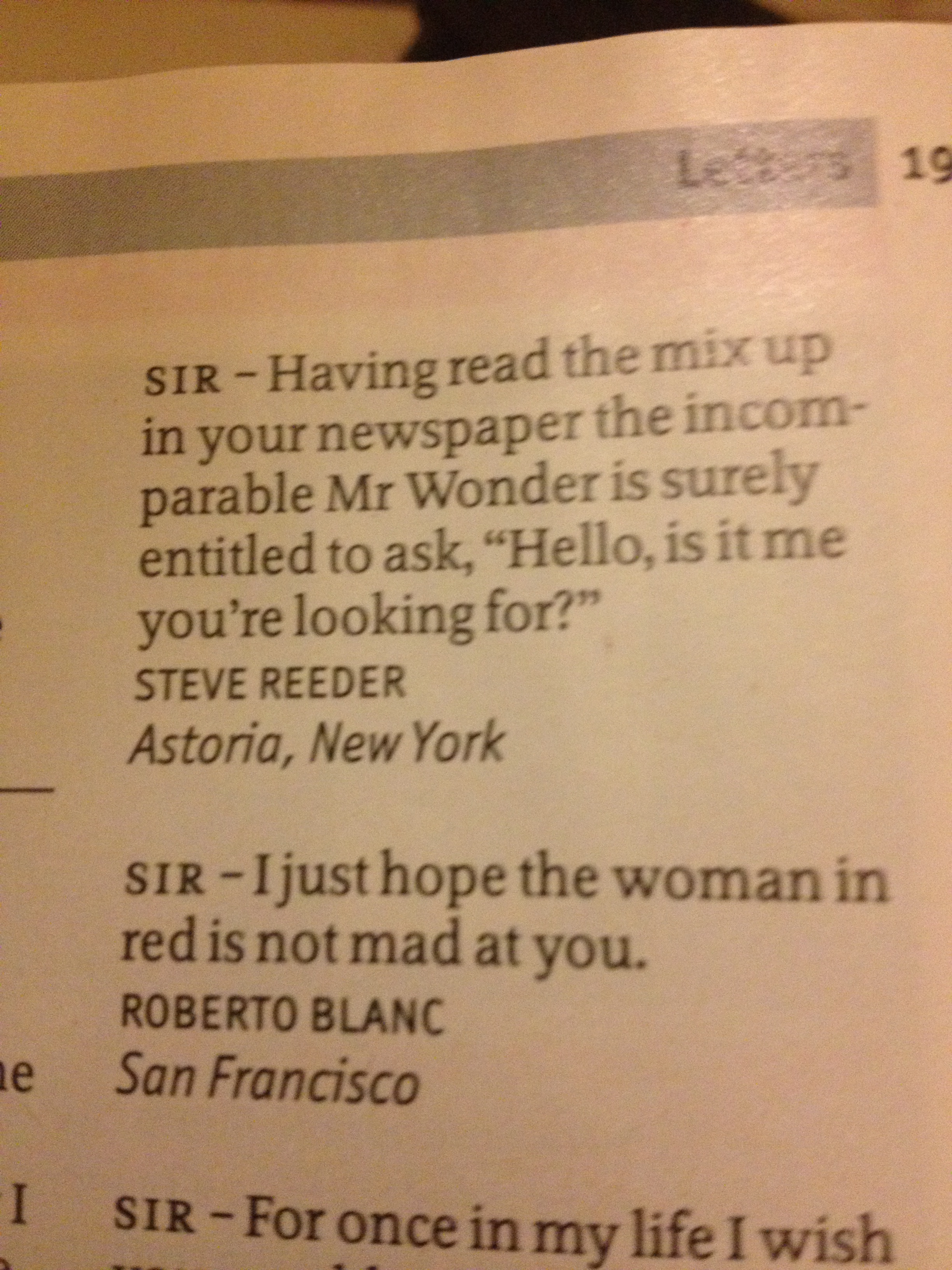

Hilarious. They mixed up Stevie Wonder and Lionel Ritchie (and have since fixed the error, in this article):
I’m not sure how we can protect so much free expression, yet “liking” something on Facebook isn’t something that be protected.
The internet is proving to be quite the legal hot mess. Zuckerberg and facebook everything, app data privacy laws, Google’s maps/network issues, the piracy bills…they’re all fascinating (to a point. After I’ve hit that wall of overload, I just roll my eyes and click the x on the tab and move onto something equally mind-numbing, all while knowing that my personal browsing history is being mined by companies trying to sell me things. Trust me, I feel sorry for the person or computer that has to sort through my history. It’s equal parts fascinating, terrifying, and boring.)
You shouldn’t be able to get fired for “liking” your competitors, whether it’s a political contest or not. (Just read the article about “liking” on facebook not being protected speech.) I don’t understand why we can’t protect this not-speech because it’s less expressive than a post, for example. The intention is clear.
I agree with Eugene Volokh on this one:
However, First Amendment scholars said there isn’t much to infer: “Liking” a Facebook page is much like putting a bumper sticker on a car or wearing a button. One critic of the ruling is Eugene Volokh, a law professor at the University of California at Los Angeles, who critiqued the judge’s decision in a blog posting.
In an interview, Volokh said while a “like” could be ambiguous, there’s no question it counts as speech. A thumbs-up gesture is symbolic expression protected by the First Amendment, for instance, and “liking” something on Facebook is even more clearly expressive because it generates text on a computer screen, he said.
“It is conveying a message to others. It may just involve just a couple of mouse clicks, or maybe just one mouse click, but the point of that mouse click, a major point of that mouse click, is to inform others that you like whatever that means,” he said.
source: law.com
On facebook that I “like” certain things, such as:
|
|
|
|
Books
|
|
|---|---|
|
|
|
|
Movies
|
|
|
|
|
|
Television
|
|
|
|
|
|
Games
|
|
|
|
|
|
Athletes
|
|
|
|
|
|
Sports Teams
|
|
|
|
|
|
Activities
|
|
|
|
|
|
Interests
|
|
etc.
Of course I “like” bacon. I like it. No explanation needed.
Walking away from explosions without looking at them is another story entirely. (Does it benefit me in any way? Of course not, this is facebook.) I’ve never actually blown something up. I mean, in theory, I would like walking away from explosions without looking at them but in all honestly, I’m too chicken-shit responsible to do anything like that.
Do I like it when things blow up? Not really, no.
Do people understand that I’m not being serious? Hopefully.
Do I agree with everything that those pages post? No.
Does my boss think that my political views will affect my ability to do my work or “hinder the harmony and efficiency of the office”? No.
Am I worried that I’m at risk of being fired over any of my postings? Not really. (I have something I like to call my “Grandmother goggles.” If I wouldn’t say it to my grandmother, I won’t post it. Granted, I have a pretty understanding grandma, but still. That’s not a bad rule to live by.)
But am I mindful of what I post? Usually. That’s why I don’t bitch about everything on my blog or facebook wall, or whatever. I don’t want it coming back to haunt me (work-wise or life-wise).
Do we all need to remember that just because we don’t like it doesn’t mean we can make it illegal? Of course.
For example, I hate people who post racist content all over the internet. Are they protected? Yes.
Do I respect their rights? Yes.
Do I want to? No.
Do I support separation of facebook and work? Yes.
Do I think that’s entirely possible? No.
Are we in for years of legal battles about our privacy, our rights, our information? Yes.
Should we try to be cognizant of what we’re agreeing to on those “Terms and Conditions” pages? Of course.
Is that way harder than it sounds? Absolutely.
Awww, this story is really sweet. Grandma, I’d do the same thing for you!!
The best part about this is that he blames getting lost on not having GPS.
2-Year-Old Noah Joel Rides Toy Bike 3 Miles To See Sick Grandmother In Hamelin, Germany
Posted: 05/ 1/2012 3:31 pm Updated: 05/ 2/2012 2:00 am
A tenacious toddler from Hamelin (Hameln), Germany gave his mother a terrific shock when he bicycled across town by himself to visit his sick grandmother, the Daily Express reports.
Two-year-old Noah Joel’s mother thought he was playing in his room when the tiny toddler gave her the slip.
“He is a very determined, confident little boy. He was worried about his grandmother and wanted to do something about it,” a family friend told the German Herald.
So, with his backpack filled with his favorite candy, Noah hopped on his toy bicycle and set off to see his ailing granny who is in the hospital.
According to a press release by local police, the little guy’s solo journey did not go totally unnoticed. Police said they received several concerned calls claiming that a seemingly lost toddler had been seen criss-crossing the same road several times.
Noah’s frantic mother, having discovered his mysterious disappearance, had also called the police in search of her son.
Police finally intercepted the boy, but not before the tiny tot had covered three miles on his little bike, the German Herald reports.
“He didn’t really know the way to the hospital. But he blamed that on his bike for not being fitted with SAT NAV,” said a police spokesperson,referring to Satellite Navigation.
When police caught up with him, they saw that Noah didn’t even have shoes on, the Daily Express reports.
source: here
This is really cute. 6 daughters!?!
PEOPLE & PLACES | COLORADO PERSONALITIES ND THEIR FAVORITE HAUNTSColorado Rockies beer vendor Captain Earthman, a.k.a. Brent Doeden, reflects on “Cold beer!” at Coors Field and beyond
POSTED: 04/26/2012 01:00:00 AM MDT
UPDATED: 04/26/2012 08:32:35 AM MDT “Captain Earthman,” a.k.a. Brent Doeden, has been hawking cold drinks at Coors Field since the stadium opened in 1995. (Cyrus McCrimmon, The Denver Post)
BRENT DOEDEN
The colorful gent known as Captain Earthman has been a fixture in Denver’s sports and music venues since 1986, when he first started vending at the old Mile High Stadium.
Most folks probably know him fromCoors Field, where he has hawked beer, soda and snacks at Colorado Rockies games since the stadium opened in 1995.
“I needed some extra income — I was a single parent with a 6-year-old daughter,” Brent Doeden says of his debut at a Broncos game. “They gave me a tray of sodas in the third level of the east stands.
“I walked out and said something incredibly stupid and people started laughing and bought all my sodas. I fell in love with it and have been doing it ever since.”
A grandfather, Doeden lives with his wife, Becky, and has six daughters.
COORS FIELD
One of Doeden’s top spots in Colorado is Coors Field. He not only spends at least 81 games a year at the stadium, but it’s the backbone of his vending career, which is a full-time job.
“It’s a beautiful place and I love the feel,” Doeden says. “It was an instant classic from the day it opened, and the fans are just terrific.”
He’s particularly fond of thestatueof a baseball player outside the stadium’s main entrance, a work by Loveland’s George Lundeen.
The 9½-foot bronze, titled “The Player,” honorsBranch Rickey, the innovative Brooklyn Dodgers general manager who invented the modern farm system and shattered Major League Baseball’s color barrier by signing Jackie Robinson.
On a recent April afternoon, just hours before he was due inside the stadium, Doeden basked in the sun just a few feet from the statue. A young couple walked up with a camera. They didn’t want a
 Branch B. Rickey, left, grandson of Branch Rickey, at the 2005 unveiling of “The Player,” by sculptor George Lundeen. (Hyoung Chang, Denver Post file)
photo of the statue — the guy wanted a photo of himself with Captain Earthman.”Say ‘Rockies,’ ” the woman said, aiming the camera.
Doeden drew himself up and grinned.
“Cold beer!” he yelled.
Q: You turn 56 in May and still lug those beer trays like a trouper. How do you do it?
A: Young guys wonder about that constantly. My trays weigh about 60 or 70 pounds and this is one of the few places I dominate. But up at Red Rocks the young guns tear me apart. I can’t do 120-pound trays anymore. But I ride my bicycle everywhere, and that’s a great workout.
Q: So how many beers do you sell at an average game?
A: It depends on who’s playing. At a good game I sell 200.
Q: You are quite a showman in the stands. Where does that come from?
A:That’s the entertainer in me. I discovered it when I was 16 and working in a fish market at Fort Walton Beach, Fla., where you had an audience. And I was in the high-school acting club and found I really liked interacting with a crowd.
Q: What is your current state of mind?
A:Outrageously happy. Baseball season’s started.
Q: How did the Captain Earthman persona start?
A:It just happened over the years of vending. I used to be a really private person. And when I was a teenager and we’d be hanging out doing dumb things, I’d used to say, ‘If it’s from the earth, man, I’ll do it.’ That’s where it began.
Q: What historical figure do you most identify with?
A:Neil Armstrong. He got to walk on the moon. I’m from outer space — the Orion nebula: They’re still calling me but I can’t go there.
Q: What is your greatest fear?
A:Making the wrong change while vending. It’s bad karma.
Q: What is your most treasured possession?
A:My album collection. I have 11,000 albums — all vinyl.
Q: And your greatest extravagance?
A:Going into a Goodwill store and walking out with eight or nine albums. And I’m a big collector of “Star Wars” and “Star Trek” stuff.
Q: What trait do you most dislike in others?
A:Stupidity. I don’t have much tolerance for stupidity, even in myself.
Q: What trait do you most dislike in yourself?
A:Sometimes I get really lazy, not while working but at home. Once I sit down it’s hard to get back up.
Q: What is your favorite journey?
A:Going to Hawaii. I’ve been twice. One of my daughters just moved there so I have another reason to go back.
Q: If you could change one thing about yourself, what would it be?
A:To quit putting my foot in my mouth. I seem to do that sometimes.
Q: What do you consider your greatest achievement?
A:Raising a family and all of them turning out OK. There have been minor bumps in the road but the kids are all fine.
Q: How would you like to die?
A:I’d like to be abducted by a spaceship. But I wouldn’t call it an abduction. I’d just be hitching a ride home.
William Porter: 303-954-1877 or wporter@denverpost.com
(I still have backlogs of articles I’d like to address, so hopefully I can start posting and writing my critiques, comments, etc. soon!)
Madeline sent me this link last week and I thought I’d share the article with you.
Before you read it, know this: I’m a huge believer in the idea that there can be successful co-parenting, or successful relationships, or marriages full of good sex (or all of those things combined with monetary comfort!).
While I don’t think I’d last too long as a stay-at-home mom, I also don’t imagine my future to be full of trying to work 60 hour weeks and then awesome parenting while my husband just hangs out.
Note to readers: this is all coming from my childhood. My extreme paranoia about terrible husbands stems from my past experiences. My mom worked her ass off trying to support us all financially (and put my brother and I through private schools) while my dad didn’t take on the additional burden of stay-at-home dad (including, but not limited to: laundry, cooking, dishes, cleaning, childcare, etc.) even though it would have been well within his means and skill set and would have drastically improved the parental-contribution-to-the-family-via-work balance that did not exist.
Admittedly, my memories have been lost to my own subconscious erasure as well as the emotional tints that seem to color our own recollections of the past. Therefore, I can claim no exact memory validity yet still claim personal memory legitimacy. Whatever. You try to recollect and see for yourself how difficult it can be.
Regardless, as a young, twenty-something woman, I do feel pressure. Tons of pressure. Some of it is self-inflicted and some of it stems from a whole host of other influences. That pressure to succeed drives my work ethic, my independence, my stubborn sense of self, and my panic about the future. (Always panic, that’d be my motto.)
I always read the comments, too. Sometimes they’re far more enlightening than the content of the article itself. Since this one only has three, it wasn’t difficult to get through them. Here’s the lengthiest (is that a word?) one:
BRYANROBB
I expected more from you, Good. This is terribly one sided reporting, and borderline misandristic to the likes of Jezebel. No wonder men don’t want to marry, every which way we turn we’re getting boxed and blamed. Did you ever stop to consider that the older men who make more than their women counterparts are the last vestiges of a bygone era? Soon they will retire, and as the women age through the system it is very likely that these young women will make more than their male counterparts. Also, give me the kids over cut throat corporate America any day. The two earner model is the cause of our failures as decent parents, all so we can afford more stuff? I don’t care who works and who doesn’t, but someone needs to be home with the kids in the formative years. And sure, I’m definitely for subsidizing child care. For single MOMs and DADs. Too bad almost all low income entitlements go to girls and men are exempt. Stop waging war on men for Pete’s sake.
I don’t disagree that this article is very one-sided. But then again, there’s not enough space in the world to give equal time to discuss women’s ambitions while simultaneously deconstructing the reasons that men may feel maligned by the media and neglected about the social pressures they face.
This article isn’t about men.
The only time that the author (whose posts I generally adore, by the way) could REALLY use some more statistical reference is when she says,
And while women are consumed with the problems of “work-life balance”—trying to maintain a successful career while raising a family—men seldom feel as much pressure or face as much doubt about their ability to “do it all.”
Why Are Young Women More Ambitious? They Have to Be
- NONA WILLIS ARONOWITZ
Associate Editor
The headline of a new study by the Pew Research Center claims to have discovered “A Gender Reversal On Career Aspirations.” But upon closer inspection, the study appears to imply that young women are more ambitious than men their age across the board. Sixty-six percent of 18 to 34-year-old women rate their career high on their list of life priorities, compared with 59 percent of young men. This figure hasn’t really “reversed,” but it has shifted markedly in the past 15 years—in 1997, only 56 percent of young women felt the same way, compared to 58 percent of men.Today’s young women aren’t planning to make any sacrifices on the home front, either—they’re prioritizing their personal lives, too. The amount of young women who say that having a successful marriage is one of the most important things in their lives has risen nine percentage points since 1997, from 28 to 37 percent. For young men, that stat is trending in the opposite direction—from 35 percent in 1997 to 29 percent now. More young women than men care about being a good parent—59 percent, compared to 47 percent of their male counterparts. It looks like young women are more likely to be thinking consciously about their priorities, period. Do dudes just not give thought to their futures at all?
Perhaps guys aren’t mulling their life priorities because they trust that marriage, parenthood and career usually work out better for them in the longrun. They’re right about that. When women begin their careers, they earn virtually the same as their male peers (95 cents to every dude dollar), but as they near their early thirties, the pay gap widens—women have kids, take maternity leave, and stall their careers for a few years, or else they get passed over for promotions and yearly raises. By the time a women nears retirement age, she earns around 75 cents for every dollar a man her age earns.
Although marriage is lower on young men’s list of priorities, they’ll fare better when they eventually tie the knot. Numerous studies show that married men are happier, live longer, make more money, and experience less stress, while married women are rewarded with more housework, less money, worse sex and a few extra pounds. And while women are consumed with the problems of “work-life balance”—trying to maintain a successful career while raising a family—men seldom feel as much pressure or face as much doubt about their ability to “do it all.” Women still end up performing the majority of the parenting, regardless of their jobs, and despite public platitudes revering the work of motherhood, the lack of universal childcare and inadequate (or nonexistent) parental-leave policies set women up to fail.
No amount of girl power—or denial—can obscure these deep-set gender dynamics. Women are acutely aware of the need to be especially ambitious in order to succeed—the same extra ambition any marginalized group needs to climb the career ladder and crack glass ceilings. It’s the reason more women are getting college degrees, and the reason why many women try more intently to find a mate at a younger age (although that’s changing). The sexual economy, as well as the professional one, are simply skewed in men’s favor, especially as the years go on. Why wouldn’t they be more relaxed about their life choices?
Photo by (cc) Flickr user gcoldironjr2003.
article source: GOOD
Why pay $20/month for a digital subscription to the NYT when I can just follow their twitter feed and access links via social media for free? Sure it cuts down on my reading, but it also cuts down on my bills, and for that, I’m grateful.
Someday, I’ll have a subscription to the newspaper. It will be real. Somebody will have to hurl it at my doorstep every morning. I’ll hear the thump and be reminded that I’ve arrived at full adulthood. I’ll gleefully smear ink across my fingers as I turn the thin pages. I’ll glance at the advertising sections and clip out coupons that I’ll never use. (Future me would love 20% off of this new magical pore-reducing, ultra-moisturizing calming cream! I’ll think.) I’ll check the obituaries to see if there’s anyone I know. I’ll look at the weather in Chicago, in New York, in Cape Town. I’ll read the calendar of upcoming events. I’ll tsk at the rising crime in the neighborhoods, I’ll worry for the future of our schools, I’ll laugh at poorly written op-ed pieces (and then, of course, I’ll be the one writing letters to the editor).
(That jubilant scene will actually only happen like once a week. Mostly, the paper just end up in the recycling pile or in my kids’ homework assignments.)
Anyway, we’ve got a ways to go before we get there, so in the meantime, here’s this:
OPINION
The Flight From Conversation
 Photographs by Peter DaSilva and Byron Smith, for The New York Times
By SHERRY TURKLE
Published: April 21, 2012
Peter DaSilva for The New York Times
Readers’ Comments
Readers shared their thoughts on this article.
At home, families sit together, texting and reading e-mail. At work executives text during board meetings. We text (and shop and go on Facebook) during classes and when we’re on dates. My students tell me about an important new skill: it involves maintaining eye contact with someone while you text someone else; it’s hard, but it can be done.
Over the past 15 years, I’ve studied technologies of mobile connection and talked to hundreds of people of all ages and circumstances about their plugged-in lives. I’ve learned that the little devices most of us carry around are so powerful that they change not only what we do, but also who we are.
We’ve become accustomed to a new way of being “alone together.” Technology-enabled, we are able to be with one another, and also elsewhere, connected to wherever we want to be. We want to customize our lives. We want to move in and out of where we are because the thing we value most is control over where we focus our attention. We have gotten used to the idea of being in a tribe of one, loyal to our own party.
Our colleagues want to go to that board meeting but pay attention only to what interests them. To some this seems like a good idea, but we can end up hiding from one another, even as we are constantly connected to one another.
A businessman laments that he no longer has colleagues at work. He doesn’t stop by to talk; he doesn’t call. He says that he doesn’t want to interrupt them. He says they’re “too busy on their e-mail.” But then he pauses and corrects himself. “I’m not telling the truth. I’m the one who doesn’t want to be interrupted. I think I should. But I’d rather just do things on my BlackBerry.”
A 16-year-old boy who relies on texting for almost everything says almost wistfully, “Someday, someday, but certainly not now, I’d like to learn how to have a conversation.”
In today’s workplace, young people who have grown up fearing conversation show up on the job wearing earphones. Walking through a college library or the campus of a high-tech start-up, one sees the same thing: we are together, but each of us is in our own bubble, furiously connected to keyboards and tiny touch screens. A senior partner at a Boston law firm describes a scene in his office. Young associates lay out their suite of technologies: laptops, iPods and multiple phones. And then they put their earphones on. “Big ones. Like pilots. They turn their desks into cockpits.” With the young lawyers in their cockpits, the office is quiet, a quiet that does not ask to be broken.
In the silence of connection, people are comforted by being in touch with a lot of people — carefully kept at bay. We can’t get enough of one another if we can use technology to keep one another at distances we can control: not too close, not too far, just right. I think of it as a Goldilocks effect.
Texting and e-mail and posting let us present the self we want to be. This means we can edit. And if we wish to, we can delete. Or retouch: the voice, the flesh, the face, the body. Not too much, not too little — just right.
Human relationships are rich; they’re messy and demanding. We have learned the habit of cleaning them up with technology. And the move from conversation to connection is part of this. But it’s a process in which we shortchange ourselves. Worse, it seems that over time we stop caring, we forget that there is a difference.
We are tempted to think that our little “sips” of online connection add up to a big gulp of real conversation. But they don’t. E-mail, Twitter, Facebook, all of these have their places — in politics, commerce, romance and friendship. But no matter how valuable, they do not substitute for conversation.
Connecting in sips may work for gathering discrete bits of information or for saying, “I am thinking about you.” Or even for saying, “I love you.” But connecting in sips doesn’t work as well when it comes to understanding and knowing one another. In conversation we tend to one another. (The word itself is kinetic; it’s derived from words that mean to move, together.) We can attend to tone and nuance. In conversation, we are called upon to see things from another’s point of view.
FACE-TO-FACE conversation unfolds slowly. It teaches patience. When we communicate on our digital devices, we learn different habits. As we ramp up the volume and velocity of online connections, we start to expect faster answers. To get these, we ask one another simpler questions; we dumb down our communications, even on the most important matters. It is as though we have all put ourselves on cable news. Shakespeare might have said, “We are consum’d with that which we were nourish’d by.”
And we use conversation with others to learn to converse with ourselves. So our flight from conversation can mean diminished chances to learn skills of self-reflection. These days, social media continually asks us what’s “on our mind,” but we have little motivation to say something truly self-reflective. Self-reflection in conversation requires trust. It’s hard to do anything with 3,000 Facebook friends except connect.
As we get used to being shortchanged on conversation and to getting by with less, we seem almost willing to dispense with people altogether. Serious people muse about the future of computer programs as psychiatrists. A high school sophomore confides to me that he wishes he could talk to an artificial intelligence program instead of his dad about dating; he says the A.I. would have so much more in its database. Indeed, many people tell me they hope that as Siri, the digital assistant on Apple’s iPhone, becomes more advanced, “she” will be more and more like a best friend — one who will listen when others won’t.
During the years I have spent researching people and their relationships with technology, I have often heard the sentiment “No one is listening to me.” I believe this feeling helps explain why it is so appealing to have a Facebook page or a Twitter feed — each provides so many automatic listeners. And it helps explain why — against all reason — so many of us are willing to talk to machines that seem to care about us. Researchers around the world are busy inventing sociable robots, designed to be companions to the elderly, to children, to all of us.
One of the most haunting experiences during my research came when I brought one of these robots, designed in the shape of a baby seal, to an elder-care facility, and an older woman began to talk to it about the loss of her child. The robot seemed to be looking into her eyes. It seemed to be following the conversation. The woman was comforted.
And so many people found this amazing. Like the sophomore who wants advice about dating from artificial intelligence and those who look forward to computer psychiatry, this enthusiasm speaks to how much we have confused conversation with connection and collectively seem to have embraced a new kind of delusion that accepts the simulation of compassion as sufficient unto the day. And why would we want to talk about love and loss with a machine that has no experience of the arc of human life? Have we so lost confidence that we will be there for one another?
WE expect more from technology and less from one another and seem increasingly drawn to technologies that provide the illusion of companionship without the demands of relationship. Always-on/always-on-you devices provide three powerful fantasies: that we will always be heard; that we can put our attention wherever we want it to be; and that we never have to be alone. Indeed our new devices have turned being alone into a problem that can be solved.
When people are alone, even for a few moments, they fidget and reach for a device. Here connection works like a symptom, not a cure, and our constant, reflexive impulse to connect shapes a new way of being.
Think of it as “I share, therefore I am.” We use technology to define ourselves by sharing our thoughts and feelings as we’re having them. We used to think, “I have a feeling; I want to make a call.” Now our impulse is, “I want to have a feeling; I need to send a text.”
So, in order to feel more, and to feel more like ourselves, we connect. But in our rush to connect, we flee from solitude, our ability to be separate and gather ourselves. Lacking the capacity for solitude, we turn to other people but don’t experience them as they are. It is as though we use them, need them as spare parts to support our increasingly fragile selves.
We think constant connection will make us feel less lonely. The opposite is true. If we are unable to be alone, we are far more likely to be lonely. If we don’t teach our children to be alone, they will know only how to be lonely.
I am a partisan for conversation. To make room for it, I see some first, deliberate steps. At home, we can create sacred spaces: the kitchen, the dining room. We can make our cars “device-free zones.” We can demonstrate the value of conversation to our children. And we can do the same thing at work. There we are so busy communicating that we often don’t have time to talk to one another about what really matters. Employees asked for casual Fridays; perhaps managers should introduce conversational Thursdays. Most of all, we need to remember — in between texts and e-mails and Facebook posts — to listen to one another, even to the boring bits, because it is often in unedited moments, moments in which we hesitate and stutter and go silent, that we reveal ourselves to one another.
I spend the summers at a cottage on Cape Cod, and for decades I walked the same dunes that Thoreau once walked. Not too long ago, people walked with their heads up, looking at the water, the sky, the sand and at one another, talking. Now they often walk with their heads down, typing. Even when they are with friends, partners, children, everyone is on their own devices.
So I say, look up, look at one another, and let’s start the conversation.
Sherry Turkle is a psychologist and professor at M.I.T. and the author, most recently, of “Alone Together: Why We Expect More From Technology and Less From Each Other.”
A version of this op-ed appeared in print on April 22, 2012, on page SR1 of the New York edition with the headline: The Flight From Conversation.
source: The New York Times
News has come today that Rick Santorum is expected to suspend his presidential campaign and support Mitt Romney.
While I’m not a huge Romney fan (not just because of the incident with the highway and the dog), I’m even less a fan of Rick Santorum. I’m glad he’s going to be leaving; I’m glad that he can no longer continue to bait the emotions of voters and participate in the reality show-esque circus that has become our election process.
However, I hope that his departure from the race isn’t because of his daughter Isabella’s health. I sincerely hope that they do the best they can to keep her comfortable and to provide for her. I’m glad that she has a family that seems to care for her so well and love her so much.
Santorum Expected to Suspend Presidential Campaign
Updated: Tuesday, 10 Apr 2012, 11:19 AM MST
Published : Tuesday, 10 Apr 2012, 11:05 AM MST
(NewsCore) – Rick Santorum is expected to announce he is suspending his campaign for the Republican presidential nomination at an event in Gettysburg, Pa., Tuesday, FOX News Channel reported.
Santorum was scheduled to hold a press conference at the Gettysburg Hotel at 2 p.m. ET.
The event comes amid growing pressure on the former Pennsylvania senator to drop out of the race and back the Republican front-runner, Mitt Romney.
Santorum’s chances for the nomination had dimmed considerably following Romney’s decisive sweep of the Wisconsin, Maryland and Washington, D.C., primaries last week. The former senator fueled further speculation about his possible exit from the race by leaving the campaign trail for several days over the long holiday weekend.
Here’s more about Isabella and a bit about Trisomy 18, her genetic condition:
Santorum’s daughter to leave hospital
Former Sen. Rick Santorum’s daughter Isabella was released from the hospital Monday night, a spokesman tells CNN. The GOP presidential candidate interrupted his campaign Friday, when his 3-year-old daughter was hospitalized for reasons the campaign did not disclose.
Isabella suffers from a chromosomal disorder called Trisomy 18, where extra genetic material is present on chromosome 18. The extra material interferes with normal development, according to the National Institutes of Health.
“We appreciate the outpouring of support and prayers,” said spokesman Hogan Gidley. “The prayers worked, she’s doing much better, so we’re thankful for that. It puts things in perspective.”
Santorum expects to return to the campaign trail Tuesday.
Santorum has been outspoken and candid about his family’s struggle against Trisomy 18, as he did when he sat down for a Red Chair interview (above) with CNN back in November.
Trisomy 18 occurs in about 1 in 5000 live births, according to the NIH, but many fetuses with this disorder do not survive a full pregnancy.
The NIH describes Trisomy 18 as “a relatively common syndrome,” which is 3 times more likely in girls than in boys. It causes severe developmental and medical problems, including heart defects and defects to other organs prior to birth, shortened breast bones and club feet. Unlike Down syndrome, where a child has 3 copies of chromosome 21, developmental issues in Trisomy 18 are linked to medical complications that are more potentially life-threatening in the early months and years of life, according to the Trisomy 18 Foundation.
Children with Trisomy 18 sometimes can’t cough or clear their throat so fluid will accumulate in the lungs, making them susceptible to respiratory failure.
In the past, Isabella has had pneumonia in both her lungs.
About 90% of children born with Trisomy 18 die within their first year of life, but a small number have gone on to reach adulthood into their 20s and 30s, although they’ve been severely impaired.
“She has a disorder called Trisomy 18, which we were told is incompatible with life,” Santorum told CNN in November. “Well, we’re showing that that’s not only not true, but it is really the center of our life.”
From a website this morning, the comment:
Yes, the left (and specifically the entertainment industry left) is an isolated (and insulated) sub-culture that’s totally out of touch with the rest of the country.
Ah, that must be it. The left-leaners are isolated in their giant cities. It’s a serious problem. The insulation of smog and pollution have addled our brains and turned us away from the truth.
That must be why about half of the US population (give or take a few percentage points) espouses a more liberal, socially conscious way of thinking than the somehow-less-isolated conservatives (I’d love to see proof that they’re less isolated – didn’t we just go through the whole “The conservative candidates are screwed because they can’t win big cities” situation?). Maybe that’s why we also have a Democrat in the White House.
But then again, the left is just an out of touch sub-culture.
Ha, so what’s the dominant culture? The religious right? Hardly. There are plenty of quiet conservatives who believe that religion doesn’t have to be the battleground. There are plenty of people whose conservative beliefs are based less in religion and more in business. I don’t consider them to be a part of the fracas. They’re just waiting in the wings to reap the rewards, and I applaud them for their patience.
But honestly, if you can’t poke a little fun at yourself, how much fun can you really be?
link: here
Um, I thought the goal of pro-lifers was to protect life from its conception instead of trying to blow up not only small clusters of cells growing inside of women but other people who may happen to be in the clinic too.
This is why abortion arguments and such make me so incredibly angry. As a society, we have an obligation to protect our people. We have an obligation to speak our minds (not blow up buildings to make a point). We have an obligation to participate actively and engage in politics and all-things government related. Instead, I feel like people jump on the social-issues bandwagon just because their pastor talks about it at church on Sunday. They believe what they feel in their hearts, what they know in their hearts to be the word of God.
Um, hello? I don’t care what your God says. What I care about is the Constitution. What I care about is how we as a society are working together for positive change, forward progress, that whole bit.
We’ve regressed to the point that we’re no longer able to discuss politics in a civilized manner.
We’re no longer intelligent enough to talk politics at all. In my opinion, that’s why we’ve reverted to fighting so desperately for social issues rather than the much larger (and arguably more important) issues of economics that are plaguing our country. We’ve chosen to be ignorant, to place our futures in the hands of Congress and the people pulling their Senator’s strings, the big corporations that are funding campaigns and driving policy decisions. It’s sickening.
We’ve stopped looking past the superficial facade that our candidates present. We’ve stopped caring about anything except their sex scandals and their family lives. Why? What good has it done?
And we – the American people – are blind to it, because we simply haven’t taken the time to learn anything about our own policies. We long ago stopped reading bills. We long ago stopped trying to take an active role in the decisions that our leaders make about our future as a people.
And that’s when everything started to go to hell, pardon the expression.
Stop listening to candidates who talk solely about social and religious issues. Better yet, keep listening, but listen better. Listen to what they’re not saying. And for those of you who vote solely on religion, remind yourself of a few things: Jesus didn’t hate people, Jesus didn’t react violently to people he didn’t like/was afraid, Jesus helped people.
We have to stop hiding from our own fears under blankets of grateful ignorance. They’re making everything worse. Stop worrying about abortion, gay marriage, whether or not the President spent too much time talking about basketball. Start worrying about bigger picture shit, like the fact that we won’t have a government to crucify if we continue along the path we’re on. We’re not a superpower any more. We are not #1. We need a huge slice of humble pie and some reflection about what we’ve done that’s landed us in this nasty situation. (and by nasty situation, I mean the fact that we stand overloaded with debt and war and overwhelming internal discontent and that some of our citizens are even suggesting that we invade yet another country. That’s hilarious, in the worst way.)
Start reading about what’s actually going on in your government. Start trying to understand the policies that we make. Understand our budgets, our structures, our strategies. Give it ten minutes a day. Look deeper than what you see on TV. Look past the sweater vests, the snappy campaign ads, the promises.
Vote according to what you know in your heart to be true, but first, fact check those feelings.
[by the way, violence usually isn’t the answer. To any question. Bombing a Planned Parenthood is sick. I don’t care if they perform abortions there. They do abortions at your local hospital – are you bombing them, too? No. And you wouldn’t. Reminder: 3% of what PP does is abortions (are abortions? subject-verb agreement issue here). 97% is other stuff that’s important. Like STI testing. Like birth control. You may not support abortion, but you shouldn’t try to stop those who do from having them. It’s not your life. Stop interfering. Also, I just love Wisconsin. They’re the home of custardlist.com, Kopp’s, and the Cheese Castle. How could you bomb such a beautiful (if politically contentious) state?]
Wisconsin Planned Parenthood Bombing Draws FBI Vow To Protect Public Access To Abortion Clinics
Posted: 04/ 4/2012 11:54 am Updated: 04/ 4/2012 11:58 am
In the wake of the Planned Parenthood bombing in Grand Chute, Wisc., the Federal Bureau of Investigation has reaffirmed its commitment to protecting women’s access to reproductive health facilities.
Teresa Carlson, special agent-in-charge of the FBI’s Milwaukee office, announced the arrest of 50-year-old Francis Grady for “arson of a building used in interstate commerce” and “intentionally damaging the property of a facility that provides reproductive health services” on Tuesday. She said in a statement, “The FBI will always investigate and bring to justice anyone who resorts to violence as a means to harm, intimidate, or prevent the public’s right to access reproductive health services.”
Around 7:30 p.m. Sunday evening, a bomb was placed on the windowsill of a Grand Chute Planned Parenthood clinic — one of the three Planned Parenthood facilities in the state that offers abortion services. The bomb went off, causing a fire at the clinic that damaged one of the exam rooms. No one was hurt.
Grand Chute law enforcement was able to track down Grady after his white SUV, which was spotted leaving the scene shortly after the bomb went off, was involved in a traffic accident nearby. Grady is scheduled to make his initial appearance in U.S. District Court in Green Bay at 1:30 p.m. Wednesday afternoon.
U.S. Attorney James Santelle, Eastern District of Wisconsin, will be prosecuting Grady. He said in a statement:
“When the Congress passed the Freedom of Access to Clinic Entrances (FACE) Act in 1994, it specifically empowered law enforcement to respond to those who engage in violent and other obstructive behaviors that interfere with access to reproductive services. The complaint that we filed today in federal court not only responds to the particular conduct of Francis Grady in committing arson at and causing damage to the Planned Parenthood Clinic in Grand Chute, but it also signals the continuing, strong commitment of federal, state, and local authorities to ensure access to clinics — and to seek criminal penalties against anyone who would compromise that right.”
source: Huffington Post, regrettably
At least you’ll be prepared!
From the New York Times (link follows story):

It took Zenaide Muneton 20 seconds to convince me that she was the perfect nanny. Short and dark-haired, she has a goofy, beaming smile and knows how to make everything fun for a little kid. Time to brush your teeth? She shakes her hands and does a pantomimed teeth-brushing dance. Bath time? She pumps her arms up and down in a going-to-the-tub march. After I told her I’d love to hire her, she smiled and thanked me.
Then we both laughed, because there is no way I could possibly afford her. As one of New York City’s elite nannies, Muneton commanded around $180,000 a year — plus a Christmas bonus and a $3,000-a-month apartment on Central Park West. I should be her nanny.
I began researching this bizarre microeconomy shortly after my wife and I started looking for someone to watch our son for a few hours a week. We met with several candidates, all of whom had good references and seemed fine with him. Still, we weren’t sure how to judge them. Should we hire the one who seemed to be the most fun? The most experienced? A native English speaker or someone who could speak a foreign language to him? Someone with a college degree? A master’s?
We had no idea. But I began to wonder if price conveyed any important information about the nanny market. All the candidates we spoke with charged about $15 to $18 per hour, which, though standard in our Brooklyn neighborhood, seemed like a bargain when I learned that some nannies charge considerably more than double that rate. Would my son suffer with a midmarket nanny?
This fear led me to the Pavillion Agency, which specializes in finding domestic workers for New York City’s wealthy. Pavillion introduced me to Muneton, 49, who grew up in “a very poor family” in São Paulo. In 1990, she befriended a young American woman who had relocated to Brazil. When Muneton invited her to her family’s home, the woman saw her natural ease with children and suggested that she move to America and become a nanny. Within a few months, Muneton was caring for the children of a rich family in South Carolina for only $100 a week.
When Muneton started working through Pavillion in 2002, however, she increased her salary to $85,000 a year. As she gathered sterling recommendations, she began increasing her pay. Eventually she worked for some of the country’s wealthiest people, whom she accompanied on private jets to many of the world’s most exclusive resorts. Today, she says, “there are no more poor people in my family.” Muneton bought a nice house for her mother, a condo for her sister and a taxi cab each for two of her brothers. She also owns a beach house in Brazil, a penthouse in Miami and two properties (a six-unit building and a duplex) in Los Angeles.
How does a nanny earn more than the average pediatrician? The simple answer is hard work — plus a strange seller’s market that follows a couple of quirky economic principles. A typical high-priced nanny effectively signs her (and they are almost always women) life over to the family she works for. According to Cliff Greenhouse, Pavillion’s president, that kind of commitment is essentially built into the price. Many clients are paying for the privilege of not having to worry about their child’s care, which means never worrying if their nanny has plans. Which, of course, she can’t, pretty much ever.
And, alas, it seems that there just aren’t enough “good” nannies, always on call, to go around. Especially since a wealthy family’s demands can be pretty specific. According to Pavillion’s vice president, Seth Norman Greenberg, a nanny increases her market value if she speaks fluent French (or, increasingly, Mandarin); can cook a four-course meal (and, occasionally, macrobiotic dishes); and ride, wash and groom a horse. Greenberg has also known families to prize nannies who can steer a 32-foot boat, help manage an art collection or, in one case, drive a Zamboni to clean a private ice rink.
And then there’s social climbing. “A lot of families, especially new money, are really concerned about their children getting close to other very affluent children,” Greenhouse says. “How do they do that? They find a superstar nanny who already has lots of contacts, lots of other nanny friends who work with other high profile families.” There are the intangibles too. “I’m working with a phenomenal Caribbean nanny right now,” Greenhouse says. “She is drop-dead beautiful. Her presentation is such that you’re proud to have her by your children’s side at the most high-profile events.”
My wife and I don’t care about any of that stuff. But it’s hard not to wonder if the nannies who make twice as much an hour as the ones we’re considering are also twice as good. Nannies can be evaluated in the same way as what economists call “experience goods” — like wine, whose value can only be determined after experiencing it. When it comes to experience goods, price can be useful to reject anything below a certain minimum. After all, a $3 bottle of wine or a $5-an-hour nanny are pretty sketchy.
But price is useless — or worse, misleading — in differentiating among the adequate. I’ve often assumed that a $40 bottle of wine is twice as good as a $20 bottle even though the American Association of Wine Economists has essentially proved that the price of wine has almost no bearing on enjoyment. When nonconnoisseurs buy an expensive bottle, they’re acting like new parents hiring a nanny: they’re basically paying for a false sense of assurance. Or hoping to impress somebody.
Actually, nanny prices might be even more misleading than the wine market. They also bear resemblance to “credence goods,” an economic term for something — whether a jar of vitamins or an auto tuneup — whose true value can never quite be determined. You’re more likely to overpay for a credence good in the hope that a higher cost increases the likelihood of a benefit.
So if economics can’t fairly convey the price of a nanny, what does? Jeanne Brooks-Gunn, a director at Columbia University’s National Center for Children and Families, reassured me that academics know, roughly, nothing about how nannies impact children. There has not been any sort of serious study on nanny quality, she says, because it would be nearly impossible to get permission from nannies (often paid under the table) or their employers. Also, most child-development research is dedicated to at-risk children, and the kids of people with the resources to hire nannies don’t typically qualify.
Brooks-Gunn did, however, have some advice for what can make a good nanny. The single-most important characteristic is the extent to which a nanny is responsive to the child’s mood and interests. Brooks-Gunn said that when she chose a nanny, she simply handed her son to every candidate she interviewed and chose the one who responded most sensitively.
After our talk, I spoke with one of her graduate students, Erin Bumgarner, who moonlights as a part-time nanny for around $17 an hour — the same amount that Park Slope parents pay to immigrant nannies with no college education. I couldn’t think of any other field in which people with such disparate educational backgrounds could make the same amount. But Bumgarner told me it makes sense. She is willing to work for only parents she likes — she already quit one well-paying job for this reason — and who allow her to focus on her school work. The value of that is also built into the price. Even if it costs her a Central Park West apartment.
source: The New York Times


 a mile high and then some...