Unknown's avatar

About kb

free spirit, lover of red wine, bacon, sushi, the ocean, and adventure. I work in the legal field, do freelance writing, and take care of children.

On Racism and the Windy City

Chicago is one of those strange places where cultures mingle quite happily but there’s also a prevailing sense of deep separation between different classes and races.

I don’t know the truth about what happened here, but it does seem a little bit fishy. Chicago doesn’t have the best reputation as a city that upholds human rights, particularly when the defendant is black.

(My personal opinion is that the CPD is not actually working to help you as a resident, they’re working to help themselves. I lived in fear of my own precinct for a brief period of time during my senior year of college after reporting the actions of a Sergeant in an attempt to file a simple police report.)

MARY MITCHELL: Chicago has its own Trayvon Martin-like scandal

By MARY MITCHELL mmitchell@suntimes.com April 2, 2012 10:44PM

Story Image

Howard Morgan was hospitalized in 2005 after allegedly being shot by the Chicago police. | Courtesy ABC7 Chicago

At a time when the shooting in Florida of Trayvon Martin is drawing supporters from across the country, Chicago has its own shooting scandal.

Like the Trayvon case, nothing about the 2005 shooting of Howard Morgan makes sense. Chicago police officers shot Morgan 28 times during an alleged traffic stop. However, it was Morgan who was charged with attempted murder, among other offenses.

But unlike the Trayvon case, Morgan’s wife and supporters have had a difficult time getting the media to pay attention to the case even though it involved a volatile mixture of cops and race.

Morgan is African-American. All of the police officers involved in the shooting are white.

“This man is the only man in the world who was shot 28 times and still alive to tell the truth about what happened,” Rosalind Morgan told me during a telephone interview on Monday. “This is crazy. There’s been a news blackout. I had to go outside to get someone to help.”

After a second trial, Morgan was convicted of attempted murder and is scheduled to be sentenced at 26th and California at 8 a.m. Thursday amid protests that the second trial amounted to double jeopardy.

“He should have been acquitted of the remaining charges,” Rosalind Morgan argued. “His constitutional rights were violated. He did not have a fair trial.”

Occupy Chicago protesters are planning to demonstrate in front of the Cook County Courthouse Thursday, although uniformed police officers are expected to pack the courtroom. Morgan faces up to 80 years in prison.

Morgan, a former Chicago police officer, was working as a policeman for the Burlington Northern Santa Fe Line in 2005 when he was shot 28 times by four white police officers during a traffic stop.

Although the police officers alleged Morgan opened fire when they tried to arrest him, the fusillade of bullets turned Morgan a human sieve and put him in the hospital for seven months.

He was later charged with four counts of attempted murder; three counts of aggravated battery and one count of aggravated discharge of a firearm at a police officer.

Morgan languished in jail until an anonymous donor put up the $2 million bond.

In 2007, a jury acquitted Morgan of aggravated battery and discharging a weapon at a police officer. They deadlocked on attempted murder charges.

Prosecutors retried the case and in January, and a second jury found Morgan guilty on the attempted murder counts. Morgan’s supporters argue that the verdict subjected him to double jeopardy because he was acquitted in the first trial of discharging a weapon.

“It’s just wrong. They want to sweep this under the carpet and don’t want to take the blame,” the wife said.

“All of the young people who were victims of police shootings are dead. They can’t tell their side of the story. Mr. Morgan was shot 28 times — 21 in the back of his body and seven times in the front. The man deserves to be treated fairly,” she said.

This controversial police shooting occurred around the same time the cover was being pulled on police torture and corruption in Chicago.

Yet similar to the public’s initial nonchalance with respect to the Jon Burge torture victims, the Morgan case hasn’t sparked any protests.

“None of the big ministers have gotten involved. Jesse Jackson hasn’t stepped in,” Morgan told me.

I caught up to Jackson in Memphis where he is taking part in observances marking the anniversary of the assassination of Martin Luther King Jr. Jackson’s been all over the Trayvon Martin shooting. But he agreed that it has been difficult for the public to sustain outrage over the Morgan shooting.

“When he first got shot, we visited him in the hospital,” Jackson said. “After the first trial, we thought we won the case, but this has gone up and down. We intend to go to court with him on April 5th, and a number of our people intend to be in the courtroom,” he said.

“This [police involved shootings] is pervasive.”

Meanwhile, the Morgans are pursuing a civil suit in federal court against the police officers.

“It’s horrible, but I have to take up the mantle of justice for my husband,” the wife said. “If they can get away with double jeopardy, they can get away with anything.”

Howard Morgan, Black Off-Duty Cop Shot 28 Times By White Chicago Officers, Faces Sentencing

Posted: 04/ 3/2012 1:39 pm Updated: 04/ 4/2012 11:02 am

Howard Morgan Shot 28 Times

Howard Morgan.

As much of the country follows the Trayvon Martin case, activists in Chicago are hoping to bring some of that attention to Howard Morgan, a former Chicago police officer who was shot 28 times by white officers — and lived to tell his side of the story.

Morgan was off-duty as a detective for the Burlington Northern Santa Fe railroad when he was pulled over for driving the wrong way on a one-way street on Feb 21, 2005, the Chicago Sun-Times reports. While both police and Morgan agree on that much, what happened next is a mystery.

According to police, Morgan opened fire with his service weapon when officers tried to arrest him, which caused them to shoot him 28 times. His family, however, very much doubts those claims.

“Four white officers and one black Burlington Northern Santa Fe Railroad police man with his weapon on him — around the corner from our home — and he just decided to go crazy? No. That’s ludicrous,” Morgan’s wife, Rosalind Morgan, told the Sun-Times.

She was not the only person to doubt CPD’s side of the story. A Change.org petitionsigned by more than 2,600 people called for all charges against Morgan to be dropped, and now Occupy Chicago is getting involved.

“After being left for dead, he survived and was then charged with attempted murder of the four white officers who brutalized him,” Occupy wrote on their website, adding that Morgan was found not guilty on three counts, including discharging his weapon. The same jury that cleared him of opening fire on the officers, however, deadlocked on a charge of attempted murder — and another jury found him guilty in January.

That jury was not allowed to hear that Morgan had been acquitted of the other charges.

Protesters and Morgan’s family say the second trial amounted to double jeopardy, and claim officers have gone to great lengths to obstruct justice in the case:

Howard Morgan’s van was crushed and destroyed without notice or cause before any forensic investigation could be done….

Howard Morgan was never tested for gun residue to confirm if he even fired a weapon on the morning in question.

The State never produced the actual bullet proof vest worn by one of the officers who claimed to have allegedly taken a shot directly into the vest on the morning in question. The State only produced a replica.

“If they can do this and eliminate double jeopardy and your constitutional rights, then my God, I fear for every Afro-American — whether they be male or female — in this corrupt unjust system,” Morgan’s wife told the Sun-Times.

Howard Morgan will be sentenced Thursday. He faces 80 years in prison.


from www.freehowardmorgan.com :

Free Howard Morgan Flyer

On Being 12

MRSHART

I’d like to pretend that I’m an adult, but this gets me every single time. It’s my favorite license plate ever.

Maybe it’s because of who I dated through most of college, but I think the prospect of not knowing that your romantic Mrs. Hart license plate can also be read as Mr. Shart cracks me up.


On Ignorance, blissfully.

Um, I thought the goal of pro-lifers was to protect life from its conception instead of trying to blow up not only small clusters of cells growing inside of women but other people who may happen to be in the clinic too.

This is why abortion arguments and such make me so incredibly angry. As a society, we have an obligation to protect our people. We have an obligation to speak our minds (not blow up buildings to make a point). We have an obligation to participate actively and engage in politics and all-things government related. Instead, I feel like people jump on the social-issues bandwagon just because their pastor talks about it at church on Sunday. They believe what they feel in their hearts, what they know in their hearts to be the word of God.

Um, hello? I don’t care what your God says. What I care about is the Constitution. What I care about is how we as a society are working together for positive change, forward progress, that whole bit.

We’ve regressed to the point that we’re no longer able to discuss politics in a civilized manner.

We’re no longer intelligent enough to talk politics at all. In my opinion, that’s why we’ve reverted to fighting so desperately for social issues rather than the much larger (and arguably more important) issues of economics that are plaguing our country. We’ve chosen to be ignorant, to place our futures in the hands of Congress and the people pulling their Senator’s strings, the big corporations that are funding campaigns and driving policy decisions. It’s sickening.

We’ve stopped looking past the superficial facade that our candidates present. We’ve stopped caring about anything except their sex scandals and their family lives. Why? What good has it done?

And we – the American people – are blind to it, because we simply haven’t taken the time to learn anything about our own policies. We long ago stopped reading bills. We long ago stopped trying to take an active role in the decisions that our leaders make about our future as a people.

And that’s when everything started to go to hell, pardon the expression.

Stop listening to candidates who talk solely about social and religious issues. Better yet, keep listening, but listen better. Listen to what they’re not saying. And for those of you who vote solely on religion, remind yourself of a few things: Jesus didn’t hate people, Jesus didn’t react violently to people he didn’t like/was afraid, Jesus helped people.

We have to stop hiding from our own fears under blankets of grateful ignorance. They’re making everything worse. Stop worrying about abortion, gay marriage, whether or not the President spent too much time talking about basketball. Start worrying about bigger picture shit, like the fact that we won’t have a government to crucify if we continue along the path we’re on. We’re not a superpower any more. We are not #1. We need a huge slice of humble pie and some reflection about what we’ve done that’s landed us in this nasty situation. (and by nasty situation, I mean the fact that we stand overloaded with debt and war and overwhelming internal discontent and that some of our citizens are even suggesting that we invade yet another country. That’s hilarious, in the worst way.)

Start reading about what’s actually going on in your government. Start trying to understand the policies that we make. Understand our budgets, our structures, our strategies. Give it ten minutes a day. Look deeper than what you see on TV. Look past the sweater vests, the snappy campaign ads, the promises.

Vote according to what you know in your heart to be true, but first, fact check those feelings.

[by the way, violence usually isn’t the answer. To any question. Bombing a Planned Parenthood is sick. I don’t care if they perform abortions there. They do abortions at your local hospital – are you bombing them, too? No. And you wouldn’t. Reminder: 3% of what PP does is abortions (are abortions? subject-verb agreement issue here). 97% is other stuff that’s important. Like STI testing. Like birth control. You may not support abortion, but you shouldn’t try to stop those who do from having them. It’s not your life. Stop interfering. Also, I just love Wisconsin. They’re the home of custardlist.com, Kopp’s, and the Cheese Castle. How could you bomb such a beautiful (if politically contentious) state?]

Wisconsin Planned Parenthood Bombing Draws FBI Vow To Protect Public Access To Abortion Clinics

Posted: 04/ 4/2012 11:54 am Updated: 04/ 4/2012 11:58 am

Planned Parenthood Bomb

In the wake of the Planned Parenthood bombing in Grand Chute, Wisc., the Federal Bureau of Investigation has reaffirmed its commitment to protecting women’s access to reproductive health facilities.

Teresa Carlson, special agent-in-charge of the FBI’s Milwaukee office, announced the arrest of 50-year-old Francis Grady for “arson of a building used in interstate commerce” and “intentionally damaging the property of a facility that provides reproductive health services” on Tuesday. She said in a statement, “The FBI will always investigate and bring to justice anyone who resorts to violence as a means to harm, intimidate, or prevent the public’s right to access reproductive health services.”

Around 7:30 p.m. Sunday evening, a bomb was placed on the windowsill of a Grand Chute Planned Parenthood clinic — one of the three Planned Parenthood facilities in the state that offers abortion services. The bomb went off, causing a fire at the clinic that damaged one of the exam rooms. No one was hurt.

Grand Chute law enforcement was able to track down Grady after his white SUV, which was spotted leaving the scene shortly after the bomb went off, was involved in a traffic accident nearby. Grady is scheduled to make his initial appearance in U.S. District Court in Green Bay at 1:30 p.m. Wednesday afternoon.

U.S. Attorney James Santelle, Eastern District of Wisconsin, will be prosecuting Grady. He said in a statement:

“When the Congress passed the Freedom of Access to Clinic Entrances (FACE) Act in 1994, it specifically empowered law enforcement to respond to those who engage in violent and other obstructive behaviors that interfere with access to reproductive services. The complaint that we filed today in federal court not only responds to the particular conduct of Francis Grady in committing arson at and causing damage to the Planned Parenthood Clinic in Grand Chute, but it also signals the continuing, strong commitment of federal, state, and local authorities to ensure access to clinics — and to seek criminal penalties against anyone who would compromise that right.”

source: Huffington Post, regrettably 

On living in Colorado

Colorado Weather in April


I usually don’t repost internet memes, but this one made me laugh.

One of my friends was flying back into Denver this morning and was looking forward to laying out in the park this afternoon. The mental image of a person sunbathing in a snowsuit made my day.

On the weekend, happily

Spring Flowers NightI had a lovely weekend.

I feel like I’ve been slowly returning to society for the past couple of weeks. I’ve been reconnecting with old friends and carving out time to make new friends and have adventures. I’ve been quite pleased to discover that I haven’t lost my fun side. I’m also thrilled to report that in spite of being terrified that I’d never make new friends, that was a silly fear.

On Thursday, I saw one of my cousins perform in her school play. They did “The Rockin’ Tale of Snow White,” a darling adaptation of one of my favorite stories. After, I went to meet Jacob at a bar downtown to watch his friend’s band play. (I saw them play last week, and they’re great! But then again, I’m just such a huge fan of keyboards, so I might be a bit biased.)

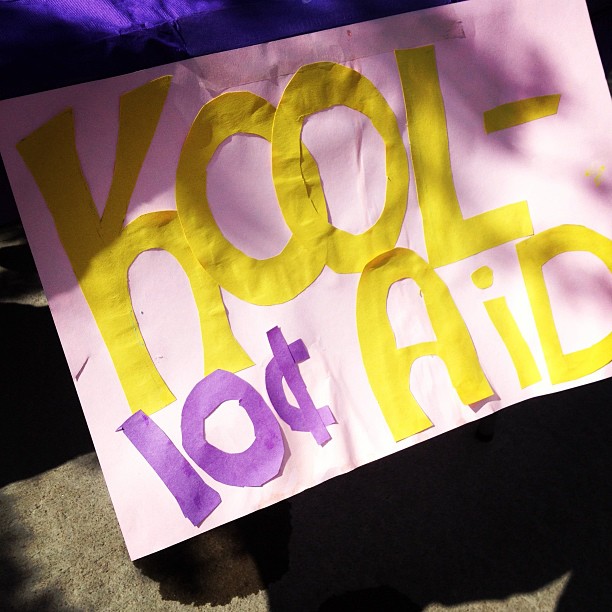
Friday night was my “do absolutely nothing” night, followed by a busy Saturday full of babysitting (we had our first Kool-Aid stand of the year. The four-year old wanted to sell the cups for 11cents, so the mom told her that for every cup she sold for 10c, she’d throw in an extra penny. It was cute.) laundry, my brother’s birthday dinner, drinks with friends, and dancing at my favorite goth/80s bar.

Kool-Aid Stand

I had a reverse-gay moment on Saturday. There’s a funny thing that happens: often, when someone is meeting a gay person, they’ll say, “I have a gay friend! You would just love him!” as though they’re matchmaking and as though all gay people are just “going to love” each other. So on Saturday night, I was out with some friends in a mixed-group, and I got really excited to tell the only straight guy there that I had a straight friend who he would just love. I even asked him if he liked baseball. Ha.

Brunch Eggs Benedict

Sunday was brunch on the patio at a cute place in Capital Hill (bottomless mimosas, yes, please!), with an afternoon of Cheeseman Park lounging after.

Talking Point, Stick and Flowers

This stick is the “Talking Point.” Jacob and my new friend Ben carry it around with them whenever they lounge in the park. It serves as a sort of marker/flag. We decorated it with plastic flowers (as Ben said, “For $2, you can carry beauty around wherever you go.” He also mentioned that you must have the confidence to pull off carrying around fake flowers, but I think they’re great.) and another stick. I wanted to get more sticks and create a teepee, but unfortunately, large sticks are hard to come by.

I’m so happy that it’s almost summer. There’s nothing I love more than afternoons in the park. (But oh man, sunscreen is so expensive!)

I was all excited to tell you about the lukewarm water week that happened at my apartment, but now I feel like an ass. A couple of weeks ago, a water heater in our apartment building broke and we were left with tepid water for our showers. (And there’s nothing I love more than hot water. I hope they never invent time travel – I’ll refuse to go back past the dawn of reliably hot water.) My landlord assured me that we’d have hot water again as soon as he got the new hot water heater, and sure enough, it’s been wonderful. I was on the phone with him today, and he said, “How’s the hot water, dear?” I was a little embarrassed by my enthusiastic response. But last night, Mike had to watch a documentary for one of his classes about poverty around the world. (I liked it and it’s streaming on Netflix, if you’re interested: The End of Poverty? It’s a good history of globalization/the rise of such severe poverty and it attempts to argue against privatization, although I’m not sure how effective the final argument is.) As I was watching, I was remembering how little hot water we had in South Africa and I feel like an ass for complaining about clean, running, just-not-hot water. I’ll take that over no running water any day.

On Email forwards that might make you cry…

If this doesn’t pull at your heart, you have no soul.

Normally, when I get email forwards, I freak out and rant about how annoyed I am that people are so narrow-minded, but this email made me cry.

I’ve been spending a lot of time lately thinking about how lucky we are to be alive and how lucky I am to be working toward a life that I love – and in doing that, I’ve been trying to spread as much positive energy as I can.

So here, from Aunt Sally (who rocks):

The
Cab Ride

I arrived at the address and honked the horn.
after waiting a few minutes
I walked to the
door and knocked.. ‘Just a minute’, answered a
frail, elderly voice. I could hear something
being dragged across the floor.

After
a long pause, the door opened. A small woman in
her 90’s stood before me. She was wearing a
print dress and a pillbox hat with a veil pinned
on it, like somebody out of a 1940’s
movie.

By her side was a small nylon
suitcase. The apartment looked as if no one had
lived in it for years. All the furniture was
covered with sheets.

There were no
clocks on the walls, no knickknacks or utensils
on the counters. In the corner was a cardboard
box filled with photos and
glassware..

‘Would you carry my bag
out to the car?’ she said. I took the suitcase
to the cab, then returned to assist the
woman.

She took my arm and we walked
slowly toward the curb.

She kept
thanking me for my kindness. ‘It’s nothing’, I
told her.. ‘I just try to treat my passengers
the way I would want my mother to be
treated.’

‘Oh, you’re such a good
boy, she said. When we got in the cab, she gave
me an address and then asked, ‘Could you drive
through downtown?’

‘It’s not the
shortest way,’ I answered
quickly..

‘Oh, I don’t mind,’ she
said. ‘I’m in no hurry. I’m on my way to a
hospice.

I looked in the rear-view
mirror. Her eyes were glistening. ‘I don’t have
any family left,’ she continued in a soft
voice.. ‘The doctor says I don’t have very
long.’ I quietly reached over and shut off the
meter.

‘What route would you like me
to take?’ I asked.

For the next two
hours, we drove through the city. She showed me
the building where she had once worked as an
elevator operator.

We drove through the
neighborhood where she and her husband had lived
when they were newlyweds She had me pull up in
front of a furniture warehouse that had once
been a ballroom where she had gone dancing as a
girl.

Sometimes she’d ask me to slow
in front of a particular building or corner and
would sit staring into the darkness, saying
nothing.

As the first hint of sun was
creasing the horizon, she suddenly said, ‘I’m
tired. Let’s go now’.

We drove in
silence to the address she had given me. It was
a low building, like a small convalescent home,
with a driveway that passed under a
portico.

Two orderlies came out to
the cab as soon as we pulled up. They were
solicitous and intent, watching her every move.
They must have been expecting her.

I
opened the trunk and took the small suitcase to
the door. The woman was already seated in a
wheelchair.

‘How much do I owe you?’
She asked, reaching into her
purse.

‘Nothing,’ I
said

‘You have to make a living,’ she
answered.

‘There are other
passengers,’ I responded.

Almost
without thinking, I bent and gave her a hug. She
held onto me tightly.

‘You gave an
old woman a little moment of joy,’ she
said
‘Thank you.’

I squeezed her
hand, and then walked into the dim morning
light… Behind me, a door shut. It was the sound
of the closing of a life…

I didn’t
pick up any more passengers that shift. I drove
aimlessly lost in thought. For the rest of that
day, I could hardly talk. What if that woman had
gotten an angry driver, or one who was impatient
to end his shift?
What
if I had refused to take the run, or had honked
once, then driven away?

On a quick
review, I don’t think that I have done anything
more important in my life.

We’re
conditioned to think that our lives revolve
around great moments.

But great
moments often catch us unaware-beautifully
wrapped in what others may consider a small
one.


On a Cat in a Box

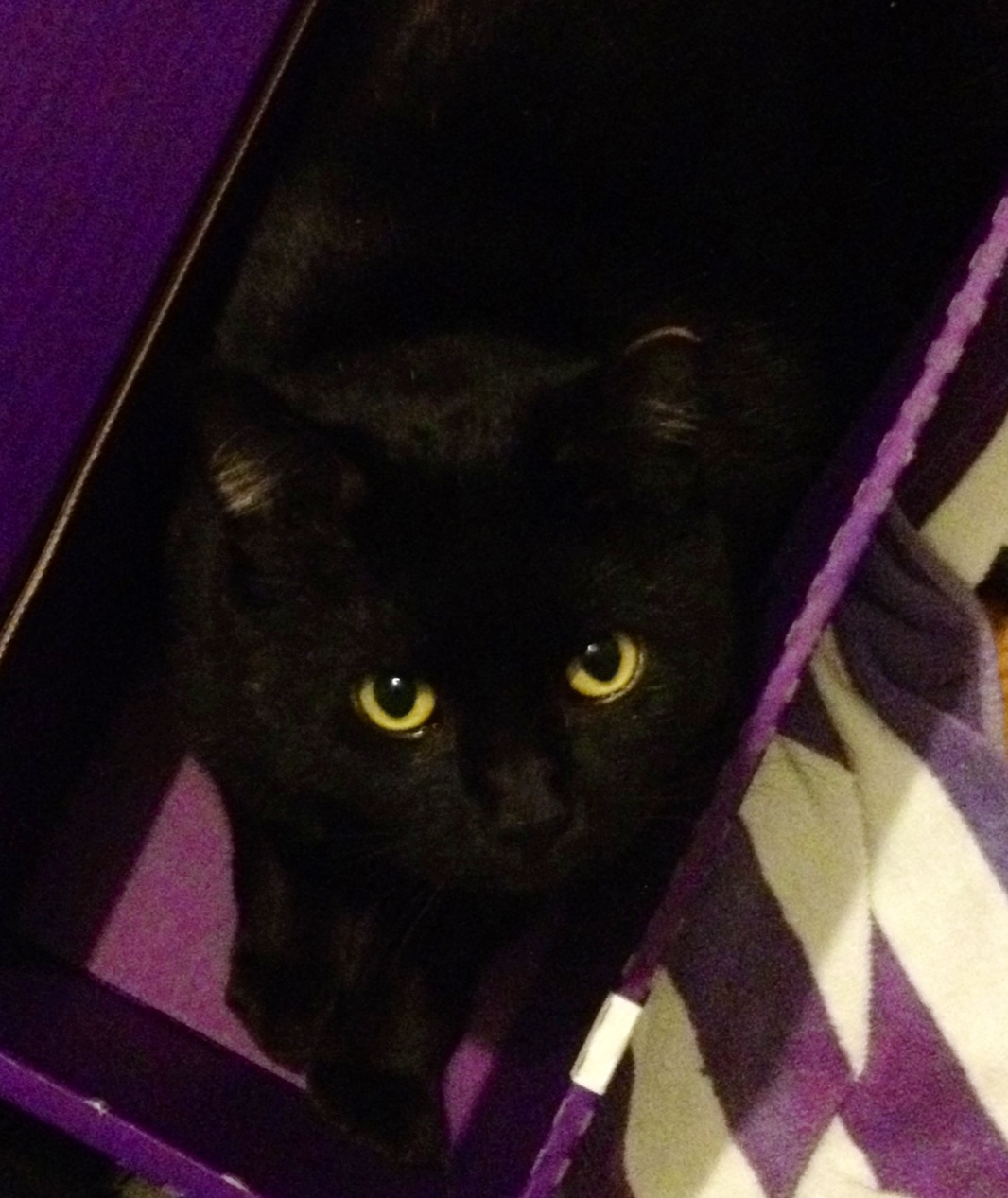
black cat in a box

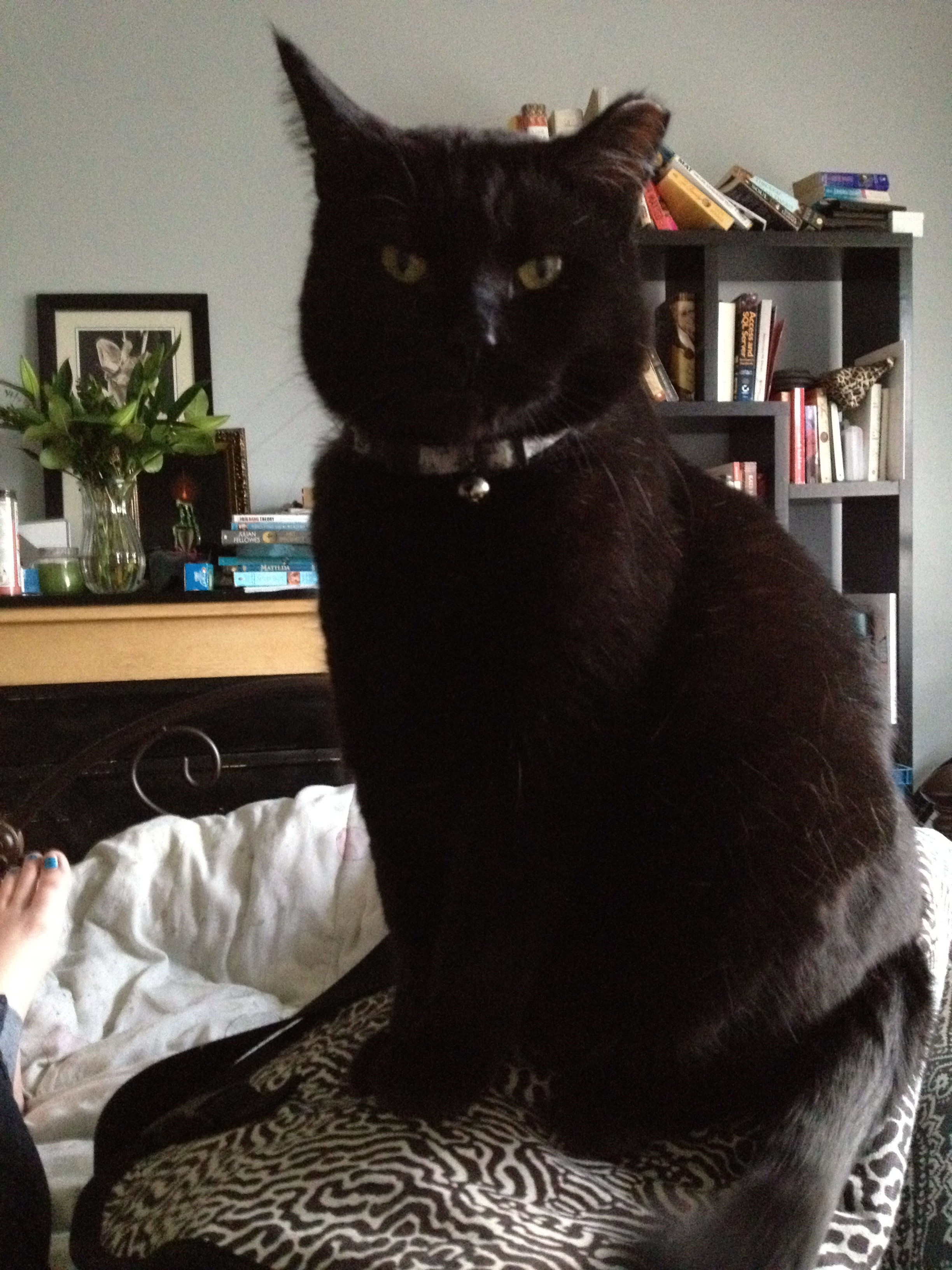
…I swear I’m going to write about nannies soon, but in the meantime, Carlos in a box.

Sometimes I wonder why I bother buying him toys when he’s just a pleased when cardboard boxes come through the door.

Have you seen that commercial where the couple buys a panther instead of a home security system and the panther just stares at them all night?

Owning Carlos is much like that. I’ll wake up, and he’ll be sitting on or near me, just staring. Sometimes, I think he’s waiting for me to shift into a position so that he can come snuggle, but sometimes I wonder if he’s wondering what kind of prey I’d be.

From the New York Times, On Nannies

I’m going to blog to you about this article later, but I’ve got piles and piles of work to do before that can happen.

At least you’ll be prepared!

From the New York Times (link follows story):

IT’S THE ECONOMY

The Best Nanny Money Can Buy

Illustrations by Jillian Tamaki
By ADAM DAVIDSON
Published: March 20, 2012

It took Zenaide Muneton 20 seconds to convince me that she was the perfect nanny. Short and dark-haired, she has a goofy, beaming smile and knows how to make everything fun for a little kid. Time to brush your teeth? She shakes her hands and does a pantomimed teeth-brushing dance. Bath time? She pumps her arms up and down in a going-to-the-tub march. After I told her I’d love to hire her, she smiled and thanked me.

Then we both laughed, because there is no way I could possibly afford her. As one of New York City’s elite nannies, Muneton commanded around $180,000 a year — plus a Christmas bonus and a $3,000-a-month apartment on Central Park West. I should be her nanny.

I began researching this bizarre microeconomy shortly after my wife and I started looking for someone to watch our son for a few hours a week. We met with several candidates, all of whom had good references and seemed fine with him. Still, we weren’t sure how to judge them. Should we hire the one who seemed to be the most fun? The most experienced? A native English speaker or someone who could speak a foreign language to him? Someone with a college degree? A master’s?

We had no idea. But I began to wonder if price conveyed any important information about the nanny market. All the candidates we spoke with charged about $15 to $18 per hour, which, though standard in our Brooklyn neighborhood, seemed like a bargain when I learned that some nannies charge considerably more than double that rate. Would my son suffer with a midmarket nanny?

This fear led me to the Pavillion Agency, which specializes in finding domestic workers for New York City’s wealthy. Pavillion introduced me to Muneton, 49, who grew up in “a very poor family” in São Paulo. In 1990, she befriended a young American woman who had relocated to Brazil. When Muneton invited her to her family’s home, the woman saw her natural ease with children and suggested that she move to America and become a nanny. Within a few months, Muneton was caring for the children of a rich family in South Carolina for only $100 a week.

When Muneton started working through Pavillion in 2002, however, she increased her salary to $85,000 a year. As she gathered sterling recommendations, she began increasing her pay. Eventually she worked for some of the country’s wealthiest people, whom she accompanied on private jets to many of the world’s most exclusive resorts. Today, she says, “there are no more poor people in my family.” Muneton bought a nice house for her mother, a condo for her sister and a taxi cab each for two of her brothers. She also owns a beach house in Brazil, a penthouse in Miami and two properties (a six-unit building and a duplex) in Los Angeles.

How does a nanny earn more than the average pediatrician? The simple answer is hard work — plus a strange seller’s market that follows a couple of quirky economic principles. A typical high-priced nanny effectively signs her (and they are almost always women) life over to the family she works for. According to Cliff Greenhouse, Pavillion’s president, that kind of commitment is essentially built into the price. Many clients are paying for the privilege of not having to worry about their child’s care, which means never worrying if their nanny has plans. Which, of course, she can’t, pretty much ever.

And, alas, it seems that there just aren’t enough “good” nannies, always on call, to go around. Especially since a wealthy family’s demands can be pretty specific. According to Pavillion’s vice president, Seth Norman Greenberg, a nanny increases her market value if she speaks fluent French (or, increasingly, Mandarin); can cook a four-course meal (and, occasionally, macrobiotic dishes); and ride, wash and groom a horse. Greenberg has also known families to prize nannies who can steer a 32-foot boat, help manage an art collection or, in one case, drive a Zamboni to clean a private ice rink.

And then there’s social climbing. “A lot of families, especially new money, are really concerned about their children getting close to other very affluent children,” Greenhouse says. “How do they do that? They find a superstar nanny who already has lots of contacts, lots of other nanny friends who work with other high profile families.” There are the intangibles too. “I’m working with a phenomenal Caribbean nanny right now,” Greenhouse says. “She is drop-dead beautiful. Her presentation is such that you’re proud to have her by your children’s side at the most high-profile events.”

My wife and I don’t care about any of that stuff. But it’s hard not to wonder if the nannies who make twice as much an hour as the ones we’re considering are also twice as good. Nannies can be evaluated in the same way as what economists call “experience goods” — like wine, whose value can only be determined after experiencing it. When it comes to experience goods, price can be useful to reject anything below a certain minimum. After all, a $3 bottle of wine or a $5-an-hour nanny are pretty sketchy.

But price is useless — or worse, misleading — in differentiating among the adequate. I’ve often assumed that a $40 bottle of wine is twice as good as a $20 bottle even though the American Association of Wine Economists has essentially proved that the price of wine has almost no bearing on enjoyment. When nonconnoisseurs buy an expensive bottle, they’re acting like new parents hiring a nanny: they’re basically paying for a false sense of assurance. Or hoping to impress somebody.

Actually, nanny prices might be even more misleading than the wine market. They also bear resemblance to “credence goods,” an economic term for something — whether a jar of vitamins or an auto tuneup — whose true value can never quite be determined. You’re more likely to overpay for a credence good in the hope that a higher cost increases the likelihood of a benefit.

So if economics can’t fairly convey the price of a nanny, what does? Jeanne Brooks-Gunn, a director at Columbia University’s National Center for Children and Families, reassured me that academics know, roughly, nothing about how nannies impact children. There has not been any sort of serious study on nanny quality, she says, because it would be nearly impossible to get permission from nannies (often paid under the table) or their employers. Also, most child-development research is dedicated to at-risk children, and the kids of people with the resources to hire nannies don’t typically qualify.

Brooks-Gunn did, however, have some advice for what can make a good nanny. The single-most important characteristic is the extent to which a nanny is responsive to the child’s mood and interests. Brooks-Gunn said that when she chose a nanny, she simply handed her son to every candidate she interviewed and chose the one who responded most sensitively.

After our talk, I spoke with one of her graduate students, Erin Bumgarner, who moonlights as a part-time nanny for around $17 an hour — the same amount that Park Slope parents pay to immigrant nannies with no college education. I couldn’t think of any other field in which people with such disparate educational backgrounds could make the same amount. But Bumgarner told me it makes sense. She is willing to work for only parents she likes — she already quit one well-paying job for this reason — and who allow her to focus on her school work. The value of that is also built into the price. Even if it costs her a Central Park West apartment.


source: The New York Times 

On Hurt and Hope, intangibly

Hurting other people is something that I try never to do. Emphasis on try. Sometimes it’s unavoidable, and through the hurt that I cause (regardless of intention), I hurt as well.

Sharing hurt is never pleasant. Suffering, regardless of cause, is painful but entirely unavoidable. A life well lived is full of moments of pure joy and pure pain, emotional and otherwise.

I’ve been doing quite a bit of reflection. I’ve come up short. It’s hard to try to help someone hurting heal, particularly when the hurt they’re feeling is entirely your fault. It’s hard when you’re hurting, too.

But to keep at something simply to avoid suffering isn’t a wise course of action either. Sometimes the hurt is unavoidable. To be free and live the life I want, I must ensure that my needs are met. I must ensure that I am doing the very best I can to become the person that I so badly want to be, the best person that I can be.

“You yourself, as much as anybody in the entire universe, deserve your love and affection.”

There are no words of solace, there are no words to soothe, to mend, to heal. The honest core of me and the apologies proffered are the best that I can do. And yet I still hurt because I know the hurt that I’ve caused isn’t easily mended.

“Better than a thousand hollow words, is one word that brings peace.”

Everyone has their own motivation in life, their own driving force. They carry with them their experiences and the wisdom that they’ve gained from those experiences, both failed and successful. Love and life are so similar, so miserable in their sorrows, but so miraculously wonderful when they work. And so very worth it.

Hope is the only thing that can drive healing. My hope for the best is guiding me right now; it’s the one thing I am entirely certain of. To hope is to be invigorated. That hope will drive away sorrow, or at least mitigate the dull numbness edged with daggers that circles the heart and threatens to overwhelm.

“No one saves us but ourselves. No one can and no one may. We ourselves must walk the path.”

Moral of this story: Ugh, walking the path sucks, but you just have to keep on keepin’ on.