On Slut-Shaming, Angrily

I wish that someone would tell every adolescent girl that she’s normal (we’ll get back to that – normal is the wrong word), beautiful, and worthy.

I didn’t get those messages – and if I got them, I was unable to internalize them properly – and as a result, spent much of my adolescence feeling confused, ugly, and not letting myself believe that I could get what I deserved. Hell, at that point, I didn’t even know what I deserved. I was intelligent and curious, but the teenage fragility usually got the better of me.

Thankfully, I eventually realized that I am (and always have been) valuable, beautiful, unique, hilarious, intelligent, relevant, and most importantly, worthy. (Fuck normal, by the way. There is no normal. Nothing you do will ever be normal. Your normal is someone else’s weird.)

Worthy, though, is important. It’s something we forget, it gets swept under the rug, especially because we’ve got a society that objectifies women. Our dominant culture and many of our sub-cultures see women as either an alien demographic or an accessory. We are often reduced to a collection of parts. It’s hard to respect parts.

Sexuality is an integral part of being a human being. Sexuality is one of the most repressed parts of our society – and that repression is arguably one of the most detrimental things to our young people. We’ve got two sides to this problem: the over-sexualization of nearly everything – magazines, celebrities, music, campaign ads, products, clothes, etc. – and we’ve also got the modesty movements that make sex into something shameful and dirty, not even worth teaching about.

Why is that a problem? Sex sells, and while it’s used to get both men and women to buy, only men are allowed to engage in sexuality activity. Women are expected to look the part but not act it. As a teenager, all of these mixed messages get confusing.

But at the end of the day, it’s not the messages that really matter (it is, but it shouldn’t be). Teenagers are going to have sex. They’re going to have sex whether or not we tell them how and provide them with information about how to do it safely. They’re going to have sex whether or not they have to be home at a certain time. They’re going to have sex because their hormones are telling them to and because they’re curious.

Yes, some teenagers won’t. And yes, some teenagers will wait until they feel ready and confident. But some won’t. And regardless of their own feelings about the emotional impacts of sexual activity, they might try it. That’s not the problem. As long as they’re having informed, safe, and relatively awkward, inexperienced sex, everything should be all right.

The problem is what happens after. The problem is that our society hasn’t figured a lot of this out. The problem is that there are far too few open dialogues about sexuality and self-worth and self-esteem and value and human emotions for our kids to engage in.

This article about a girl who was “slut-shamed” and bullied about someone she’d dated makes me sick. To a certain extent, I believe that suicide and self-harm have become so glorified that they can become a romanticized ideal in the mind of a young person, but I won’t address that in detail here. Because no one should be pushed to the point where they see death as the only way out. Never. Especially not because of someone who they’ve dated.

So here’s the deal: when a young woman enters into a sexual relationship with someone, there’s an implicit amount of trust given over to them. That person has the responsibility to take care of that trust. Granted, teenagers aren’t always the most responsible or mature of creatures, but I think that too often, we let them get away with a tremendous amount by allowing for the excuse “boys will be boys” and others like it.

This is where girls get into trouble. This is where we aren’t supporting them enough. This is where we need more positive messages. This is where we need support and care and understanding.

Instead, we’re met with messages of consequences, messages that treat us more like chattel than the decision-makers that we’re capable of being. Adolescent girls become a collection of parts, rather than a whole person.

If you’re still struggling to understand what I’m trying to say, let’s look at a relevant example:

The GOP has run into some issues this year with their inability to keep their mouths’ shut regarding the issue of rape in our country. Rape is a big fucking deal. The consequences of rape are a big fucking deal. And yet, the collection of cells that may be turning into life in a woman’s body is somehow more important than the woman herself.

And yet, women are “asking for it” when they wear the clothes they want. Or the clothes they see in magazines.  And yet, some women “rape so easy.”

=

Yes, it’s like that. Even today, Pepperdine has published a piece warning girls about rape as a result of their slutty costumes. Men should be outraged, too! The argument that scantily clad women will incite men to rape infers that men are incapable of self-control, that they are little more than beasts.

What messages are we giving our girls, between the magazines urging them that self-worth comes from clothing, between the politicians fighting to remove uterine rights, and between our own self-consciousness when it comes to discussing sex?

Our teenage girls are scared. Our teenage boys are scared. And they handle it differently. Teens succumb to peer pressure. They treat others the way they think they should treat them. Perhaps if we were able to re-frame the conversations about sexuality, about our bodies, about ourselves, we’d be better able to head off slut-shaming behaviors that our kids aren’t going to grow out of. The kids who bully and slut-shame at seventeen don’t grow out of it. They grow up and become adults who bully and slut-shame and legislate.

I wish that someone would tell teenagers, particularly girls, a few things:

First, the guys that you like now won’t be the guys you like in ten years. The guys who are cool now might even be unemployed and still living with their parents. (I’m not wrong.)

Second, don’t take shit from anyone, especially not someone you’re dating. I had to learn this lesson the hard way. Sixteen year old me didn’t understand how much power I had. Don’t let people put you down, and draw the line and then stick to that line, no matter what.

Third, prepare for your future. Take the time to become an interesting, educated person. That’s going to get you laid more often down the road than any amount of body glitter and brow-shaping tips. (Although, you know, sixteen year old me also could have learned the lesson “don’t over-pluck your eyebrows,” so perhaps I should have been reading more girly magazines. Also, body glitter is just really messy. Don’t buy it. Ever.)

Fourth, fuck ’em. Seriously, if someone has an issue with you, don’t listen. I know it’s really hard to ignore bullying and mean-spirited commentary, but the less you care, and the less you let anything affect you, the less power people have over you. Love your own life, and people will start to love it too. And if they don’t? Fuck ’em. (Not like sexually fuck them, but fuck ’em, in the sense that they’re not worth your time or energy.)

Fifth, you’re worthy. Whoever you are. Not everyone is going to like you. You’re not going to like everyone. But at the end of the day, as long as you love and respect yourself, you’ll be happy. And don’t forget to love your weird. Embrace it. It’s what makes you you.


On Education, Gratefully

My word for 2012 has been “gratitude.” I have tried to be more mindful of the wonderful blessings in my life and express gratitude in all areas of my life. First things first: I have improved dramatically at writing and remembering to send Thank-You notes. I think that may be the only real deliverable; the rest of my gratitude practice has been solely in my own mind and heart.

As I’ve been crawling, inching, barely progressing on the series Breaking Bad, I’ve been reflecting on my own life, my own decision-making rationale, my gifts and support systems. Of course, the onslaught of gratitude and related emotions has been a refreshing reminder of how beautifully hopeful and heartbreaking life can be.

But the greatest gift I’ve ever been given was my education. From the age of three, I was enrolled in private, Catholic schools. While I realize that Catholic schools are a hot-mess of crazy (this is true), I also realize how valuable the emphasis on education is. I remember begging my parents – pleading my case every single year – to let me go to public schools. They didn’t.

I went to a Christian Brothers high school, but my real luck came from the Jesuit university I attended. The Jesuits are noted for their commitment to the education of the whole person. If there’s one thing I took away from my college experience, it was “solidarity.” While Loyola may not be known for their commitment to the betterment of Rogers Park (I think it’s a no-win situation, as far as land ownership goes, but on the plus side, the Loyola stop is in pretty good condition. and there used to be a Dunkin Donuts!), they’ve always emphasized service-learning and commitment to communities of all kinds, more than just their own student body.

My professors there were not all devout Christians, but they were all devout scholars and educators (give or take a few). One of my favorite professors was a women’s studies professor who taught some of my feminist theory classes. She was a devout Catholic, but freely admitted that as a woman, she had problems with some of the catechism. I so adored her commitment to her faith but her willingness to question it and call attention to its hypocrisies and flaws. It allowed me to see the Catholic faith in a new light, and for that, I will be forever grateful.

While attending Loyola, I lived in one of the most racially diverse neighborhoods in the city of Chicago, which is already a wonderful blend of everywhere. But that’s not the point, even though I will carry pieces of Rogers Park in my heart forever. The point is that my educational experiences have left me a more rounded, grounded, rational human being. I’ve traveled to Europe for a forensic trip because I was lucky enough to have the most badass forensic teacher (we had one of the only forensic science classes in the country at the time) ever. Loyola prepared me to open my heart and mind to the conditions in the townships in South Africa.

All of this education has left me curious, well-informed (mostly), and most importantly, someone who cares about the well-being of all human beings (solidarity, solidarity, solidarity, and so on).

Regardless of your religious views (trust me, I have plenty of opinions and don’t ever get me started about the current Pope), this article should give you hope for the future and hope that educations such as mine will continue to cultivate a love of learning in young minds everywhere:

By Carl Bunderson

Denver, Colo., Oct 16, 2012 / 03:03 am (CNA).- Our Lady of Lourdes Catholic School based in Denver, Colo., has nearly doubled its enrollment in just one year by introducing a classical curriculum.

“This is something people want, and they’ve wanted it for a long time, and now it’s available,” principal Rosemary Anderson told CNA Oct. 10.

Our Lady of Lourdes is a pre-kindergarten through eighth grade school. The parish’s pastor, Monsignor Peter Quang Nguyen, had helped turn around a number of schools in the Archdiocese of Denver which had been in danger of closing. He was assigned to Lourdes five years ago.

When Msgr. Quang hired Anderson to be principal in 2010, the school was in “quite a bit of debt” and had only 104 students enrolled. That figure is 180 today.

The school’s capacity is 235 and Anderson believes that by the next school year, “we’ll have to start wait-listing kids.”

“The biggest problem when I came on was that everyone thought the school was going under. The attitude has changed…Now people know this place will be there, and their kids are getting a phenomenal education, and parents don’t have to worry that it will close in a few years.”

“I’m very grateful for Monsignor Quang’s support. None of this would have happened if he wasn’t completely on board,” she added. “We were right in this together.”

Anderson noted that classical education is meant to help students learn how to think, rather than merely teaching them “subjects.” The program at Lourdes school was inspired by 20th century author Dorothy Sayers’ essay “The Lost Tools of Learning,” and the work of Laura Berquist, who was involved in the founding of Thomas Aquinas College – a Catholic university in southern Calif. which uses the classical model.

“She’s a huge influence,” Anderson said, “she founded a homeschooling curriculum called ‘Mother of Divine Grace’ and is brilliant in the ways of classical education.”

The foundation of classical education is a set of three methods of learning subjects, called the trivium, which is made up of grammar, logic, and rhetoric.

Lourdes school will focus on the grammar and logic phases, and will introduce the eighth graders to rhetoric.

The trivium “happens pretty naturally” using the classical curriculum, and ideas of grammar and logic and integrated into the subjects taught to students: “it flows naturally from the way teachers are teaching,” Anderson expressed.

This year saw the hiring of five new teachers, in a faculty of 15 total. And out of those five, four have either had a classical education or taught in a classical school,  Anderson reported. “I brought in people who know what the vision is…they’re confident in how to teach” classically.

Anderson noted that the school drew in numerous students who had previously been schooled at home. Several homeschooling parents enrolled their children as this type of education wasn’t available before. “Now they know there’s something that will sync up with what they’ve taught” their children.

Several non-Catholic families have also come to Lourdes just for the classical education, Anderson said. She expects that group to grow as well, “because it’s a great education.”

Parents at the school are very invested in the classical model, which she “welcomes completely.” She pointed to the Catholic teaching that parents are the primary educators of their children, and that “we’re just here to help them.”

Anderson was encouraged to differentiate her school, and with the “support and knowledge”of Bishop James D. Conley – former apostolic administrator of the archdiocese – chose to follow this approach to education as a way of imparting to students the art of learning.

“The classical approach is Catholic, through and through,” said Anderson. While “other schools are doing great things,” “no other Catholic schools in the diocese are doing this yet.”

The school’s re-organization will be a three-year process. The first year, which is occurring presently, involves a re-vamp of the English department and the introduction of Latin classes.

Latin was introduced in place of Spanish because of its importance as the basis of all Romance languages. Students “logically process things better when they know Latin,” said Anderson. She pointed to high school freshmen who “test into honors French, without having had any French before, just by knowing the root language.”

Latin is important for the grammar stage of the trivium because its nouns decline, or change their ending according to function they are performing in a sentence. This helps students to better understand how languages work, and it is coupled with the memorization of poetry.

The second year of the school’s rehabilitation will consist of a renewal of science and social studies.

“We’re not necessarily changing the material we’re teaching, but how it’s given to the kids, which is a step away from dependency on textbooks,” said Anderson.

Students will be reading more primary sources for history, and in English classes, reading historical novels to tie-in with their history classes.

“All the classes are very intertwined. What they’re reading in English should correspond to what they’re learning in history, and in history should be able to carry over to the virtues they’re learning about in religion, so it’s all very integrated.”

Morgan McGinn is in her second year at the school, and teaches second grade. She discussed how the move to classical education has changed her teaching style.

“I have to read and discover knowledge on my own before I can share it with my kids…It’s definitely changed my teaching; I can’t just look at a book anymore and read the lesson, and be prepared for the next day.”

“I’ve had to almost flip everything I know about education upside-down to teach classically,” she said.

Her students are now “required to think more,” rather than having “the information they need to know fed to them.”

The holistic approach of classical education, meant to build up the whole person, translates to an emphasis on the fine arts. “We already had a great performing arts and speech department here…so that was already very integrated,” said Anderson.

The school’s music and performing arts teacher, Patricia Seeber, is a veteran of the school, having taught there for 13 years.

“The feel where we’re at spiritually with the kids, that we’re making that the most important part of the day, has shifted for the better,” she said.

“It just feels like they’re really responding to it in a great way.”

In keeping with the introduction of Latin into the curriculum, Seeber has added Latin hymns among the songs prayed at the school’s bi-weekly Masses.

“We raised the bar I think a step or two higher than a lot of schools do, and the kids really rise to the occasion.”

Lourdes’ classical education is meant to help the students realize their full potential “spiritually, intellectually and socially,” and help draw them to God through the true, the good, and the beautiful.

The parish’s maintenance director, Bryan Heier, reflected on Anderson’s leadership at the school, saying “with enrollment as high as it is so quickly, she’s doing something right.”

On Volunteering, Excitedly

Exhaustion to end the week, but the exhaustion is the best kind.

Mike and I have volunteered to be counselors at an adoption camp this weekend. We started today, and will go until Sunday. Mike will be working with middle and high schoolers, and I’ve been assigned to Pre-K. (I can’t even tell you how excited I am! Pre-K is the best time. They’re still so cute and baby-ish, but you can see their future grown-up selves starting to shine through.)

The camp is an African Caribbean Heritage Camp – it’s been held in Denver for 14 years now. Most of the counselors are of African or Caribbean descent, but since Mike and I were both adopted, we fit the counselor profile as well. This year’s theme is: The Colors of Us: Celebrating Transracial Adoption.

We meet the kids tomorrow morning, and Mike will be up early to go on a day-long white water rafting trip. (White-water? Not so much. We had terrible snow this winter, and it’s already August, so I feel like it’ll be more like a float trip with some bumps along the way that will stand in for rapids.)

While the counselors are keeping the kids entertained, the parents are attending different sessions and workshops all centering on adoption, race, and culture. One of the sessions held on Saturday will be discussing white privilege through the lens of transracial adoption. The high school kids will be attending the session with their parents and the counselors, and I think that’s an awesome opportunity for discussion and reflection. I’ll be curious to hear what Mike has to say about it.

Mike and I haven’t gotten to do anything like this since we were in South Africa, and I know that we’re both really looking forward to this weekend.

Cute stories, quickly, before I fall asleep on my keyboard:

My mom’s little neighbor, who’s still working through adoption in her mind, asked me how old I was when I was “traded in” the other day.  Hah, I had such a good laugh about that. Traded in, like they just wanted a newer model or something.

AND…..

Guess what I got at Costco today? (Besides a Polish sausage covered in spicy mustard.) Both seasons of Party Down for $11.99. Life is beautiful (and so is Adam Scott).

Going to be a hectic – but very fun – weekend!

On Childhood Haircuts, Nostalgically

I was little. My mom knew I was going to cut my own hair. I’d been cutting the dog’s hair, cutting the grass, cutting everything in sight with my scissors.

One day, I came down the stairs and I had taken the scissors to my bangs. Instead of cutting straight across, I had cut them so that they were really slanted. I had this giant triangle section of my bangs gone. And there was nothing that could be done about it.

I hid the hair behind a chair in the empty upstairs bedroom that we used as an office. (My only flash of memory of this incident was thinking that if I put the hair behind the chair, they’d never find it.)

So, seeing this interview with two little girls in the aftermath of an unfortunate hair cut, I smiled. The 5-year old daughter of an NPR staffer cut her 3-year old sister’s hair. You should listen to it. Oh my goodness, they are so adorable.


On Lawnmower People, Begrudgingly

I got a picture message from my mom a few minutes ago with the subject: “Found this note in a box. Made me laugh.”

I needed the smile today. But oh man, I am so embarrassed. That’s absolutely the handwriting and indignant sarcasm of my childhood.

(Okay, so it could be worse. I did say please. Check this link out, it goes to a drawing done by a 6-year old in timeout. He asks his parents how they’re doing in hell. Hah, so good.)


On Everything, mostly

I’ve been avoiding blogging lately. Not because I don’t want to, but because there is so much swirling inside my head and I fear that it will all lump together incoherently and ruin the messages I intend to convey. But I am finding that the longer I put it off, the more everything builds up.

So faced with the incoherent, potentially ruinous lumping or the lack of content, I’ll take the lumping. City Park Statue with Frogs

On Friday night, Jacob and I made dinner and walked around the park as darkness fell. It was cold and rainy, but the air felt good and the conversation warmed my soul. I am grateful for my friendships. My friends are all individualistic, beautiful people. They possess the qualities that I value most in this world, and I respect them immensely.

It doesn’t hurt that Jacob and Carlos adore each other, either. Carlos doesn’t snuggle for just anyone, but he will always snuggle for Jacob. It’s cute.

Jacob and Carlos

(Side note: I got home on Sunday night, and Mike told me that he thought Carlos had died earlier. I was concerned, and upon hearing the story, I just shook my head and looked at the furry creature rubbing himself against my ankles. Mike said that the other black cat that lives in the building had somehow managed to get herself outside my window, and Carlos was howling and trying to attack her through the window. The cat had gotten himself through the blinds and was frantically trying to get at her. I’m just glad the glass held – I accidentally put my hand through one of the panes last  year – and Mike grabbed the cat and took him away from the window. I’m still not sure how I managed to adopt a cat that’s half pit bull. I’m also not sure how he can go from ferocious and wild to loving and needy, demanding that I snuggle with him. I do love him, though, so he should consider himself very lucky.)

in the Mirror

Swisher comes on Wednesday. I can hardly believe that it’s just two days now. I am so excited to not have to take mirror pictures all the time so that I can send them to him. (The great news about unlimited data plans? All the picture messaging you want! It’s allowed us to share experiences, events, mundane pictures, bad hair days, etc.) My phone is filled with pictures just like the one above, and I’m pretty sure that if someone went through my phone, they’d assume that I’m just a terrible narcissist.

I can’t wait. I guess I can, but only because I have to. We’re going to be faced with the immense task of turning our past into a relationship that isn’t long distance. I imagine that it will be an adjustment, but I also imagine that it will be quite wonderful, since both of us are committed to making this work.

I love that he loves me exactly as I am. He loves my curly hair. In fact, he prefers it. He loves my mind, my weird sense of humor, my opinionated nature. I am thrilled by the fact that he wants to cook for me, and has offered to help clean! And best of all, he’s not a purse-carrier (something my family is always quick to ask about). I love that he makes me laugh, and I love how much he teases me.

At Mother’s Day brunch, my Uncle Mike and Aunt Jan were excited to tell me that they had gotten into a debate about something. (Earlier this year, I was attempting to explain that I’d like a mate whose desire for discussion matches mine, and they thought that it was hilarious. “Should we make a list of things to debate about?” my Uncle asked, before adding, “Besides who’s going to make the sandwiches for lunch tomorrow?” I love that thirty-plus years of marriage hasn’t dampened their good-natured teasing. It’s something that I’m looking forward to if I should be so lucky to find a dude who will put up with me for thirty-plus years.)

birth mom!

Speaking of family, I was lucky enough to get to spend my first Mother’s Day breakfast with my birth mom, Lise, who was passing through town with her boyfriend. I haven’t seen her since I was 18 and had just graduated from high school.

(This is us then:)

I was excited to show her the paw print in my eye, since her spirit animal is a wolf and we’ve had a few fascinating (partly creepy, but mostly fascinating) experiences – when I was three, I was on the phone with her and told her that the wolves came to me at night and gathered around my bed, but that I got scared, and when my dad came into the room, they ran away and jumped over the fence. (It was a very intense dream. I had forgotten about the entire incident, but when she mentioned the fence detail, an image rushed through my brain of the blur of wolves and the back fence.) She tells me that the way I told her that story was so unlike a three year old and that she was very comforted by it. When I was 19, I was looking in the mirror in the car and I realized that in the blue of my eye, there is very clear dark paw print that’s set off from the rest of the blue. It’s like I carry her mark with me, and I enjoy that.

My boss, who adopted his four children, says that adopted kids always want to know two things: 1. who are my parents? (or in my case, what do they look like) and 2. why did they give me up? I think he’s right. I know the answer to the second question, and half of the first.

I will never know more about my birth father, but I am so grateful to have an open adoption. I am so glad that I get to see her. I agree with my boss when he says that he doesn’t see much resemblance. As I age, I am more and more sure that I carry a lot of my birth father’s appearance with me. I so badly wish that I could see a picture of him, but there are none. Ah, well. I will settle for the relationship that I have with my birth mother, because I am so lucky to have her in my life (and I’m not actually settling at all).

Both of us are double-jointed, so we showed her boyfriend that at breakfast. He cringed, and both of us laughed. My mom says that there were times when I was little that I would say something, and she’d turn around, half expecting to see Lise there because what I had just said sounded exactly like her. Both of us are unique, beautiful women, and knowing her has helped me to understand a lot about myself. I also love being able to compare our characteristics. As much as I am a product of my environment and therefore carry the qualities of my mother, I am also so much a product of my birth mother and therefore have much of her personality and emotions. i

It’s a beautiful thing. I should also mention that my brother Mike’s birth mother, Jill, is just as wonderful. She always comments on my photos and writes on my mom’s wall on his birthday to tell her that she’s thinking about her. It’s just good. It’s all good.

Mike has actively chosen not to know his birth father. We know who he is, and I wonder if at some point later, Mike will desire to build a relationship with him. But I love and value the fact that he has that choice, and that everyone involved respects his decisions.

Adoption is a beautiful thing. Even though the nuclear family that we were both adopted into would eventually shatter completely, we were placed exactly where we were meant to be. We have been so well loved. Anyone who discounts the forces of the universe and fate would be well advised to look deeply at my life, and at my beautiful family. We are exactly where we were meant to be.

Mom babysitting

Speaking of moms, this is my mother and two of our neighbors. She was so excited to babysit for the little one across the street this weekend, and I don’t blame her. He’s so happy. He was all smiles and he handled the attention he was receiving from the four of us beautifully. I held him and fell in love with him.

And then I ran off to do my regularly scheduled babysitting, which included negotiating story time with a very grumpy four-year old and then trying to talk a seven-year old back into sleeping after the rain woke her.

I had a bit of revelation last night. Unbeknownst to me, dinner plans with my other grandma (on my dad’s side) had been cancelled, and so upon my arrival, I found no one. I went in anyway, and ended up staying for dinner at my grandma’s.

We sat outside while it was still warmish and sunny, and talked. I was guarded, as I always am when I’m there. “Is he Catholic?” she inquired about Swisher, after asking me when he was moving here. I responded that yes, he’d gone to Catholic schools. We ended up diverting, and discussing religion. “What is it with the young people these days?” she wanted to know. I responded that choosing Benedict as our pontiff was a bad choice because he’s obviously not a fan of the social justice that I found to be such a positive part of the church while I was at Loyola.

She asked if I go to mass. I don’t. I went with them on Easter, but I usually just go as part of a family-mandated holiday schedule. The disappointment in her voice was clear. I explained to her that for people my age, the Church (church in general, to non-Catholics) represents a very challenging and hypocritical worldview. I explained that Mike finds god through nature while he’s camping and fishing, and in the introspection that he does while he’s there. I explained that I find god in people. I told her that I find god through kindness and love and acceptance and understanding. I emphasized my belief that god, whatever that means, will not bar me from “heaven” based on my lack of organized religion. I emphasized that love and kindness guide me.

I actually borrowed an explanation from Kelle Hampton, a blogger, who’s book Bloom: Finding Beauty in the Unexpected is on shelves now (20% off at Barnes & Noble, I found on Friday): after her parents divorce when she was a child, she found that the church, which she had previously found to be a beautiful, loving place, became scary in its condemnation of her father’s homosexuality. She writes in the book that church so often gets in the way of god, and I think that she makes that point beautifully. It’s everything I’ve wanted to say about organized religion as an obstacle to god, because people get so wrapped up in interpreting the Bible (or whichever religious text their religion refers to) literally that they forget to live the spirit. People forget to live lives full of love and caring. I told my grandmother that Jesus hung out with lepers and prostitutes, and welcomed all. Why can’t we attempt to do the same?

As dinner progressed, I was happy, but I was also wary. Her focus is not on my career, my baby steps to success, my tiny triumphs, my personal happiness, but is instead is on my eventual marriage and whether or not the guy that I’m dating is wealthy or not. Honestly, I find that people who were raised swaddled in money are often lacking basic life skills, including independence. They can’t do anything for themselves. That was a gross generalization, but honestly, I detest the fact that financial worth somehow equates to the worth of a person. I have watched ruin come to people who must maintain some sort of lifestyle. And I refuse to be a part of that. I wish to be happy.

For a few years now, a rift has been growing between the “other side of things” and me. I’m still not sure what exactly I did to set it off, and to progressively widen it, but I have remained steadfast in my unwillingness to engage in behavior that mirrors the actions of the people whose name I bear, the family that I wanted so badly to belong to. It was last night that I realized that I have no desire to be a part of a family that does not love me unconditionally, but at the base level, it’s about respect. I have no desire to be a part of a family that does not respect me.

I respect my grandfather immensely. He is a wonderful man who is given far too little credit for his progressive thinking and his intelligence. I have always found him to be a wonderful opponent for debating issues, as he is far more patient and wise than most people I’ve ever met. He has a keen political mind and is still incredibly sharp.

I refuse to accept the lack of transparency. One of the things that I respect most about my relationship with my mother is that she is open, honest, and willing to admit when she is wrong. It’s refreshing, and it’s shaped our relationship into something I am incredibly proud of.

I find that the inability to be upfront and honest is what has most affected (and soured) my relationships with most members of my dad’s side of the family. I reached out, and was rebuffed on two separate occasions, and then informed via third party (Grandma) that I was expected to apologize.

It breaks my heart, although I will not compromise my integrity nor will I pretend that I’m not hurt. At the end of the day, I still have no idea what it is about me that’s not okay. Is it that I don’t go to church? Is it that I was offended by my aunt’s suggestion that I start to be more financially responsible for my grandparents? Is it that I have gay friends?

Since December 24, 2010, I have been confused and hurt. I refuse to remain that way and thus have decided that it’s no longer a priority of mine to worry about the things that I cannot control. It feels good to let go. It feels good to accept responsibility for things I can accept responsibility for and make amends, but unfortunately, without knowing what I’ve done, I cannot accept responsibility for the severing of these relationships. I remain the free-spirited, open-minded person that I have been. I remain honest and true to myself. It is out of my hands, and I’m alright with that.

On my little brother, who will always be fruitypants to me

Mike's tent

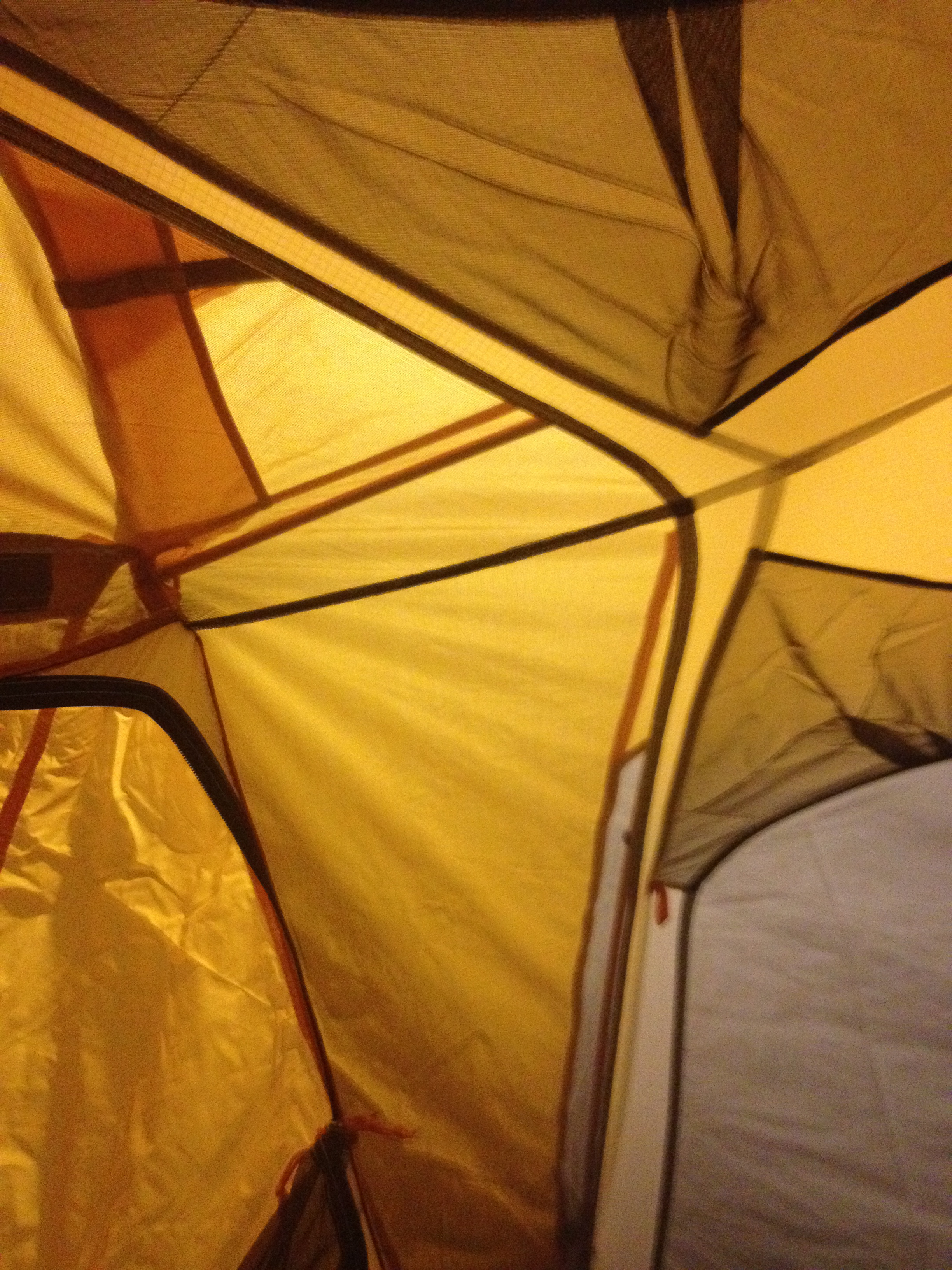
When I got home from my quick weekend in Chicago, I was a bit surprised to see an orange tent set up in our living room. Mike was so excited to tell me all about it: how lightweight it is (3 pounds!), how it’s great for backpacking, how it’s got a rain fly and he’s excited to make oatmeal under it in the mornings if it’s raining. Lots of conversation about the possibilities of rain with this tent – apparently the rain fly can be put up before you build the body of the tent so that in case of inclement weather you don’t risk getting your tent soaked while you mess with the poles and rain fly. I think that’s marvelous.

We had to take the tent down because someone with sharp claws was just as excited as Mike about the new tent. Carlos kept sneaking around the tent, trying to get in through the flap. I’d see a swish of black tail as he got in, only to run out moments later when Mike caught him. Then I’d see the little black face sniffing around the bottom of the tent. Not wanting to have to buy a new tent due to slash-holes caused by my cat son and his nasty habit of relentless investigation, the tent was packed away. However, I did enjoy sitting inside a tent inside my living room. It brought back childhood memories of Mike and I camping in the backyard.

(This is one of my favorite pictures of us ever.)

I so love the fact that I came home to a tent. I so love that my roommate is my brother. I love that we are nearly exact opposites. Mike’s idea of fun is a week spent fishing and hiking and backpacking. That’s my idea of perfect hell. My idea of fun is dancing, or the library, or four hours in a bathtub with books, or drinking wine. I do believe that those may constitute Mike’s perfect hell.

However, give that kid some sports, and you’re all set. I really like going to games with Mike. I always learn something and I always have fun. Above, my first Cubs game ever after I graduated from college.

He’s the athletic one. I mean, he’s 6’4″ and I’m barely 5’8″. He does the heavy lifting; he opens jars; he reaches things on the top shelf. He’s the one that’s good at math (damn good). He does the detail work. He’s focused, calm, patient, way too laid-back for his own good, kindhearted, organized, neat. He’s analytical and observant. He loves his outdoor activities, but my idea of outdoor activities involves drinking in a park. He cooks, too. He’s going to be a great dad and make some lady who can’t cook very happy one day.

I’m the impulsive, energetic one. I’m loud and quite outspoken. I’m the one who thinks about the big picture, who takes care of administrative detail like paying the bills, and who is wound up 99.99% of the time. I am in no way patient or detail oriented, and I’ll never be accused of being organized or neat. And I can’t cook to save my life. (Baby steps, I keep telling myself. Noodles and sauce from a jar is totally food.)

Even though we’re not biological siblings, we’re a matched set. We make a really good team. We balance each other out. I’m impressed by his dedication to his schoolwork, fascinated by his love of strange things like his panini maker, and excited about our mutual enjoyment of tea. He knows how to calm me down when I’m stressed; he’s wise beyond his years.

We get each other. We used to climb the apple tree in the backyard together. We used to throw tennis balls at the house. When we were little, we thought it’d be the best idea ever to take out the hall closet that separated our rooms and create one giant room that was full of everything fun. Or if we couldn’t have one giant room, we wanted a secret tunnel.

During nap time (which sucks when you’re 7 years old), we’d grab Mom’s exercise mat and use it to sled down the stairs. In the summer, we’d have cannonball contests – which I never won. We dug mud holes in the garden, took our bikes and scooters all over the neighborhood, stayed out late and played hide and seek….

When I went off to college, I had a rough time the first night. I’ve never been that good at hiding my emotions, and I’m prone to bouts of hysterical crying. And so, I cried. I cried, and I cried, and I cried. (It was pretty bad.) My mom and brother and uncle and cousin left me all alone in Chicago (which would turn out to be one of the best adventures of my life, so in hindsight, no complaints). No one would have ever known about this if my uncle hadn’t told us – I’m glad he did – but apparently, Mike cried through Illinois on the way back to Denver.

My brother is one of the most amazing people I know. I’m so lucky that he’s mine. (Don’t tell him that – I don’t want it to go to his head.) I am so grateful.


On Getting Dirty

Playing outside was one of my absolute favorite things. At the first hint of warm weather, I’d be out in the backyard, digging up the plants (weeds, mostly)  that were already starting to grow. Warm sunshine on my back and cold, frozen ground at my feet. It was always so disappointing to realize that since it’s Colorado, we weren’t out of snow-season yet.

Even now, on the warm days in March that signal a hint of spring, I run outside barefoot to feel the grass against my toes. I still forget that the ground hasn’t completely thawed, so I’m often left with cold, muddy feet. Happy feet.

Even though we never we able to get our mud pools to hold water (who’d have thought?), they were good for something after all!

By the way, I’m totally letting my kids get dirty. (We’ll see how I feel about that when I’m trying to get all the grass stains out of their clothes and keep the mud out of my house. But for now, it sounds wonderful.)

Why Getting Grimy As A Child Can Make For A Healthier Life

by NANCY SHUTE

04:53 pm

March 23, 2012

Maybe the kids would be healthier if Mom skipped this sometimes.

EnlargeiStockphoto.com [side note: stock photos are sooo creepy, but it must be so fun to try and imagine all of the stock photos that people will need.]
Maybe the kids would be healthier if Mom skipped this sometimes.

We’ve known for a while that people who grow up on farms are less likely to have ailments related to the immune system than people who grow up in cities. Those include asthma, allergies, inflammatory bowel disease and multiple sclerosis.

Exposure to germs as a kid seems to be helpful, while living in an environment that’s squeaky clean seems to pose risks for some illnesses. Still, nobody knew precisely why. But now some scientists say they think they’ve figured out the details of the “hygiene hypothesis.”

They found that microbes in the gut keep a rare part of the immune system reined in. No microbes, and the immune cells go crazy in the lungs and intestines, increasing the risk of asthma and colitis. Add in the microbes, and cells in question, invariant natural killer T cells, retreat.

The discovery was one of those lovely “aha” moments in science. Or as says Richard Blumberg, the chief of gastroenterology at Brigham and Woman’s Hospital in Boston, and co-author of the study says: “We made the serendipitous observation that these cells were dramatically enriched in the lung and colon in mice that lacked any microbes.”

These are mice raised in totally germ-free environments in the lab. What really piqued the scientists’ interest was that the immune response in the super-clean mouse innards looked very similar to what happens in diseases like asthma.

But they were still missing the connection with exposure to bacteria in early childhood. So Blumberg and his colleagues took pregnant germ-free mice and exposed them to microbes the day before they gave birth. The baby mice had fewer iNKT cells in their guts, even after they grew up.

The researchers also found that genetically altered mice without the iNKT cells don’t get colitis, even if they were raised in a germ-free environment.

It’s unclear which microbes help regulate the immune cells, according to Dennis Kasper, director of the Channing Laboratory at Brigham and Women’s, and a co-author of the study, which was published online in Science. Figuring that out is very important, he says. “You can’t just put any piece of dirt into a baby and direct the control of the immune system,” he says.

He thinks there are a very few special molecules in the 500 to 1,000 species in the intestine that control the immune cells, but it’s going to take a lot more work to figure that out.

Of course, this study was done in mice, but it gets at some fundamental questions that would be impossible ask in humans. No germ-free cages for us.

And their findings square with 20 years of epidemiological research showing that exposure to microbes and parasites in childhood reduces the risk of autoimmune disease.

There’s evidence that children who are given antibiotics early in life are more likely to have immune-based problems like asthma and food allergies. There’s even someevidence that women might have more autoimmune diseases than men because they’re kept cleaner than boys as children.

These disorders are more common in developed countries, and in people who move from the developing world into tidier lands.

So parents may someday emulate the germy mouse world, rather than a scrubbed and sterile environment, to ensure the health of their offspring.

Source: NPR