Unknown's avatar

About kb

free spirit, lover of red wine, bacon, sushi, the ocean, and adventure. I work in the legal field, do freelance writing, and take care of children.

On Cupcakes on a Plane

This article reminds me of my own attempt to classify a certain foodstuff as a solid, rather than a gel.

For the record, I totally disagree with the author of this article. Considering the fact that I accidentally got a 20oz bottle of water (filled approximately a third of the way full) through airport security last week, I’d argue that they’ve got more important things to do than catch ladies with cupcakes. You know, things like actually follow the spirit of these regulations rather than the letter and see how that fares for them. Nit-picking about frosting isn’t going to help until we’ve set a precedent. I am going to need signs with pictures showing me that I cannot bring Jell-O, or frosting, or hair gel, or whipped cream, or mousse. I want those juxtaposed right up next to the axes, knives, handguns, and scissors.

(Advice to the lady: open the jar. Lick all frosting. Close jar and continue with your screening process. Eat cupcake sans frosting in future.)

10/2012 @ 3:36PM |2,753 views

Cakes On A Plane: Cupcakegate And You

Photo Courtesy of Consumertraveler.com

By now you’ve heard of the Incident of the Confiscated Cupcake. It seems that one Rebecca Hains, of Peabody, Mass., was returning home from Las Vegas last month, when Transportation Security Administration agents confiscated her cupcake on the grounds of excessive frosting, which the TSA classifies as a gel.

On the one hand, dude, it’s a cupcake! On the other hand, the incident raises questions about both airport security and the American diet.

The diet first. Call me a curmudgeon, but despite the trend sweeping the nation from Boston to Beverly Hills, I firmly believe that a cupcake should never be more frosting than cake. Go back to the old-school cupcake-to-frosting ratio, and I’m convinced that the percentage of obese Americanswould decline from 33.8% to, oh, say, 33.75% (hey, you gotta start somewhere, right?). Plus, too much frosting is just gross. If this requires TSA enforcement, then I’m all for it.

Seriously, though: although regular readers know that I don’t have much sympathy for ham-fisted TSA tactics, this time I come down on the side of the folks in blue.

Turns out that this was no ordinary cupcake. It was in a glass jar. Who the heck carries a cupcake in a glass jar? And TSA rules on glass jars containing gels are clear: no larger than three ounces, packed together with your other gels and liquids in a clear, quart-size plastic bag. Ms. Hains’s cupcake, no matter how darling, violated these rules. If the cupcake needed to be in a jar, she could have put it in her checked luggage. If she needed a dessert in a jar to eat on the plane, how about honey-roasted walnuts?

“When you think about it,” writes TSA blogger and erstwhile security officer Bob Burns, “do you think an explosive would be concealed in an ominous item that would draw attention, or something as simple as a cute cupcake jar?” Makes sense to me. Read the rest of his post here.

Bottom line: if you need to take cakes on a plane, how about just carrying them in the box they came in?

source: Forbes

I don’t know about you, but cupcakes in a jar sound amazing to me.

I have been on a weird kick lately where I’ve been trying to fully embrace the adulthood that’s threatening to overwhelm me (you should see what I bought off of Amazon.com today – six boxes of tea, a novel, and two seriously motivational career woman books….I’m rolling my eyes at myself right now. I have not yet subscribed to Amazon Prime, so some remnants of my youth remain.)

But this means research. I’ve been reading cooking blogs. I’ve been reading design blogs. I’m hoping that in ten years (or, more realistically, thirty to forty), when I can finally afford a house/condo, Future Me have some sense of structure, order, etc. I think this means fashion, so I guess I’d better work on dressing myself before I work on dressing my house. (I realized last night that Kevin hasn’t seen me wearing makeup in days. It might even be weeks. I’ve fallen into a rut, mostly.)

But….cupcakes in a jar remind me of cheesecake in a jar, which is going to be my first project once I get all settled back into my apartment (with Carlos, of course!)

This must happen this weekend. The moving, not the cheesecake making. Baby steps.

Virtual Picnic- Cheesecake in a Jar

by JAMIE on APRIL 22, 2011 

(snagged the pictures and the recipe from My Baking Addictionwhich I am totally addicted to!)

Post image for Virtual Picnic- Cheesecake in a Jar(photos from My Baking Addiction)

Cheesecake in a Jar

YIELD: 4-6 servings depending on size of jars used

INGREDIENTS:

½ cup plus 2 tablespoons granulated sugar
zest of one lemon
2 packages cream cheese, 8 oz each; room temperature
2 large eggs; room temperature
¼ cup heavy cream
1 ½ teaspoons pure vanilla extract

1 cup fresh berries

DIRECTIONS:

1. Preheat oven to 350 degrees F.

2. Begin to boil a large pot of water for the water bath.

3. In the bowl of your stand mixer fitted with your paddle attachment, combine the sugar and lemon zest and mix until the sugar is moistened and fragrant. Add in the cream cheese and cream together until smooth. Add eggs, one at a time, fully incorporating each before adding the next. Make sure to scrape down the bowl in between each egg. Add heavy cream and vanilla and mix until smooth.

4. Pour batter into canning jars until about ¾ of the way full. Place jars into a larger pan and pour boiling water into the larger pan until halfway up the sides of the jars.

5. Bake 25 to 30 minutes, the edges will appear to be set, but the center will still have a little jiggle to it.

6. Carefully remove the cheesecake jars from the water bath and place on a cooling rack to cool completely. Once the cheesecakes are completely cooled, place them into the refrigerator for at least 5 hours. Top will fresh berries and serve.

NOTES:

– For glossy berries, simply add 1 tablespoon of hot water to ¼ cup apricot preserves. Blend until combined and thinned out. Place the berries in a bowl and gently brush and toss the berries with the apricot and water mixture.
– If you are not a fan of lemon, simply omit the zest.
– If you are missing the graham cracker crust, serve with graham sticks.
– The jars pictured above are Weck (7.4 ounce) Tulip Jars.

On Dr. Seuss, excitedly

I love Dr. Seuss. So insightful. So relevant. So beautiful, creative, strange, and wondrous. When I went away to college, I got “Oh, the Places You’ll Go!” as a present. And I loved it. When I’m babysitting, I’m always excited when the kids bring over Dr. Seuss books to read at night. (Although, at about 9 pm, my ability to smoothly read over the rhymes is replaced by lots of yawning and mispronunciation.)

I grabbed this article from a website called “Sources of Insight” that I’d never seen before today.

Lessons Learned from Dr. Seuss

23 FEBRUARY 2010 25 COMMENTS

Lessons Learned from Dr. Seuss

“Kid, you’ll move mountains!  Today is your day! Your mountain is waiting. So…get on your way!” –Dr. Seuss

When I was a kid, Dr. Seuss was a constant source of inspiration for me.  His stories filled my head with endless possibilities.

Between Great Day for Up and The Cat in the Hat, I was pretty much prepared for making the most of any day.  I think his real masterpiece though was Oh! the Places You’ll Go!   This is the book that convinced me I could move mountains and that life is what you make of it.

21 Lessons Learned from Dr. Seuss
There are so many great lessons from Dr. Seuss.  Each of his book is such a treasure trove of ideas and actions for a better life.  What I did here is boil down a set of 21 lessons that highlight his key themes across his works and quotes:

  1. Be a thinker of great things.  Dr. Seuss teaches us, “Oh, the things you can think up if only you try!”
  2. Be careful what you wish for, because you just might get it.  Sometimes you just don’t know what you’ve got until after it’s gone.  In Bartholomew and the Ooblek, King Didd got what he wished for, but the sticky Ooblek goo was worse than the fog, snow, sunshine, and rain that it replaced.  The King quickly wanted his old weather back and he learned to appreciate it.
  3. Be your best you.   In the words of Dr. Seuss, “There is no one alive who is Youer than You.”  Make the most of what you’ve got.   In Yertle the Turtle, we see “feather envy” and it’s a gentle reminder to be careful what you wish for and appreciate what you’ve got.
  4. Bend your world in wonderful ways.  Nobody bends it like the Cat in the Hat.   From the metaphors you use, to the thinks that you think, you can shape your world that’s right in front of you.
  5. Don’t put yourself in a box.  You’re only limited by your own imagination.   The Cat in the Hat teaches us how to let our imaginations run wild.
  6. Don’t waste your time worrying who’s better than who.  In Yertle the Turtle, Dr. Seuss teaches us that “You have better things to do than argue who’s better than who.”
  7. Dream it and do it.  You can move mountains when you put your mind to it.  Direct your life like a blockbuster and make things happen.
  8. Edutainment wins over boring and ho-hum.  With whacky words, wondrous worlds, and fantastical characters, Dr. Seuss taught us the edutainment is how you change a child’s life.  Reading is only boring if you make it so.
  9. Kindle your curiosity.  Keep your mind open and your eyes peeled.  Stay curious and follow your growth.
  10. Life happens in moments at a time.  Don’t miss out on life by tuning out the little things along the way.
  11. Own your fun.   There’s more to do than play in the rain.  When you’re bored, you’re boring.   The Cat in the Hat teaches us to be the maker of our own fun.  Make each day your own special blend of whatever it is that best floats your boat.
  12. Play at your day.  You can play at your day, in every way.
  13. Persistence pays off.  Be relentless in your pursuit of things.  In Green Eggs and Ham, it was through persistence that Sam-I-Am finally got the unnamed character to try the green eggs and ham.  In real life, Dr. Seuss’s first children’s book, And to Think That I Saw It on Mulberry Street, was rejected 27 times before being published by Vanguard Press.
  14. Treat people fairly and squarely.  In The Sneetches and Other Stories, Dr. Seuss shows us that we can’t judge people by their lot in life or whether they have a star on their belly.  In Yertle the Turtle, it’s a reminder not to climb over people on your way to the top, because they’re same people you’ll see on your way back down.
  15. Try it … you just might like it.  In Green Eggs and Ham, when the unnamed character was surprised to find out that he actually likes green eggs and ham once he tried them.  You just never know until you try.
  16. Saying you’re sorry can help make things right.   In Bartholomew and the Oobleck, when the king finally said the magic words, “I’m sorry,” and “it’s all my fault,” he helped make things right again.
  17. See the bright side of things.  It’s a great day for up, when you can see the sunny side of things.  Sure sometimes you’ll have to work at it, but positivity is a skill.  Do it daily.
  18. Setbacks happen.  Deal with them and move on.   Make trouble think twice about messing with you.
  19. Some people are much more unlucky than you.  When you’re down in the dumps and things get real bad, remind yourself that somewhere, somehow, someway … somebody is much “more unlucky than you.”
  20. Success is a journey and we all have our own paths.  Make your journey count.  Don’t let fear stop you.  Don’t let conventional wisdom stop you.  Lead the life you want to live, and when there’s no path, make one.
  21. Your voice counts.  In Horton Hears a Who, Dr. Seuss shows us how one little voice can tip the scale … after all, “A person’s a person, no matter how small.”

Top 10 Dr. Seuss Quotes 
51J I 6 4IL__SL160_Dr. Seuss has so many quotable quotes, from enjoying your day to being more you.  He has such a way with words.  Even when he reminds us of something we already know, he has a way of saying it that makes an old song sound new.  Here is a sprinkling of some of my favorite quotes:

  1. Be who you are and say what you feel because those who mind don’t matter and those who matter don’t mind.
  2. Don’t cry because it’s over. Smile because it happened.
  3. Only you can control your future.
  4. So the writer who breeds more words than he needs, is making a chore for the reader who reads.
  5. The more that you read, the more things you will know. The more that you learn, the more places you’ll go.
  6. Today is gone. Today was fun. Tomorrow is another one.
  7. Today you are You, that is truer than true. There is no one alive who is Youer than You.
  8. Unless someone like you cares a whole awful lot, nothing is going to get better. It’s not.
  9. You have brains in your head. You have feet in your shoes. You can steer yourself, any direction you choose.
  10. You know you’re in love when you can’t fall asleep because reality is finally better than your dreams.

It’s inspirational gold.  There is nobody youer than you, and the more that you learn the more places you’ll go.  Bravo.

Dr. Seuss Quotes
51fcyIF5j0L__SL160_If you’re not familiar with Dr. Seuss’s quotes, then you’re in for a treat.  It’s easy to read his words, and he’s a master of saying a lot with so little.

A nice simple way to leverage his quotes is to pick one or two of your favorites.  Sometimes the right quote is just what we need to hear and it can be the perfect catalyst that we need in our life.  Enjoy!

Aloneness

  • All alone! Whether you like it or not, alone is something you’ll be quite a lot.
  • I’m afraid sometimes you’ll play lonely games too, games you can’t win because you’ll play against you.
  • You can get help from teachers, but you are going to have to learn a lot by yourself, sitting alone in a room.

Be Yourself

  • If you’d never been born, then you might be an Isn’t! An Isn’t has no fun at all. No, he disn’t.
  • You are you. Now, isn’t that pleasant?
  • You’re in pretty good shape for the shape you are in.

Everybody Deserves a Shot

  • A person’s a person, no matter how small.
  • I know, up on top you are seeing great sights, but down here at the bottom we, too, should have rights.

Fun

  • Fantasy is a necessary ingredient in living, It’s a way of looking at life through the wrong end of a telescope. Which is what I do, And that enables you to laugh at life’s realities.
  • From there to here, and here to there, funny things are everywhere.
  • I like nonsense, it wakes up the brain cells.
  • If you never did you should. These things are fun and fun is good.
  • It is fun to have fun, but you have to know how.
  • We are all a little weird and life’s a little weird, and when we find someone whose weirdness is compatible with ours, we join up with them and fall in mutual weirdness and call it love.

General

  • Be awesome! Be a book nut!
  • Christmas doesn’t come from a store, maybe Christmas perhaps means a little bit more …
  • I do not like green eggs and ham I do not like them Sam I am.
  • I meant what I said, and I said what I meant. Because an elephant’s faithful, 100 percent.
  • I’m glad we had the times together just to laugh and sing a song, seems like we just got started and then before you know it, the times we had together were gone.
  • Oh, the things you can find if you don’t stay behind!
  • Sometimes the questions are complicated and the answers are simple.
  • So be sure when you step, Step with care and great tact. And remember that life’s A Great Balancing Act.
  • They say I’m old-fashioned, and live in the past, but sometimes I think progress progresses too fast!
  • Words and pictures are yin and yang. Married, they produce a progeny more interesting than either parent.

Life Happens

  • I’m sorry to say so but, sadly it’s true that bang-ups and hang-ups can happen to you.
  • Things may happen and often do to people as brainy and footsy as you.

Make Things Happen

  • I have heard there are troubles of more than one kind. Some come from ahead and some come from behind. But I’ve bought a big bat. I’m all ready you see. Now my troubles are going to have troubles with me!
  • There’s no limit to how much you’ll know, depending how far beyond zebra you go.
  • Today is your day! Your mountain is waiting. So… get on your way.
  • Unless someone like you cares a whole awful lot, nothing is going to get better. It’s not.

Positivity

  • And will you succeed? Yes indeed, yes indeed! Ninety-eight and three-quarters percent guaranteed!
  • If you keep your eyes open enough, oh the stuff you will learn. Oh the most wonderful stuff.
  • It’s opener, out there, in the wide, open air.
  • Just tell yourself, Duckie, you’re really quite lucky.
  • You’ll miss the best things if you keep your eyes shut.

Thinking

  • Think and wonder, wonder and think.
  • Think left and think right and think low and think high. Oh, the things you can think up if only you try!

On Chicago, belatedly

Lately, my life has been one of those hectic, crowded places. Sometimes, I worry that there’s not enough room for me.

Last night, after work, I cancelled plans to meet a friend and took a long bath instead (apparently, it’s possible to literally steam the cover off of a Vogue magazine). Carlos has been very much not in the mood to love me lately, so I’ve decided that we both need a change of scenery and will be relocating back to my apartment this weekend. That was supposed to happen last night, but instead, I laid on the couch and did absolutely nothing. It was wonderful.

Tonight is a lot of rearranging. I haven’t had my car since I left for Chicago; it’s been languishing in Mom’s driveway. I need to get that back, obviously. Kevin is going up to the mountains this weekend, so he’ll need his car and I very much miss driving Simon, who feels so much less like a Mack truck than Kevin’s SUV. I need to get myself ready for the weekend. Sadly, I wish I had exciting plans to report, but instead, I’m babysitting nearly every moment that I’m awake. 3 families. 4 “shifts”. 3 days.

I’m always excited to babysit. I never view it as work, really, but it does tend to take up quite a bit of time. I’m going to put the money toward my New York trip next weekend, which I am absolutely thrilled about.

Anyway, I feel like I never get to properly describe my Chicago visits. I get too busy with everything else and reminiscing about the trip falls by the wayside. Chicago was wonderful. It was a perfect weekend. I saw a lot of people (of course, I didn’t get to see everyone I wanted to see, bummer), and had a blast.

I ended up helping with a music video shoot on Sunday, so that was exciting. I got to stand on the rocks in one of my favorite places in Chicago (no, not the Bean, the Peace Garden!) and dance around awkwardly while wearing a wig and some rather scandalous clothing. It helped that the weather was beautiful that day.

Between the shoot and the airport, I stopped at Swisher’s.  There’s nothing like saying hello to a friend’s parents while your makeup looks like you’re going clubbing at 3 in the afternoon. Thank goodness for makeup removal wipes – those things are amazing. Carry them everywhere when you travel. Just have them on you at all times. They’re all-purpose cloths sent from Heaven.

Saturday, I went to Wisconsin with Anne. We went to see the Mars Cheese Castle, which used to be this amazing, kitschy place but is now just a touristy castle – they seriously redid it to be a castle, but they do have $1.50 meat sticks, so you know I was happy. I also got some white cheese with cranberry in it, a 6-pack of Spotted Cow from my favorite Wisconsin brewery, and some chocolate. (I’m attempting to recreate the experience I had with the Fairview cheese from South Africa and can’t do it. The white with the apricots was some of the most amazing cheese I’ve ever tasted. I can’t get close.)

After we were done at the Cheese Castle, we were like, well, we drove all the way out to Wisconsin, we should probably drive some more. So we googled. Anne found http://www.custardlist.com, a website which lists the daily custard flavors around the state. Seeing that some place called Oscar’s had m&m and cookie dough, we were off toward Milwaukee. Yes, it was better than Kopp’s (although Kopp’s makes some darn good custard), and I got two scoops for less than $2.50.

Saturday night, I went to play with Patrick and Maddie, who had a hotel room downtown. (Maddie’s explanation of why they couldn’t stay at his apartment is one of the funnier things I’ve heard lately.) Anne’s apartment has a problem with hot water, so I was relieved to find that the Embassy Suites was fully stocked with towels and all the hot water I could want. (I did want, so badly.) Swisher met us for happy hour and then we went out to a bar nearby. I was exhausted, so we ended up back at the hotel with snacks and wine. It was the perfect night. I was sad because my friend Adrian was having his annual “Fried, Fried, Fried” party – it’s exactly what it sounds like – and I was looking forward to eating all the things. However, I would never make it up to the North side. Instead, I fell asleep on the couch at the hotel.

Being back in Chicago was like suddenly realizing that you lost something. I have lost my memory of the street names (not all of them, but finding myself staring at the Chicago theater on State street and wondering which way to walk was a disconcerting feeling); I have lost the flow of the trains, my balance as they stop. I felt my hand reaching out to clutch the pole in a panic as we slid into one of the stations. Being back was like going home. Swisher took me to the train, took me down Lake Shore Drive. I used to drive that every single day. This time, all I could do was stare around. The park. The lake. The river. The buildings. There’s something wonderful about the way the city looms above you, around you. It sinks into you, a little. You’ll never be able to take that bit of Chicago away.

I remember being in love when I was 19. I remember the way that I threw myself into it; the way that logistics stopped being paramount; that no distance was too far, no amount of separation too much. I want to love the way I loved when I was 19. It was pure. It was admittedly one of the most imperfect relationships you could imagine, but it was so real, and it was all-encompassing, and it was beautiful. When did I lose the ability to throw caution to the wind and jump in?

On Chicago, belatedly

I have a giant project wrapping up at 5pm today, so until then, you’re going to have to wonder why I found myself in Chicago wearing a wig and a ton of makeup on Sunday afternoon.

You’re also going to be curious about custardlist.com (yeah, it exists and it’s awesome).

On Single Moms

Kevin’s working late, so I’m stuck on the couch, trying to stay awake until he gets home. (hint: it’s not going to happen. I’m going to be dead to the world when he gets in. this week has been so exhausting!) I’ve been trying to get a chance to sit down and write a proper blog entry, but I just don’t think it’s going to happen until I’m at the airport on Friday. So hopefully you’ll get something good in time for the weekend. Unless, of course, you don’t.

Regardless, I came across this article tonight. I was at the bodega near my house the other night when I heard a reporter on the news talking about the rise in single motherhood (particularly for women who have had “some college” but don’t have degrees). I didn’t get a chance to finish listening, and haven’t even thought about looking it up since, so I was pleased to stumble upon it.

I don’t know that I necessarily like the conclusions that the author draws in the article – that this rise in single motherhood is a good thing based on a number of factors, but I do like that he points out:

“But what women of all social classes share is what one friend of mine, a single mom, calls the “if/then” attitude towards marriage. As she puts it, “If I meet the right guy, then I’d like to get married. But if I don’t meet the right guy, then that’s okay too. I’m not going to get married out of desperation.”…That insistence on doing marriage right –- or not doing it all –- transcends class.”

I’ve been spending a lot of time lately wondering about this marriage business. I, for some odd reason, still hold marriage as an eventuality, a pre-determined part of my life. I expect that I’ll be married, but I definitely agree that I’d much rather remain single forever than settling for the wrong dude. (My rant about marriage can wait for another day…) It’s curious to watch how the average age of first marriage seems to be constantly increasing (as a result of many factors, of course), yet so many people get married right out of college. I get that you might have found “the one”, but I’m also inclined to believe that those behaviors are more socially driven than they are romantic.

But what scares me more than the thought that I might have married whoever I was dating at 21 is the fact that we’re glorifying this rise in out-of-wedlock births. Granted, I dig that freedom. I also dig that I’m not constantly pressured about how I’m not married yet. Women who want to have babies but don’t have a husband are having babies every day. But they’re educated; they’re employed; they’re stable (say whatever you want, but those things do help. a lot). Working multiple jobs and relying on family members to watch your child does not sound like the kind of thing that leads to fulfillment without undue stress. It sounds like we’re perpetuating all of the downfalls of the “decline of the family” that the conservatives are so worried about. I wouldn’t mind being a single mother (some day far into the future), but I certainly wouldn’t embrace that at this point in my life. I’m in no way economically stable enough to want to be responsible for a kid.

I also think that they’ve focused in on the masculinity aspect of this, yet they’ve simultaneously entirely ignored men and their involvement in all of this out of wedlock birthing. (Even though the author brings the lack of men up in the article, I don’t think he could have adequately addressed the male component in the space allowed.) They’re also looking in the wrong places. They’re not looking at why these women are more likely to give birth out of wedlock than their more educated peers. They’re not looking at the economic impact that these pregnancies are having on the mothers, or the long-term effects. To be honest, they’re completely ignoring a lot of really terrible things in order to praise the fact that women aren’t willing to settle.

That’s great. No one wants to settle. But I think we’re letting men off the hook here by talking about how these women are strong enough to do this on their own, and the example given of one woman whose boyfriend couldn’t even buy his own cigarettes is really disgusting. Like you’d date something like that? And even worse, let it impregnate you and then just leave it to bear no financial or emotional responsibility as you raise a child because the guy you were dating wasn’t responsible enough? Bullshit.

I worry that we still don’t have enough support systems in place. We need to be sure that these women are going to be able to get jobs that will keep both them and their children healthy, educated, employed, cared for. We may not have marriage as an institution anymore, but we might need to really get behind the “it takes a village” mentality, especially as we start to embrace and adapt to our modern relationships and communities.

I’m not entirely sure that was the most coherent argument I’ve ever made. But then again, it’s late. Whatever.

Point of the whole thing? It’s not the sanctity of the family structure that I’m worried about. Single parents do a damn good job every single day. Parenting isn’t about how poor you are, how educated you are, etc. But I don’t know that this rise in births to single mothers who have some college is a positive thing, especially not based on the reasoning below:

The Increase in Single Moms Is Actually a Good Thing

BY HUGO SCHWYZER

FEB 22, 2012 5:40 PM

For the first time in American history, more than half of new mothers under the age of 30 are unmarried. The news has led to stark warnings from social conservatives about the supposedly disastrous consequences of illegitimacy –- and to renewed discussion about whether marriage remains relevant today. In the rush to pass judgment on these unwed mothers, one question is almost never asked: how many of these young single moms would actually like to be married?

Writing in the Times on Saturday, Jason DeParle and Sabrina Tavernise focused heavily on the harm to children that this new trend portends. The women they interview are exhausted, often leaving their children in the care of relatives while they go off to work multiple jobs. The article cites experts who lament single motherhood, warning that children born outside of wedlock face greater social and economic obstacles than their peers born into traditional nuclear families. Bizarrely, DeParle and Tavernise don’t even bother interviewing any fathers, an odd journalistic decision given the subject of the story. The implication of that deliberate oversight is that we already know all we need to know about why these guys won’t marry the mothers of their children. That not only shortchanges the men, it allows an even more dangerous assumption to linger: that if only these absent dads were just a little bit more physically and emotionally available, the single moms would marry them in a heartbeat. Uh-huh.

Like many of the articles that touch on contemporary American manhood, the Times piece can’t decide where the blame for male fecklessness lies. DeParle and Tavernise trot out the usual culprits: the much-oversold “mancession” (“men are worth less than they used to be”, the article laments) and the tendency, familiar to fans of Judd Apatow movies, for American men of all social classes to turn puberty into a quarter-century project. The Times interviews Amber Strader, a 27 year-old single mom, whose “boyfriend was so dependent that she had to buy his cigarettes. Marrying him never entered her mind. ‘It was like living with another kid,’ she said.”

So how much of this growing phenomenon of single motherhood is about male unreliability, and how much is about changing social mores that make marriage less relevant? I spoke with the noted sociologist of masculinity, Michael Kimmel, who said that the rising percentage of unwed moms was “over-interpreted.” Kimmel notes that in Scandinavia (where there is no equivalent to the American narrative of male haplessness) the majority of mothers in all social classes are unmarried. “They don’t need to get married because they have adequate health coverage, education, and retirement benefits.” The answer to the manufactured problem of “illegitimacy” is, says Kimmel, “better access to birth control and abortion.” Michael Kaufman, (who co-authored The Guy’s Guide to Feminism with Kimmel) concurs that this isn’t about masculinity at all, but about “the moral panic that is the conservative heart of the anti-sex agenda.”

Kimmel makes the important distinction between single mothers needing to get married andwanting to be wed “someday.” That qualification is often missing from these discussions, but it’s at the heart of Promises I Can Keep: Why Poor Women Put Motherhood Before Marriage. Poverty isn’t the primary problem, authors Kathyrn Edin and Maria Kefalas say, noting that “now there are few differences between the poor and the affluent in attitudes and values towards marriage.” However inadequate the American social safety net is compared to the Scandinavian model, it’s sufficient (barely) to ensure that very few women feel compelled to get married for economic reasons.

Single moms, write Edin and Kefalas, see motherhood as a “promise they can keep.” They are certain of their capacity to love a child. They are more cautious about committing to marry the fathers of their children (or other men), not only because of their keen awareness of divorce statistics but because they don’t see any reason to settle for less than a truly excellent relationship. Seen in that light, the rise in unwed motherhood and the declining marriage rate are cause for rejoicing. Despite Lori Gottlieb’s famous plea, fewer women than ever are willing to settle for merely “good enough.” It’s not that men are less economically viable than they were in the past — it’s that even poor women want more from a marriage than a lifetime union with a good provider. Rising rates of illegitimacy, in other words, may signify that more and more women can afford to be choosy. That’s a good thing.

A woman with a bachelor’s or higher degree is statistically far more likely to wait until after marriage to have her first child; the rise in unwed motherhood is driven primarily by women who haven’t finished college. But what women of all social classes share is what one friend of mine, a single mom, calls the “if/then” attitude towards marriage. As she puts it, “If I meet the right guy, then I’d like to get married. But if I don’t meet the right guy, then that’s okay too. I’m not going to get married out of desperation.” That jives with what Edin and Kefalas heard from many of the women they interviewed. That insistence on doing marriage right –- or not doing it all –- transcends class.

There’s another “if/then” dynamic at play in this debate over single motherhood. As the authors of Promises I Can Keep write, if — and it’s a huge “if” — society wants to encourage more women to get hitched before having children, “then the only course for those who want to promote marriage is to try improving the quality of male partners in the pool.”

Men don’t need to be “improved” because they’ve gotten demonstrably worse; rather, the standards for what makes a man marriage material have grown exponentially higher, even in the eyes of young moms struggling to stay above the poverty line. In that light, rising rates of single motherhood reflect undeniable progress for women.

On Drug Addiction

Drug addiction is serious business.

It starts out at a party. It’s just once. You’re not going to become one of those people….but then you do. Life is a very fragile thing, and the slide into addiction is steeper than most people think. It starts out so innocently, and suddenly, you’re lying and stealing and cheating (my three big no-no’s for living a beautiful life) your way to your next fix, chasing the high that will fix everything, for now. Battling an addiction is a lifelong commitment, and it’s sad to realize that losing just one battle could be the last battle you ever fight.

This issue is close to my heart. I know several people who are either struggling with an addiction of their own or who are struggling to cope with the addictions of their family members or friends. Even those not so far removed from the situation are deeply affected.

We as Americans don’t do enough to highlight drug addiction as an epidemic. It’s not just drug addiction, though. Homelessness, mental health, education…they’re all connected. I argue that so much of addictions, regardless of whether it’s pills, alcohol, whatever, are caused by the attempts of the addict to fill voids, to self-medicate. There’s not nearly enough mental health help out there – there’s still a stigma attached to all things mental-health-related. There isn’t easy access to treatment facilities and counseling.

We need to have better systems in place to help catch these people before they fall…we need to stop being such voyeurs and start getting real – addiction isn’t nearly so fascinating in real life as it is in the movies. It’s not glamorous, nor is it hopeful. It’s dirty and disgusting and sad. It tears apart families. It hurts parents. It leaves children alone. Addiction is a quiet killer, and it’s one that we have the power to try to stop.

from the Huffington Post: 


Whitney Houston and the Media Celebrity Death Watch

Posted: 02/22/2012 9:54 am

Every few months, the death of a celebrity sparks a new media maelstrom about drugs. But more concerned with spectacle than substance, much of the press ignores the real issues behind America’s deadliest epidemic, as well as its last famous victims.

Just minutes after Whitney Houston was found dead in a bathtub at the Beverly Hilton last Saturday at the age of 48, a caravan of network trucks began slowly encircling the plush hotel, morbidly eager to document her untimely demise. Since then, it’s been nearly impossible to turn on the TV or log on to the Web without witnessing a tribute to the singer, often including depressing video footage of her long, painful decline. Her memorial on Saturday had the pomp and pageantry of a state event — complete with dignitaries, crying onlookers and flags at half-mast.

But while speakers talked movingly about her battles, mention of the word ‘addiction’ was curiously scrubbed from the event.

It’s no surprise that the singer’s death has struck such a chord in the country. Incredibly talented, beautiful and ambitious, Whitney Houston was a rare kind of legend who changed the face of American pop music. In her later life she also became an addict whose cruel struggle with the disease unfolded in full public view. That she lay dying for hours in a luxe bathroom suite while her bodyguards cooled their heels outside is a sad commentary on the state of modern celebrity. That it took less than 10 minutes for the press to begin broadcasting her death is an even more searing indictment of contemporary media culture.

Houston, of course, is not the only celebrity whose problems have received rapt press attention. Last month it was Demi Moore. The week before that it was Disney’s Demi Lavato. Meanwhile, the weekly travails of Charlie Sheen and Lindsay Lohan have been breathless fodder for fleets of paparazzi. And for over a year before her death last year, fans of Amy Winehouse received daily updates of her ups and downs. One British tabloid even went so far as to embed a pack of paparazzi at her favorite pubs.

As someone who has suffered through my own experiences with through alcoholism, I’ve found myself growing increasingly frustrated by the failure of my colleagues to get beyond the superficial details of addiction. Indeed, much of the mainstream media has been lazy — even downright derelict — when it comes to covering what has become the nation’s most deadly health crisis.

As a longtime editor at several magazines over the past two decades, I’ve admittedly been an active participant in this game — keenly aware that for ordinary readers grappling with the mundanities of daily life, stars offer a few rare moments of transcendence. But their intoxicating effect on the American public also gives them outsized power to shape public perception. In the 1980s, Rock Hudson and Magic Johnson forced the media to finally pay attention to AIDS only after it had already killed an army of Americans. Michael J. Fox’s battle with Parkinson’s helped bring invaluable attention and funding to the disease, while prompting a debate on stem cell research that promises to have profound effects on the treatment of other illnesses.

But substantive stories about alcoholism and drug addiction remain largely outside the media purview — focused on the tribulations of A and C-list celebrities, they’re often ghettoized in gossip sites and channels like VH1. For all the daily hand wringing about celebrity overdoses and DUIs, there is precious little real reporting on the growing scientific understanding of the disease, the tragic lack of access to treatment or insurance coverage, or even the growing number of promising drugs that have begun to make real progress against this condition.

For a long time, I regarded this kind of journalism as business as usual. But my own perspective began to change as I was forced to confront the fact of my own addiction. For most of my early thirties I fancied myself a young version of the late Christopher Hitchens, a literary legend rarely spotted without a drink who once bragged that he couldn’t write without a hangover. Alas, I soon learned that I possessed neither his talent nor his hardy constitution. As a result, I spent two years in a series of rehabs and sober living facilities, witnessing firsthand the ravenous toll taken by addiction and the abject failure of our medical and political system.

My first roommate was a 23-year-old violinist from Iowa who had cycled through five detoxes and five rehabs in just 11 months. At the same rehab, I befriended an ad executive whose proclivity for Absolut eventually landed her in a homeless shelter. I met an investment banker whose weekend crystal meth binges led to a lifelong HIV infection. At one sober living facility I played poker with a rum-loving Catholic priest who led one of the largest congregations in Nigeria. I met countless others who maintain publicly productive lives while suffering though their own private hell. You can be certain that none of them will ever show up on CNN. But neither will the pernicious behavior of the insurance companies and Big Pharma, who have often illegally profited off the scourge while accumulating blockbuster profits.

As someone whose seen the effects of alcoholism close-up, I’ve grown increasingly frustrated by the failure of my colleagues to get beyond the superficial details of addiction, or to empathize with the lives of people who aren’t regulars on Perez or Page Six. Much of the mainstream media has been lazy — even downright derelict — when it comes to addressing the nation’s most pressing health crisis.

When I ask my journalist friends about their failure to take on the larger issues behind these stories, they usually reply that reporting on struggling stars is a teachable moment for many Americans. But that’s not much of an answer. It’s not really breaking news that drugs can be harmful and sometimes deadly. The real questions are: What can we do about it? And how exactly did we get here?

Ultimately, the torrent of coverage of the Whitneys and Winehouses of the world is little more than a distraction, a game of mirrors that deflects attention from millions of farmers, bankers and college kids who are also suffering and dying of drug-related causes at a record rate. It’s easier not to have to confront the reality of our drug-slammed towns, or jails full of untreated addicts, or high-school kids who swallow up to 50 Oxys a day. Entire regions of middle America have been decimated by poverty and crystal meth. America’s seemingly ravenous appetite for drugs raises questions that demand deeper explanations.

The fact is, while most major causes of preventable death in the U.S. are in decline, drugs — especially pharmaceutical drugs — remain a dramatic exception. A 2010 national survey by the Department of Health and Human Services found that over 22 million Americans suffer from alcohol or drug dependency. Drug overdose rates have more than tripled since 1999, claiming a life every 14 minutes. In fact, it’s hard to imagine a single person in the whole country who hasn’t been directly or indirectly affected. Rehabs and sober livings around the country have become a vast $20 billion business, many of them operating under woefully inadequate oversight. Many Americans under the age of 30 have become hooked on opiate painkillers like OxyContin and Vicodin, buying them on the street for prices as high as $80 a pill. According to the Centers for Disease Control and Prevention, the abuse of these painkillers was responsible for close to half a million emergency room visits in 2009, a number that has nearly doubled in just the past five years.

Our nation’s seemingly ravenous appetite for drugs also raises problematic questions about the larger culture the media has helped create. Why is it that a nation that enjoys one of the highest standards of living in the world also suffers one of the highest rates of drug abuse? Why are so many of us driven to substances to obliterate reality? What does this continuing scourge say about the values and morals that underlie our society?

Given the expensive impact of drugs and alcohol on our medical and prison system and addiction’s massive impact on workplace productivity, the continued lack of serious discourse on the issue remains surprising. Certainly it’s not just reporters who are to blame. Though the Obama administration recently doled out extra funding for drug prevention programs, it still spends several billion more on a drug war than seems as unwinnable as Vietnam. To its credit, starting in 2014, Obama’s historic new health plan will mandate insurers for the first time ever to treat addicts the way they treat victims of other diseases, putting an end to decades in which desperately ill addicts were denied life-and-death treatment.

For their part, however, the Republicans have been uncharacteristically more restrained on the subject. Not long ago they could dismiss the drug epidemic as symptoms of urban permissiveness and decaying inner-city neighborhoods. But as drugs intrude deeper and deeper into the leafy middle class suburbs and the wide-open ranges of America’s heartland, the law and order types at the GOP have become tongue-tied. During the season’s endless series of GOP debates, not a single candidate was quizzed about their policies on drugs or treatment. While Ron Paul has been an articulate advocate of drug legalization, Mitt Romney and Rick Santorum’s websites devote not a word to their drug policies, even though Bain Capital, once run by Mitt Romney, is one of the leading owners of the nation’s 20,000 rehabs and sober living facilities. Newt Gingrich, a one-time pot smoker who has lately taken to extolling the virtues of AA’s Big Book, has maintained a hardline anti-drug stance, even though he’s backed down on his former pledge to put drug dealers to death. Last year, in Florida, newly-elected Tea Party Gov. Rick Scott mounted a crazy and ultimately doomed campaign against an effort to regulate the state’s pill mills, which produce the vast majority of the country’s illegal prescription painkillers. Not to be outdone, the Tallahassee Republicans recently voted for a bill that would dramatically slash funding for drug prevention in a state that has one of the highest percentages of drug abusers in the country.

In short, there’s no lack of important, compelling stories out there that could benefit from a little media attention. And while some enterprising reporters and bloggers have risen to the challenge, they’re the exception rather than the rule. What’s responsible for their continued reluctance? The continuing stigma around addiction undoubtedly has something to do with it. Even though decades of research proves addiction is a condition with complicated genetic and chemical roots, far too many journalists continue to see it as a sort of moral weakness. Their failure to actively report on the issue represents both a lack of initiative and funding. After all, covering Whitney’s last moments is a lot easier (and less expensive) than going up against the wrath of formidable lawyers and lobbyists employed by corrupt pharmaceutical behemoths. It’s also a lot more comfortable than venturing into the ravaged small towns of Iowa and Montana to witness first-hand the devastation wrought by poverty and crystal meth.

The senseless death of one of America’s most outsized talents is undoubtedly a cause for mourning. But tragic as her death may be, Houston is just another person lost to an epidemic that has also killed thousands more in just the path month. It would be a fitting coda to her impressive legacy if her death ended up provide a genuine ‘teaching moment’ for America: one that would encourage the media and public to look beyond the scandals and personalities to the complicated causes and consequences of this miserable disease. But that’s probably wishful thinking. More likely, in a couple of weeks the hysterical pundits and satellite trucks will roll on to the scene of the next tragedy. As Truman Capote famously noted, “The dogs bark and the caravan moves on.” Meanwhile the 22 million people affected by this disease will stay exactly where they are.

On Putting Holes in Your Body

I’d so much rather my kids go crazy with piercings than with tattoos. You can totally take piercings out, regardless of scarring, but a tattoo is forever. (Not that I’m anti-tattoos – obviously, I couldn’t be, I have two – but I think that your taste in body art at sixteen is going to be much different than your taste at forty.)

I’m going to encourage my kids to get piercings when they’re determined to express themselves via the mutilation of their perfectly wonderful skin. I’ll protest, of course, and agonize a little over coffee with my girlfriends, but in the end, I’ll have to meet them halfway. And then I’ll go with them to make sure they don’t go to some sketchy piercing parlor, or worse, let their friends do it for them.

I remember the incident when I pierced my belly button with only a safety pin. If I was in an interview and they asked me what accomplishment I was  most proud of, I’d honestly have to bite my tongue before that one slipped out. I’m serious. I know it’s incredibly gross, immature, all of the bad things, but it literally took me hours to do it and I still look back and think, damn, that’s determination. Idiotic, absolutely, but it was a great show of perseverance. (This is also a prime example of the infections, etc. that they discuss in this article. Again, another reason why I’m going to go with my kids. I’ll take pictures, just to embarrass them. I’m learning from my own mistakes – or perhaps anticipating the moves of my as-yet-unborn-and-therefore-not-yet-rebelling children.)

But are kids really getting so many piercings these days? I would argue that the trend died out quite a while ago, just after the emo scene came crashing down. But maybe I’m just old. Or a square. Either or.

Ah, well…

From NPR

When Body Piercings Go Bad

by NANCY SHUTE

12:37 pm

February 21, 2012

Will it look as good with a scar?

EnlargeiStockphoto.comWill it look as good with a scar?

Thinking about getting a body piercing? Who hasn’t, right?

Well, one thing to consider is that about 20 percent of the time there are complications from the procedure, such as infection or scarring, a fresh review of the medical literature finds.

Piercings of the bellybutton and upper ear are especially prone to problems.

“I think piercing can be quite dangerous, actually,” says Anne Laumann, a professor of dermatology at Northwestern University’s Feinberg School of Medicine, who was a co-author of the review. “I would not encourage it in a teenager.”

Indeed, a 20 percent complication rate with a medical procedure would make many patients think twice.

But given the popularity of piercing, that’s a message that might not keep a young person from putting metal to flesh. So Laumann hopes that people contemplating piercings will become educated enough on the health issues that they can avoid the most common problems.

Prevention is paramount. And enemy No. 1 is infection. “You’ve got an open wound,” Laumann told Shots. “You’ve got germs on your skin, like we all do. That’s where the problem comes.”

Most piercing-related infections are local and get better with time, the analysis found. Still, it’s important to make sure that the person doing the piercing uses sterile equipment and cleans the piercing site, Laumann says. Then it’s up to the piercee to keep the site clean.

Bellybutton piercings can take a year to heal, according to the analysis, which was published in the American Journal of Clinical Dermatology. Maybe that’s why bellybutton piercings are particularly prone to infection. “Is it terrible? It’s not terrible,” Laumann asks. “Is it comfortable? It’s not comfortable.”

The study recommends that during that healing period, owners of navel piercing refrain from sit-ups, and cover the area during exercise or intimate relations to reduce risk.

She’s also down on piercing the upper ear, because it’s easy for the cartilage there to get infected. That can lead to necrosis, or death, of the cartilage, and collapse of the upper ear. Piercing the earlobe doesn’t cause those problems, Laumann says, because there’s no cartilage involved.

OK, what else should you know about? Scarring, for one. Some people form large, disfiguring keloid scars after piercing. (The nasty lump on the earlobe in this slide showof problems is a piercing-caused keloid.) Permanent hole marks or bumps are more typical.

Then there’s the fact that piercing jewelry needs to be removed before medical procedures, playing contact sports, and other activities. Removing the jewelry frequently for those reasons, or to hide it from bosses or relatives, can slow healing and increase infection risk. When it comes to nipple piercings, the study reports dryly, “The recommendation is to remove jewelry before breastfeeding.”

Despite her warnings, Laumann is philosophical about the fact that the fad for piercing shows no sign of abating. And her paper suggests that body piercers take a careful history of their customers to identify factors, such as some allergies, that may predispose someone to have complications.

And she does see some positive applications. Right now she’s working on using tongue piercing jewelry to help quadriplegics drive wheelchairs and computer cursors.

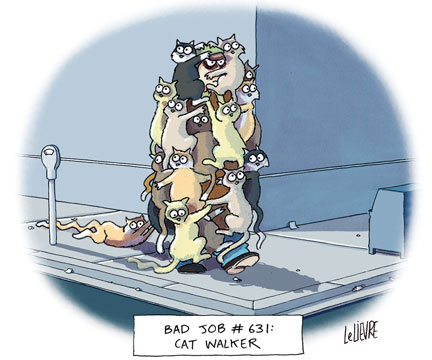
On the Chase

This is for Mom, mostly.

But I know the rest of you hate cats too, so enjoy!

Kevin and I worked from home the day of the blizzard a few weeks ago, which was absolutely wonderful. However, we (I) made the mistake of letting Carlos out to wander about in the snow. My thinking? What if he gets lost some day? He’ll need to know how to get home.

As it turns out, Carlos knows how to get home. But he also knows how to escape. Ever since that day, whenever you open the door to Kevin’s apartment – which inconveniently for me, opens directly to the outside world at ground level – Carlos is waiting. He doesn’t even wait for the door to open more than 6 inches. He’s ready to run. Which he does frequently. If I’m lucky, he’ll wait for me to start chasing him. Otherwise, he’s just going to go until you get ahead of him and make him go back. Then he slinks along the brick wall, looking for an alternate escape route. If he doesn’t find one, he’ll run back inside.

I wish I had more of a scaredy cat and less of a panther.

Ah, well, there’s always next time. [joke – I’m never getting another cat. After this, I’m moving on to dogs. They run in the park with you instead of run to the park away from you.]

from Reader’s Digest [yeah, I really am 80]:

On Gay, from a parent’s perspective

When Your 7-Year-Old Son Announces, ‘I’m Gay’

Posted: 02/16/2012 1:04 pm

Considering that my son has a longstanding crush onGlee‘s Blaine and regularly refers to him as “my boyfriend,” I thought there was a fair chance that he would someday say, “I’m gay.” But my kid is only 7 years old. I figured I had a few years before we crossed that threshold (if we ever did), probably when he was 14 or 15. I never thought it would happen this soon.

Six months ago “gay” wasn’t even a word in my son’s vocabulary. He has always known that some of our male friends are married to men and some of our female friends to women, and it is such a normal part of his life that he never needed a special word to describe them. When he did notice the word and asked what it meant, I told him that when boys want to marry boys and girls want to marry girls, we call that “gay.” He didn’t seem very interested and quickly went off to do something else more exciting than a vocabulary lesson with his mom.

Fast-forward a few months. I was on the phone with a relative who had just discovered that I wasblogging on The Huffington Post and openly discussing my son’s crush on Blaine. I was in another room alone (I thought), explaining, “We’re not saying he’s straight, and we’re not saying he’s gay. We’re saying we love who he is,” when my son’s voice piped up behind me.

“Yes, I am,” he said.

“Am what, baby?” I asked.

“Gay. I’m gay.”

My world paused for a moment, and I saw the “geez, Mom, didn’t you know that already?” look on my son’s face.

I got off the phone and leaned down to eye level with him and rubbed my nose against his. “I love you so much.”

“I know,” he said, and ran off to play with his brothers.

Since that day, any time the word “gay” has come into conversation, he has happily announced to those around him, “I’m gay!” He says this very naturally and happily, the same way he announces other things that he likes about himself. Mention that a person is tall and he’ll quickly add, “I’m tall!” If he hears the word “Legos,” barely a second passes before he says, “Legos. I love Legos.” Saying “I’m gay” is his way of telling people: this is something I like about myself.

It’s amazing, but it’s also shocking. How many people have a 7-year-old come out to them? A lot of people don’t know how to react, and I don’t blame them. Before my son, I’d never met a child who came out this young — and we don’t know anyone else who has. The mere idea of children having a sexual orientation makes people uncomfortable. It’s something we don’t think about (or just don’t like to).

But here’s the thing: straight children have nothing to announce. Straight is the assumption. No one bats an eye at a little girl with a Justin Bieber poster in her bedroom, or when little girls love playing wedding with little boys every chance they get. If our sexual orientation is simply part of who we are, why wouldn’t it be there in our elementary years?

I’ve heard from countless adults who say they knew that they were gay as young as kindergarten but lacked the language to talk about it. And in most cases, they knew it was something wrong that they should hide. Because gay people are part of my son’s everyday life, he has the vocabulary, and it has never occurred to him there is anything wrong with it.

On one occasion after an “I’m gay” announcement, I watched my husband reach out to ruffle our son’s hair. “I know, buddy,” my husband said to him. “And you’re awesome, too.” That’s how we’re handling it. We want him to know we hear him, and that he’s wonderful. It feels like the right thing to do, and that’s all we have to go by. We don’t have any other examples.

We did take a few extra steps. Within a few days we had a quick talk with him about how some people don’t like it when people are gay, explaining that those people are wrong. If he hears anyone says anything about being gay like it is something bad, he is to run and get us immediately. We had a brief conversation with his teachers: Our son is identifying as gay. We don’t think there’s anything wrong with that or with him. And this is the only acceptable opinion on the subject. All his teachers, while surprised, were on board. We learned that he hasn’t used that word at school yet, so we’ll cross that bridge when the time comes.

I don’t think it will always be easy. We don’t know what to expect. At this point we aren’t looking for trouble, but at the same time we’re preparing for it. We know we have a journey ahead of us, just like everyone does. And this is one part of the story of our son and our family.

Do I think this is the last word on his orientation? I don’t know. He’s 7. Maybe as he gets older he’ll tell me something else, but it’s just as likely that he won’t. But really, that doesn’t even matter. What matters is right now. And right now I have a young son who happily announces “I’m gay.” And I’m so proud to be his mom.

from the Huffington Post