On Marriage, Trepidatiously

The man I once thought I was going to marry got married last weekend. By all accounts, it was a beautiful wedding. (This is one of those thank-goodness-for-facebook moments. Some of my friends are still friends with him, so I got to see pictures. Pssh. You wouldn’t be a little curious?)

When we met in 2007, it was instantaneous. The beginning of summer crept over Chicago and I fell in love. When I saw him before I moved back to Chicago, the feelings came flooding back.

When I moved back to Chicago, I was naive enough to think that it’d be easy for us to be together. It wasn’t.

There was a big fight, the fallout, and then the gradual rebuilding of what would be one of the greatest loves of my life.

I was patient (not a state of mind I’m entirely used to). I played it cool (again, not something I’m familiar with). I was awesome (of course).

Our tentative embrace of the potential relationship resumed. I knew it was officially unofficial when, after a party at their new place, I fell asleep in his bed. Just as I was drifting off, I overheard someone asking about me, and clear as day, I heard his response, “Katie? She’s my main squeeze.” I fell asleep smiling.

The next summer, he drove with me out to Colorado. I remember driving into Rocky Mountain National Park with him, thinking that I wished I could bottle the happiness that I felt. It was the swell that you fill in your core when you’re so full of beautiful emotions. It was everything I knew would never last.

Rocky Mountain National Park

(ahh! and there’s Simon on the right. That’s one love that will never die.)

As the summer faded to a close, things began to crack. There was the gradual frustration that I felt with everything. There was the future. We began to talk about the future, and I stopped seeing us and started seeing my parents (hint: not a good thing). We fought. We broke up. The anguish was drawn-out, peppered with those moments of hope that all would be salvaged. It ended badly.

I am thrilled for them as they begin their lives together as husband and wife. But I am so relieved. I don’t even feel bad saying that: I am so relieved. About a lot, but mostly the fact that I am not married.

I want to be married someday very badly, but I am very much willing to wait until it’s a thousand percent right. (Even if that means I end up 45, single, and find myself “accidentally” adopting cats from shelters and taking them home to keep me company while I drink Malbec and wait for my pineapple curry to be delivered from the Thai place.)

But damn, this world can be a very lonely place. Even when you’re not alone. But even so, the thought of getting married as a means of ensuring companionship is terrifying.

In the very immortal words of Outkast, “Forever never seems that long until you’re grown.”

On the Supreme Court and Socialism, Quite Happily

I heard the news about the Supreme Court’s ruling on health care in the car on the way to work this morning. I am thrilled. We are one step closer to joining the ranks of the countries that have affordable health care. Now, if only we could get rid of that pesky “for profit” part…

The cries of socialism are ringing, though. On my way into my office building, a co-worker told me that one of the guys who eats breakfast was ranting about how we’re turning into a nation of socialists.

Hardly.

But it got me thinking about people, specifically. Our democratic model is supposed to allow for involvement by all citizens. Of course, the better educated and motivated the citizens are, the better the democracy, which in theory will work in the best interests of its people.

There was a man standing on the corner on my way to work. He caught my eye because his Hawaiian shirt did not match his checkered shorts. He was holding a sign that said, “Honest work for honest pay.” It also listed his phone number.

There’s another man, wearing some sort of identification badge (as a way to legitimize his request) who stands on the corner where I turn onto the main thoroughfare as I leave work. He’s there every day, even in the hot sun, and his sign says that he’s an Army veteran and a father of four, willing to work.

When I was a child, the signs read, “Anything helps,” or “I’m not going to lie, I need a beer,” and while I don’t mean to make light of the homeless epidemic that has been a problem for longer than I’ve been alive, which is entirely related to our own lack of mental health care -particularly for our veterans – and other necessary services, I find the fact that the signs’ messages have changed to be an indicator of a far deeper problem.

Who are we as a society to put profit before people? Have we forgotten about the “general welfare“?

When a baby is born, it is a helpless individual in need of constant attention. While most of these babies grow up to be adults, the paths that they take (both willfully and unwillingly) are greatly divergent from their shared beginnings as infants in need of clean diapers, a warm bed, and food.

Somewhere along the way, some of these people seem to have forgotten that our fragile existence is dependent upon reliance on others. Reliance on others sounds like hippie nonsense, but it’s not. Every individual possesses unique strengths that serve as an asset to the communities in which they live. A community that is able to utilize these assets in the best manner possible has far greater strength and is a far more vibrant place to be.

People are quick to make assumptions when they see someone standing on a street corner holding a sign that begs for work. I urge you to imagine how you would come to that decision. It’s not a dignified action, the begging, and people know that. They have weighed their options and come up with nothing, and so, standing on the corner with a sign is their last attempt.

Say what you will about people who receive assistance from the government (and in doing so, I urge you to consider the bailouts of banks and large corporations as something similar, just for perspective), but at the core of everything lies the concept of humanity. If we desire to create a society driven by the pursuit of sustainability and progress, we must remember that each and every citizen matters, regardless of their ability to accumulate wealth or their social standing.

In our rush to actualize the American dream, we started valuing white collar jobs, and in doing so, began to devalue labor. Human labor is a necessary force for sustained growth and the success of a nation. People want to work. They want to feel as though their work matters.

Business can be successful when people matter, but the desire to drive the profit margin ever higher must cease. I work for a company that proves that human is more important than anything else. We have been providing software for decades (longer than I’ve been alive), and have maintained and grown the business without sacrificing the integrity of the people who work here. My boss always says, “We are not what we do,” and he lives by that. He once had to get up in the middle of a very important demonstration of our product to go attend to his family, and he did so without hesitation. I respect that.We work together, as a community. We share ideas, inspirations, and celebrate the good news. We are a support network during times of grief and sadness. This is a unique kind of company, and I’m glad I work here.

I’m arguing for or against socialism, but I’m arguing that as a country, we’ve begun to neglect of the most important facets of our society: our people.

The United States is no longer the greatest nation in the world. What we lack in education, human services (including health care), and global respect, we make up for in incarceration rates, defense spending, and bravado. In order to keep ourselves relevant on the world stage, we must learn to compromise between the corporation and the individual. We are a government “by the people, for the people,” and it’s time that we started remembering that.


On the Verge, Intently

This week has been one of those painful weeks where growth and realization have come quickly, but at a price. The week broke right into a bubble that was threatening to make me seriously happy, or at the very least content. It’s good to be reminded that these bouts of confidence and satisfaction are merely semi-permanent. Keeps me on my toes.

“Your social life has gone downhill. You’re lower on my totem pole,” he said over dinner. And inside, I ached.

“We’re enigmas,” she tells me, and I know she’s right. “Most 24 year olds aren’t as concerned about jobs and careers and futures.” (Arguably, I’m over-concerned.)

I bear a bit of resentment towards my peers who seem to be so carefree (careless?) with their time, their motivation, their agendas.

I got upset with him today. The realizations came swiftly and unbidden, settling around my heart like ice. I fear I’ve made a huge mistake. I grew upset and let it spill out today, a fury that had been brewing for four days. I questioned his motivations and tried to gently remind him that if what he’s doing now is overwhelming, then the real world is going to be a shock. There are no breaks. It wasn’t fun, and at the end of it, I don’t feel any better.

“They don’t ever change.” She told me this nearly a year ago, as I stood annoyed in the kitchen at work. And again, I hear her words echoing through my head. I wanted so badly to believe that those nine months gave him time to grow. I let myself believe and now, I’m trapped in something that might not be right, fearing that I could be sabotaging it myself or that I could be absolutely correct.

I’m trying to remind myself that the artificial idea of “success” isn’t important. But then I see her, struggling to feed her family because her lousy husband won’t work. The fear returns. Motivation. Work ethic. Drive. Those things matter. For me, it’s not so much money or status as it is the ability to continually plod along with a set of goals in mind.

As I grow into the person I will become, I am reminded often that nothing is certain. I am reminded that everything you know is not enough. Respect might not be enough, but it’s certainly incredibly important.

I’m working on my patience, too.

To quote the poignant words of a fictional twenty-something, “Your dreams are not what you thought they’d be.”

Baby steps.

On Gender and Ambition, dejectedly

(I still have backlogs of articles I’d like to address, so hopefully I can start posting and writing my critiques, comments, etc. soon!)

Madeline sent me this link last week and I thought I’d share the article with you.

Before you read it, know this: I’m a huge believer in the idea that there can be successful co-parenting, or successful relationships, or marriages full of good sex (or all of those things combined with monetary comfort!).

While I don’t think I’d last too long as a stay-at-home mom, I also don’t imagine my future to be full of trying to work 60 hour weeks and then awesome parenting while my husband just hangs out.

Note to readers: this is all coming from my childhood. My extreme paranoia about terrible husbands stems from my past experiences. My mom worked her ass off trying to support us all financially (and put my brother and I through private schools) while my dad didn’t take on the additional burden of stay-at-home dad (including, but not limited to: laundry, cooking, dishes, cleaning, childcare, etc.) even though it would have been well within his means and skill set and would have drastically improved the parental-contribution-to-the-family-via-work balance that did not exist.

Admittedly, my memories have been lost to my own subconscious erasure as well as the emotional tints that seem to color our own recollections of the past. Therefore, I can claim no exact memory validity yet still claim personal memory legitimacy. Whatever. You try to recollect and see for yourself how difficult it can be.

Regardless, as a young, twenty-something woman, I do feel pressure. Tons of pressure. Some of it is self-inflicted and some of it stems from a whole host of other influences. That pressure to succeed drives my work ethic, my independence, my stubborn sense of self, and my panic about the future. (Always panic, that’d be my motto.)

I always read the comments, too. Sometimes they’re far more enlightening than the content of the article itself. Since this one only has three, it wasn’t difficult to get through them. Here’s the lengthiest (is that a word?) one:

BRYANROBB
I expected more from you, Good. This is terribly one sided reporting, and borderline misandristic to the likes of Jezebel. No wonder men don’t want to marry, every which way we turn we’re getting boxed and blamed. Did you ever stop to consider that the older men who make more than their women counterparts are the last vestiges of a bygone era? Soon they will retire, and as the women age through the system it is very likely that these young women will make more than their male counterparts. Also, give me the kids over cut throat corporate America any day. The two earner model is the cause of our failures as decent parents, all so we can afford more stuff? I don’t care who works and who doesn’t, but someone needs to be home with the kids in the formative years. And sure, I’m definitely for subsidizing child care. For single MOMs and DADs. Too bad almost all low income entitlements go to girls and men are exempt. Stop waging war on men for Pete’s sake.

I don’t disagree that this article is very one-sided. But then again, there’s not enough space in the world to give equal time to discuss women’s ambitions while simultaneously deconstructing the reasons that men may feel maligned by the media and neglected about the social pressures they face.

This article isn’t about men.

The only time that the author (whose posts I generally adore, by the way) could REALLY use some more statistical reference is when she says,

And while women are consumed with the problems of “work-life balance”—trying to maintain a successful career while raising a family—men seldom feel as much pressure or face as much doubt about their ability to “do it all.”

I don’t know that she’s entirely correct in making that assumption. I’d argue that men are feeling the pressure to “do it all” but instead of being accepted, they’re facing the same social stigmas that have kept gendered activities as segregated as a 7th grade school dance for so many generations.
Regardless of our new stances on equality and whatnot, we are failing to accept that there are differences. In our quest for equalization, we’ve neglected so much about individuality, about personality, about biology, and in doing so, we’ve created a situation that’s arguably far worse than before.
Take the emergence of “stay at home dads,” for instance. Advertising for household items is always geared toward women. Stay at home dads aren’t given the same amount of respect. It’s emasculating, I’m sure, to know that people don’t value what you do. But then again, welcome to the flip side of things.
For me, a household has many factors for success. You need cash flow to buy supplies, necessities, etc. But you also need to address the rest of it: chores, bills, laundry, parenting, cooking, shopping, maintenance, etc. Those two elements (the cash flow and the “rest of it”) need to be in harmony in order for a household to maintain successful balance. Communication is key. More than that, all parties need to recognize the importance of contributions made for the common good of the household.
Honestly, the thing that scares me most about this article is the bad sex after marriage, not to mention the extra weight, less money and more stress. But then again, it’s up to those women (obligatory heterosexual bias of the media comment here) to stand up to their husbands and tell them what’s up. I won’t stand for more housework, more stress, and less sex. And he’ll know that before he marries me. If that’s a deal breaker, I will have chosen the wrong man.

Why Are Young Women More Ambitious? They Have to Be


The headline of a new study by the Pew Research Center claims to have discovered “A Gender Reversal On Career Aspirations.” But upon closer inspection, the study appears to imply that young women are more ambitious than men their age across the board. Sixty-six percent of 18 to 34-year-old women rate their career high on their list of life priorities, compared with 59 percent of young men. This figure hasn’t really “reversed,” but it has shifted markedly in the past 15 years—in 1997, only 56 percent of young women felt the same way, compared to 58 percent of men.

Today’s young women aren’t planning to make any sacrifices on the home front, either—they’re prioritizing their personal lives, too. The amount of young women who say that having a successful marriage is one of the most important things in their lives has risen nine percentage points since 1997, from 28 to 37 percent. For young men, that stat is trending in the opposite direction—from 35 percent in 1997 to 29 percent now. More young women than men care about being a good parent—59 percent, compared to 47 percent of their male counterparts. It looks like young women are more likely to be thinking consciously about their priorities, period. Do dudes just not give thought to their futures at all?

Perhaps guys aren’t mulling their life priorities because they trust that marriage, parenthood and career usually work out better for them in the longrun. They’re right about that. When women begin their careers, they earn virtually the same as their male peers (95 cents to every dude dollar), but as they near their early thirties, the pay gap widens—women have kids, take maternity leave, and stall their careers for a few years, or else they get passed over for promotions and yearly raises. By the time a women nears retirement age, she earns around 75 cents for every dollar a man her age earns.

Although marriage is lower on young men’s list of priorities, they’ll fare better when they eventually tie the knot. Numerous studies show that married men are happier, live longer, make more money, and experience less stress, while married women are rewarded with more housework, less money, worse sex and a few extra pounds. And while women are consumed with the problems of “work-life balance”—trying to maintain a successful career while raising a family—men seldom feel as much pressure or face as much doubt about their ability to “do it all.” Women still end up performing the majority of the parenting, regardless of their jobs, and despite public platitudes revering the work of motherhood, the lack of universal childcare and inadequate (or nonexistent) parental-leave policies set women up to fail.

No amount of girl power—or denial—can obscure these deep-set gender dynamics. Women are acutely aware of the need to be especially ambitious in order to succeed—the same extra ambition any marginalized group needs to climb the career ladder and crack glass ceilings. It’s the reason more women are getting college degrees, and the reason why many women try more intently to find a mate at a younger age (although that’s changing). The sexual economy, as well as the professional one, are simply skewed in men’s favor, especially as the years go on. Why wouldn’t they be more relaxed about their life choices?

Photo by (cc) Flickr user gcoldironjr2003.

article source: GOOD

On Simon, on the occasion of 80,000

I drove the long way home yesterday, and to my immense satisfaction, pulled up to my apartment building just as he had hit 80,000 miles.

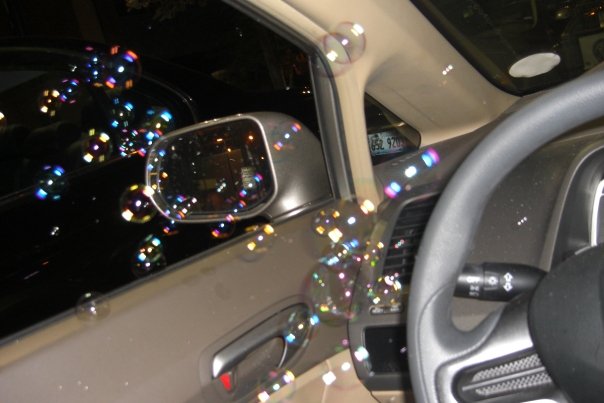
(I have no idea why it looks like it’s raining in my car.)

At six years old, he’s all grown up. I’ve had him for nearly 50,000 wonderful miles. We go everywhere together, and I imagine that I will keep him until he dies, or until I have kids, or something else gets in my way.

And of course, on this most excellent occasion, Simon found himself in the shop, having an oil change and some transmission issues. A few months ago (six months? nine? I think it was summer but who knows), I was driving down Colorado Blvd when my car freaked out. Now, I’m not one who has any experience in dealing with car problems, so my car jerking and shuddering and jumping all over the place while the D light was blinking was positively terrifying.

I called the Honda dealership. Of course, I should have anticipated their response: “That normally doesn’t happen in a Civic. We normally see that in Odysseys and Pilots.” Alas, they informed that it was a pressure switch in my transmission and that I need to bring my car in. “Can I drive on it for a bit?” I asked. They told me that I could, but I’d probably get terrible gas mileage.

Here we are so many months later. The D light stopped blinking and the never did the shuddering jumping jerking business again, so I never brought it in. But it’s been worrying the back of my brain, as transmission issues do. The gas mileage has remained pretty steady, so no complaints here.

I took the car into my mechanic, who’s basically the best mechanic ever. He calls me to tell me that he doesn’t really feel any loss of power when he drives. I cut in about the D light. “The D light was blinking!? No one told me about that! I’ll call you back!” The phone went dead. He called me back about a half an hour later to tell me that yes, it is a transmission pressure switch error code but it’s also another error code.

But then he tells me not to worry, because it’s not bad enough to deal with. (I love this guy. He’ll let you know what’s urgent and what’s not.) I still need to be super vigilant about my transmission, because at the first sign of trouble, I’m going to need to replace something about the solenoids and the pressure switch, or worse, the whole damn thing.

I’ve got his blessing to keep driving on it and he’s going to give me the name of his transmission people. So, Simon and I shall keep adventuring until it’s time to do some serious surgery. At that point, if it’s the $400 repair, I won’t hesitate, but if it’s the entire transmission, we’ll have to do some serious thinking about whether or not it’s worth it. But for now, I’m still just as excited about him as I was the day that I got him.

I bought Simon when I was 20. It was February 4, 2008 (yeah, I guess that’s weird, but it’s a date I’ll never forget). When I turned the car on for the first time, the odometer read 33,111. I knew right then that I had to have him. (That, and the fact that I spent as much time as I could in my Grandma Mary’s car when I was a kid because she had a digital speedometer. I thought her car was the best ever. And yet, somehow, I’d managed to get a digital speedometer of my own! Luckiest girl ever, I swear.)

Simon at night, with bubbles. Illinois. 2009?

Simon, at dusk. Illinois, Halloween, 2010.

(side note: Old Dave may have been right about the sex appeal [or lack thereof] of Birkenstocks.)

In the four years that I’ve had him, he’s been crushed, crunched, cracked, and spray painted. He’s hit bugs, curbs, rocks, potholes. He’s driven and driven and driven. And I have loved every single minute of it.

Simon in Wisconsin, barely. Winter/Spring 2010.

Simon reflecting in Rocky Mountain National Park, June 2009.

Oh and the best part?

80,000 miles divided by 6 years is 13,333.33 miles per year, on average. It’s just one of those things that was meant to be.

From the New York Times, On Nannies

I’m going to blog to you about this article later, but I’ve got piles and piles of work to do before that can happen.

At least you’ll be prepared!

From the New York Times (link follows story):

IT’S THE ECONOMY

The Best Nanny Money Can Buy

Illustrations by Jillian Tamaki
By ADAM DAVIDSON
Published: March 20, 2012

It took Zenaide Muneton 20 seconds to convince me that she was the perfect nanny. Short and dark-haired, she has a goofy, beaming smile and knows how to make everything fun for a little kid. Time to brush your teeth? She shakes her hands and does a pantomimed teeth-brushing dance. Bath time? She pumps her arms up and down in a going-to-the-tub march. After I told her I’d love to hire her, she smiled and thanked me.

Then we both laughed, because there is no way I could possibly afford her. As one of New York City’s elite nannies, Muneton commanded around $180,000 a year — plus a Christmas bonus and a $3,000-a-month apartment on Central Park West. I should be her nanny.

I began researching this bizarre microeconomy shortly after my wife and I started looking for someone to watch our son for a few hours a week. We met with several candidates, all of whom had good references and seemed fine with him. Still, we weren’t sure how to judge them. Should we hire the one who seemed to be the most fun? The most experienced? A native English speaker or someone who could speak a foreign language to him? Someone with a college degree? A master’s?

We had no idea. But I began to wonder if price conveyed any important information about the nanny market. All the candidates we spoke with charged about $15 to $18 per hour, which, though standard in our Brooklyn neighborhood, seemed like a bargain when I learned that some nannies charge considerably more than double that rate. Would my son suffer with a midmarket nanny?

This fear led me to the Pavillion Agency, which specializes in finding domestic workers for New York City’s wealthy. Pavillion introduced me to Muneton, 49, who grew up in “a very poor family” in São Paulo. In 1990, she befriended a young American woman who had relocated to Brazil. When Muneton invited her to her family’s home, the woman saw her natural ease with children and suggested that she move to America and become a nanny. Within a few months, Muneton was caring for the children of a rich family in South Carolina for only $100 a week.

When Muneton started working through Pavillion in 2002, however, she increased her salary to $85,000 a year. As she gathered sterling recommendations, she began increasing her pay. Eventually she worked for some of the country’s wealthiest people, whom she accompanied on private jets to many of the world’s most exclusive resorts. Today, she says, “there are no more poor people in my family.” Muneton bought a nice house for her mother, a condo for her sister and a taxi cab each for two of her brothers. She also owns a beach house in Brazil, a penthouse in Miami and two properties (a six-unit building and a duplex) in Los Angeles.

How does a nanny earn more than the average pediatrician? The simple answer is hard work — plus a strange seller’s market that follows a couple of quirky economic principles. A typical high-priced nanny effectively signs her (and they are almost always women) life over to the family she works for. According to Cliff Greenhouse, Pavillion’s president, that kind of commitment is essentially built into the price. Many clients are paying for the privilege of not having to worry about their child’s care, which means never worrying if their nanny has plans. Which, of course, she can’t, pretty much ever.

And, alas, it seems that there just aren’t enough “good” nannies, always on call, to go around. Especially since a wealthy family’s demands can be pretty specific. According to Pavillion’s vice president, Seth Norman Greenberg, a nanny increases her market value if she speaks fluent French (or, increasingly, Mandarin); can cook a four-course meal (and, occasionally, macrobiotic dishes); and ride, wash and groom a horse. Greenberg has also known families to prize nannies who can steer a 32-foot boat, help manage an art collection or, in one case, drive a Zamboni to clean a private ice rink.

And then there’s social climbing. “A lot of families, especially new money, are really concerned about their children getting close to other very affluent children,” Greenhouse says. “How do they do that? They find a superstar nanny who already has lots of contacts, lots of other nanny friends who work with other high profile families.” There are the intangibles too. “I’m working with a phenomenal Caribbean nanny right now,” Greenhouse says. “She is drop-dead beautiful. Her presentation is such that you’re proud to have her by your children’s side at the most high-profile events.”

My wife and I don’t care about any of that stuff. But it’s hard not to wonder if the nannies who make twice as much an hour as the ones we’re considering are also twice as good. Nannies can be evaluated in the same way as what economists call “experience goods” — like wine, whose value can only be determined after experiencing it. When it comes to experience goods, price can be useful to reject anything below a certain minimum. After all, a $3 bottle of wine or a $5-an-hour nanny are pretty sketchy.

But price is useless — or worse, misleading — in differentiating among the adequate. I’ve often assumed that a $40 bottle of wine is twice as good as a $20 bottle even though the American Association of Wine Economists has essentially proved that the price of wine has almost no bearing on enjoyment. When nonconnoisseurs buy an expensive bottle, they’re acting like new parents hiring a nanny: they’re basically paying for a false sense of assurance. Or hoping to impress somebody.

Actually, nanny prices might be even more misleading than the wine market. They also bear resemblance to “credence goods,” an economic term for something — whether a jar of vitamins or an auto tuneup — whose true value can never quite be determined. You’re more likely to overpay for a credence good in the hope that a higher cost increases the likelihood of a benefit.

So if economics can’t fairly convey the price of a nanny, what does? Jeanne Brooks-Gunn, a director at Columbia University’s National Center for Children and Families, reassured me that academics know, roughly, nothing about how nannies impact children. There has not been any sort of serious study on nanny quality, she says, because it would be nearly impossible to get permission from nannies (often paid under the table) or their employers. Also, most child-development research is dedicated to at-risk children, and the kids of people with the resources to hire nannies don’t typically qualify.

Brooks-Gunn did, however, have some advice for what can make a good nanny. The single-most important characteristic is the extent to which a nanny is responsive to the child’s mood and interests. Brooks-Gunn said that when she chose a nanny, she simply handed her son to every candidate she interviewed and chose the one who responded most sensitively.

After our talk, I spoke with one of her graduate students, Erin Bumgarner, who moonlights as a part-time nanny for around $17 an hour — the same amount that Park Slope parents pay to immigrant nannies with no college education. I couldn’t think of any other field in which people with such disparate educational backgrounds could make the same amount. But Bumgarner told me it makes sense. She is willing to work for only parents she likes — she already quit one well-paying job for this reason — and who allow her to focus on her school work. The value of that is also built into the price. Even if it costs her a Central Park West apartment.


source: The New York Times 

On Upward Mobility, at 23.

[this is a really pathetic post. If you’re not in the mood for serious self-pity, please don’t read any further…]

It has been a rough few days. Right now, I feel like the part of me that feels anything but that strange apathetic misery has disappeared.
I’ve been prone to bouts of tears. They come at random times.
Last night, Kevin brought home Chinese food (I’d been camping out on his couch, feeling sorry for myself and watching Mission Impossible) and I cried. So that was awkward. For a man who has no idea how to deal with the waves of feminine emotions, it might have been too much to handle.
“Is there something you’re not telling me?” he asked.
Well. About that.

But let’s rewind.
5pm Friday.
I was seriously excited to see Katie, who was in town for the weekend. We were going to meet up, grab drinks, and meet up with her/our friend Mark after he got off work.
I’m driving home. 6th and Colorado (I always get held up at the light.) One of my Gmail accounts dings. Mail. I open it.
UCD rejects me swiftly, before the light changes.
I catch my breath. Humiliation sinks in. Shame.
I had considered many scenarios. Many. None of them included being rejected. Flippantly, I’d been saying that if I didn’t get into grad school, I’d have no idea what to do with my life. But those statements were made with the underlying assumption that I’d get in.
What?!?!? The email said that while they couldn’t tell me why, blah blah blah, something about recommendation letters. I may have ignored one of their requirements that I have two letters of recommendation from former professors. I had one. It was a beautiful letter, but I neglected to get the second, and instead used a family that I babysit for.
Idiotic move, in hindsight.
But regardless of my disregard for the stated process, I am still not good enough for UCD. So, wow.
Of course, I handled it incredibly maturely and proceeded to get absolutely, ridiculously drunk. Classy, I know. Sloppy. And to make matters so much worse, I wore heels.
Now, if you’ll remember the incident in Chicago in mid-2010…the one where upon being denied entry to a club due to my status as a “liability”, I told the bouncer that I wasn’t drunk, I just had double-jointed ankles that prevented me from walking straight. (I actually do have double-jointed ankles, for the record. Should probably stay away from heels any time my BAC is above .08.) It was basically like that.

I’m now a walking failure. Just completely lost. Doomed to pull a tiny salary for the rest of my life. I’m so upset. I can’t even tell you the last time I felt this lack of optimism. (Actually, I can. The last time this happened, I got a cat. So about two years ago. But don’t worry, I have enough cats [one is always enough cats] and I don’t have the cash for anything wild.)

I know that life is a funny place.
I get that.
But watching everyone else around me find contentment and success professionally, personally, romantically, academically…it’s all just too much.

I’m just in a position in my life where nothing is going right. When Heidi Klum and Seal announced their divorce last week, I was uncharacteristically shaken. If they can’t do it, who can? My own relationship is shaky, at best. It’s not meeting my needs, and it’s frustrating. I so badly want it to work. I don’t think he’s willing to meet me halfway. I don’t think he quite understands what I need and I’m not sure how to tell him. My job is fine. I love my company, I really do. But it’s hard to see a future where I still only pull $1800 month after taxes. It’s hard to make a life like that. I want to own a home. My future is uncertain. I hate that uncertainty. That’s the worst part.

And don’t start with the “but you’re young” bullshit. I’m almost 24. I get that I’m young. But when you were 24, did that seem so young? No. It’s that precarious time where the shedding of our adolescent predilections is finalized and our adulthood settles in. I was out with a friend and he started in with the “you’re young” business. Well, I’m not young enough that you can’t take me home with you, so don’t patronize me. I can and will play ball on your level. You just need to realize that your level is the same as everybody else’s.

I get that I’m foolish and full of thoughts. But I don’t think that those stem from my youth. I think that some of us are eternally doomed to steep in our emotions, in our thoughts, in our heads. There are plenty of people at all ages who are just as lost as I am right now. And there are plenty of people at all ages who will never have the qualities that I have. At my core, I am a beautiful person. I know that I’m fiercely intelligent. I’m open to new experiences; I’m polite (situationally, of course); I’m beautiful; I’m funny; I’m kind-hearted; I’m sarcastic; I’m an excellent maker of French toast; yes, I’m hyper-aware of my emotions – it’s the greatest gift and ultimate worst curse. I’m constantly growing and changing, becoming more and more the person that I want to be. But at my core, I’ll always be a little wild. And I like that.

I’ve been making a list of things that I can be instead of a therapist, because the door just got slammed hard on that one. But I won’t list them here, because they’re basically the primetime lineup for A&E and History channel: logger, pawn shop owner, swamp person, etc. (I’m way too much of a girl to be a swamp person, just for the record. And I refuse to eat squirrel.)

And please don’t think that I’m not grateful. I may be wallowing (I need a few days to really embrace the depths of the sadness before I can kick my way out), but I’m still aware of the blessings in my life. Sort of. Mostly. Maybe.

"I was born a poor black child"

Sometimes I’m grateful that my attention span is equivalent to that of a golden retriever. It leads me places I never expected to go. Today, I was reading about legal issues involving lawyers accessing sensitive information from their iPads, smartphones, etc and I got sidetracked, thus stumbling on this gem of an opinion piece from Gene Marks in Forbes.

Marks spends two pages talking about how he’s a lucky white man in his mid-40s, reaping the benefits of his white privilege, and then he decides to posit that black kids from the inner cities are going to be fine if they just learn how to read, and learn how to write code, and somehow stumble on the right answers and the right direction. 
He gets points for freely admitting that it’s circumstance that places kids on such separate paths from birth – the circumstances of color and economic standing. But he fails so hard at realizing that what he’s trying to get across – this idea of the self-made man, the epitome of the American Dream – is just that, a pipe dream. 
He starts out just fine here:

The President’s speech got me thinking.  My kids are no smarter than similar kids their age from the inner city.  My kids have it much easier than their counterparts from West Philadelphia.  The world is not fair to those kids mainly because they had the misfortune of being born two miles away into a more difficult part of the world and with a skin color that makes realizing the opportunities that the President spoke about that much harder.  This is a fact.  In 2011.
I am not a poor black kid.  I am a middle aged white guy who comes from a middle class white background.  So life was easier for me.  But that doesn’t mean that the prospects are impossible for those kids from the inner city.  It doesn’t mean that there are no opportunities for them.   Or that the 1% control the world and the rest of us have to fight over the scraps left behind.  I don’t believe that.  I believe that everyone in this country has a chance to succeed.  Still.  In 2011.  Even a poor black kid in West Philadelphia.

But that’s also where he starts to go wrong. Sort of. I’m not wowed by the fact that of course it’s the poor black kids in these inner-city neighborhoods – I realize that to make his point he has to give an example that’s stereotypical enough to make sense to a wide variety of readers, but then again, he’s just reinforcing the lack of expectations that we have for our black citizens. He’s unintentionally setting “poor black kids” up for failure based solely on their color. This annoys me – there are a ton of white kids who come from wealthy neighborhoods who somehow manage to never make anything of themselves, just as there are a ton of kids of all colors who do the same. Just like there are a ton of motivated, successful, intelligent people who come from diverse backgrounds. 
But his article ends without ever really exploring the real obstacles to success.  Marks completely ignores entire segments of life that can’t be forgotten when trying to figure out why inner-city kids are so screwed. 

President Obama was right in his speech last week.  The division between rich and poor is a national problem.  But the biggest challenge we face isn’t inequality.   It’s ignorance.  So many kids from West Philadelphia don’t even know these opportunities exist for them.  Many come from single-parent families whose mom or dad (or in many cases their grand mom) is working two jobs to survive and are just (understandably) too plain tired to do anything else in the few short hours they’re home.  Many have teachers who are overburdened and too stressed to find the time to help every kid that needs it.  Many of these kids don’t have the brains to figure this out themselves – like my kids.  Except that my kids are just lucky enough to have parents and a well-funded school system around to push them in the right direction.
Technology can help these kids.  But only if the kids want to be helped.  Yes, there is much inequality.  But the opportunity is still there in this country for those that are smart enough to go for it.

Marks touches on the sociological impact that the neighborhoods these kids are growing up in has on them, but he doesn’t explore it, and that’s where I find the most fault with this article. He’s looking at his “poor black kid” self without realizing that there’s a lot more to it than desire. There’s a lot more to it than drive, than ignorance. I mean, yeah, not knowing what’s out there can really hurt you. But Skype-ing with other students in your school who want to succeed just like you do is a dumb suggestion.

That’s never going to fly. Why is that? Because of the expectations of masculinity that we place on our boys. We’ve been hearing all about how black men are falling behind black women as black women become more and more educated; we hear about the decline of the black family, caused by the decline in marriage. We put this on the black women, some of whom don’t want to marry a black man based on the fact that she’s out-earning him and that she’s far more successful. We have completely forgotten about our black men. We don’t want them to be super nerdy, we don’t want them to be thugs, we don’t value them if they don’t conform to the white elite’s expectations of what a black man should be.

But all of that starts at a much younger age. These black kids – who grow up to be black men – are receiving mixed messages. They’re watching the glorification of gangsters in pop music, in pop culture, in movies and tv shows. They’re watching their friends and relatives go to prison (the odds are that 1 in 5 that a black man will go to prison at some point in his life). But more than that is the fact that to fit in and thrive in this social environment – the entirely socially constructed idea of “black”, they must mirror the actions and behaviors of their peers as a way to earn respect. This is where the problem of black being equal to ghetto becomes problematic. There is no need for such associations, and yet we all make them. And kids grow up thinking that to own their identity is to engage is behaviors that correspond with the perceptions of what that identity is.

White people – men, specifically – don’t have to work for that respect as hard because they have it. Their power is less tangible. It’s in their jobs. It’s in their suits. It’s in their bank accounts. But for a black man, one who is going to be targeted and profiled by police and just about everyone he’ll meet in his life, power and respect have to be earned in a more physical way. This is where the violence begins. To be super brainy and black in an inner city school isn’t going to make you friends. And the kind of bullying that goes on there is much different than the kind of bullying we are seeing at upper-class white middle schools.

Kids who are smart and well-read are still going to fall through the cracks, even if they have the support systems that Marks assumes they lack. He’s correct in bringing up that they may not have the family backing – but he seems to be negating the importance of familial expectations and involvement. There is no way that a 10 year old kid who has to make sure his siblings have dinner, get baths, and get into bed on time is going to have time to seek out extracurricular scholastic help. And he’s not going to find leadership and mentors through sports programs – the gear and economic involvement required to be a part of the team can’t possibly be met by a struggling family.

So let’s not assume that Skype, EverNote, etc. are going to be the tools that launch this hypothetical “poor black” Marks into the 1%. He talks about private school scholarships and how black kids just need to get on the internet and let these elite school boards know how they can improve the appearance of diversity for only the cost of reduced tuition. Wow. Let’s talk about devaluing personhood for a second.
No poor black kid should have the self-awareness to use that angle. No kid should have to use their skin color as a bargaining chip. By doing so, they are saying that they are not worth the same amount that those rich white kids are. That’s already the message that the white elite is hammering home, let’s not force kids to have to de-value themselves in order to get a better education.

We haven’t even covered college yet. But wait, Marks does. Just for a second.

There is financial aid available. There are programs available. And no matter what he or she majors in that person will have opportunities. They will find jobs in a country of business owners like me who are starved for smart, skilled people. They will succeed.

Oh, how could we have forgotten? Financial aid. The magical salve that heals all and makes dreams come true. I’m calling shenanigans. Financial aid and programs aren’t going to send you to the Ivy League school of your dreams, the ones those “poor black kids” might be reading about on their low-cost computers that they manged to buy (how, again?). Even if you end up at your local community college, your success is in no way guaranteed. Financial aid only gets you so far. And then you have travel expenses. And then you have books. And pens. And those stupid class projects that require the purchasing of dumb materials. And then there’s eating. And oh, wait, not again – that whole fitting in thing. Being a poor kid at a rich school is not a cakewalk.

Having a college degree doesn’t make you successful. Wanting something better for yourself doesn’t guarantee that you’ll find it. Yeah, the dream is alive. But that doesn’t meant that we should assume that it’s attainable. It’s not just as simple as, “Oh, I want to go to college and learn stuff so I can get a great job!” and pow! Holy shit, that’s one successful middle-aged black dude right there.

There’s a lot more to it. Being white and assuming that everyone will be afforded the same luxuries as you isn’t helping anything. Being white and segregating isn’t helping either. You’re putting black kids into a box that it’s really hard to get out of. You’re making nasty assumptions. You’re fostering racist attitudes that have perpetuated social and racial problems in the US for too long.

This isn’t about the 1%, or the American Dream. This is a sad excuse for technology-based journalism.

(By the way, most of the commenters didn’t take too kindly to the article either.)

Source: Forbes 

On Capital, sort of.

The 99%: “Money Can’t Buy You Class”

screen shot from the opening credits of the Beverly Hillbillies, showing a family of four white people driving in a car with lots of stuff in the backA very special thank you to the Countess LuAnn of the Real Housewives of New York for supplying the title to today’s post.  I doubt this is what the Countess was going for, but she brings up a good point: what’s the difference between having money and having class privilege?  Is there one anymore?
There’s always been the concept of “old money” and “new money,” and the former seems to spend a good deal of time spurning the latter until begrudgingly accepting them—usually when newer money comes along.  In fact, when Caroline Schermerhorn married William Astor in 1854, this was a marriage of old and new money.  Caroline brought to the marriage old New York Knickerbocker stock (this is where the New York Knicks get their name from) and William Astor brought the new real estate money.  The Astors were now “old” money, and would be allowed to look down their noses at the upstart Vanderbilts with their tacky railroads.
But do these lines between old and new money ever really go away?  The Beverly Hillbillies of the 1960s showed us an unsophisticated rural family transplanted into swanky Beverly Hills after oil is found on their land.  Are they accepted by their neighbors? No, obviously not. But their tight-knit family and clearly voiced morals place them as superior to their rich, superficial neighbors.  If upward mobility won’t get you accepted by the people with money, well, that’s OK—did you really want to be like them anyway?
Even on Gossip Girl, ruling prep school princess and over-achiever Blair Waldorf is portrayed as a bit of an upstart because both of her parents have earned, rather than inherited, their money (like Serena’s parents did).  As Jenny (who lives in Brooklyn, takes the subway to school, and makes her own clothes, so is clearly “poor”) tells Blair in season two:  “You might be privileged, Blair, but you work for every single thing you’ve achieved. Like me. Serena just glides through.”
What’s really going on here?
Well, the Countess has a point.  Class privilege is something different from having money, even though having money can take you pretty far. (And it should go without saying that class privilege is connected to race privilege—people of color don’t have the same opportunities or experiences as white people, regardless of how wealthy they are.)
Sociologist Pierre Bourdieu was one of the first to spell out how class privilege really comes from different kinds of capital.  There’s the obvious kind: economic capital, cash money, the stuff that gives you purchasing power and freedom from having to worry about how to pay rent, your heating bill, and your student loans.  
Then there’s social capital.  This is your network: who you know, who your parents know.  Unsurprisingly, if you go to a fancy prep school with the grandsons of Congressmen and the daughters of business leaders, you have pretty darn high social capital.  You have easier access to sources of power, which means you have more power and privilege.
Finally, there’s cultural capital.  This form of capital is not who you know, but what you know about how to succeed in the culture you live in.  (It can also include what you own, based on what you purchased because of what you know.)  So, if you’re well educated, and you read the right books, know the right artists, own the right gadgets, watch the right TV shows, can name the right designers, speak with the right accent, and eat with the right fork—well, that’s a form of privilege all on its own.  Middle-class families can be really, really good at giving their children lots of cultural capital, even when they lack economic and social capital.
I’m opening my series with this little sociology refresher so that, as you (hopefully) read on, you understand what I mean when I refer to class privilege, and you can think about what kinds of privilege different characters in pop culture might have and where they got it.  Additionally, when we talk about social mobility, we might wonder with kinds of capital are most important to that mobility.  Because, really, we’re not just talking about money.

On Everything

The Broncos won last night!! Such a good game to be at! The fourth quarter was lovely! And the weather was nice. I’m still not on the Tebow bandwagon, but at least I’m feeling a bit more proud of our team. Uncle Mike wins awesome Uncle of the Year award for hauling us back to the Light Rail station at DU, and also because his commentary during the game always makes me smile. He’s the best to sit by.  (Also, Mom and I were reminiscing about the drive to Chicago all those years ago. And he still wins for that.)

Tomorrow is National Adoption Day. Did you know that there are over 107,000 kids in foster care waiting to be adopted? A lot of them won’t ever be, which is really sad. Every child deserves a family.
I hope that when I grow up (a little more), I am able to be a foster parent or at least get involved in helping foster kids find good adoptive homes.

http://www.ccainstitute.org/our-programs/national-adoption-day.html

Also, Mike just finished writing a big paper for his psychology class about adoptions and success in life. If you’re interested, you might email him and ask for a copy. I know that he spent a lot of time working on it and considering all of the factors that can affect people who’ve been adopted.

My boss (who has four adopted children of his own) always says that kids who are adopted only want to know two things: why they were given up and who their birth parents are. He’s so right. I know why I’m where I am today and I know half of who my birth parents are, but I find that as I get older, the desire to know just what my biological father looked like grows stronger. Where is this nose from?!

I’m stoked to procreate the regular way one day and have kids who look like me, but I think that should I run into conception challenges – I’d absolutely consider adoption over other fertility stuff. (Not knocking all the IVF and surrogacy stuff, just saying.)

Today is Grandpa George’s birthday (he would have been 86) and my half-birthday. Mom always sends me a text on my half birthday, and every year, I have no idea that it’s today until I get it. (This is also just another piece of evidence that she loves me more than Mike – he doesn’t get half-birthday texts or facebook wall posts.)

Happy Birthday Grandpa George! I emailed Grandma to say that this would have been the age we would have started to tease him about being very elderly.

Pretending that you’re not as poor as you are is getting to be really stressful. I know that I make a lot of lifestyle choices, including my adventures, but each of those choices involve a lot of careful planning and sacrifice. I am so grateful for all of the support systems I have in my life – I know that if I was desperate, I could call Mom, but at the same time, I’m so determined to be completely independent that I won’t dare. There’s no need. I won’t rely on anyone to take care of me. Not now, or ever.
Once bills and rent and loan payments are made, the daily budget sits somewhere around $15 (give or take) – which sounds like it’s good enough until you realize that filling your car up with gas is two days worth of life expenses. Everything comes down to “how many days do I lose?” if I do or eat or buy this or that or the other thing. That said, I refuse to let experiences pass me by. I will not stay home and let life go on without me.  There are so many things I’d like to do (like get Simon a new bumper, one month of life expenses) that fall by the wayside. I spend a lot of time stressing out about this (and retirement), especially since I feel like so many of my friends (all of them) are making more than me.
I realize I shouldn’t complain. I’m really lucky. I’m happy at work; I’m learning a lot; it’s a laid-back environment (which I need and thrive in).
But it makes me feel like I’m not good enough, not as smart, not as talented, not as driven, not as successful, not as goal oriented, not as focused, utterly lacking potential for growth. (There’s a lot of NOTs in there, and I’d like to be able to focus more of my energy on being less NOT and more BE – as in I AM successful, I AM goal oriented, I AM focused, driven, etc.) It’s just overwhelmingly frustrating and really scary. I would like just one month where I could buy a new pair of jeans (a week or so out of my budget). Or boots that didn’t come from Target (3x the daily budget). Or eat three meals a day. Maybe next year. Maybe I just need to find another weekend job. Or start babysitting more. I’ve been eating the same damn baguette (1/7 of the daily budget) for three days now, and I’m getting about as annoyed as it is stale.

Sorry, that was ridiculous and completely self-pitying, but it needed to come out. I need to remind myself that I’m wallowing sometimes. It helps when it’s public – it makes you think twice before having any self-depreciating moments. It also enhances the wince and the inner shame. Both are great character builders.
🙂

Tonight, one of my favorite bands is in town. I didn’t even know they were coming (what does that say about me?) until yesterday when I saw that they had tweeted from Colorado Springs. But they’re going to be here! And I have tickets! And I’m beyond excited! Between this concert and the one in two weeks (Mickey Avalon), I am crossing two bands off my bucket list. It’s going to be a productive end to 2011.
Shwayze – Get U Home
Shwayze – Crazy For You
Shwayze – Drunk Off Your Love

Tomorrow is up in the air. I’m either going to take Mike’s car and go up to the mountains before babysitting, or I’m going to write my personal statement for grad school and get the mountain of laundry done before it threatens to eat both me and Carlos.
I’m secretly hoping that laundry wins this battle. I have just wanted to get rid of everything I own lately. I just want to pare down my clothes pile so that I’m only keeping what I’ll actually wear. I would also like to clean the entire apartment from top to bottom.

It’s been one of those really long weeks. I’m physically and mentally exhausted. I’ve done a lot of stuff, though. Boulder, Broncos game, Suite 200 – never again, whatever it was that I did on Monday night. I’m in a great mood and I’d like to channel this positive energy into something useful, like a clean apartment.

Also, because I haven’t subjected you to the torture that is looking at cat pictures lately, here’s Carlos just waking up. Notice how annoyed he looks to be bothered. I love him so very much. And I’d like to think that he loves me too. I think he does.