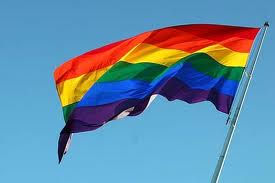
Gay

Gay is many things, but mostly homosexual. (It still always makes me think of the Village People, so that probably needs to change.)
This post is inspired by Pride Week, during which people of all sexual orientations celebrate the movement toward equality, recognition, and respect.
This week is Pride in Denver. From the Denver PrideFest website: “The mission of Denver PrideFest is to create a fun, safe and empowering space to celebrate and promote the heritage and culture of the LGBT and allied community in Colorado.”
I’m an ally. I have gay and lesbian friends, straight friends, and bisexual friends. I love them all equally.
I don’t really care how you stand on homosexuality. Because really, there is only one way to stand. And I’m not saying this because I want you all to share my thoughts, my political leanings, or my social theories. I’m saying this because every single human deserves the same rights.
Who cares if they get married?
Imagine not being able to visit your spouse in the hospital because you’re not considered family. That’s seriously fucked up.
It’s like that commercial with Justin Long that ends with “…make them get married. Like the rest of us.”
People of different races have fought for equal treatment, been awarded it by law, and yet are still persecuted for something they cannot change. Throughout the world, they are profiled, brutalized, enslaved, mocked, underpaid, overworked, disrespected, stereotyped, marginalized, and undermined. Laws are made to question their legitimacy, even in a nation built on the backs of and with the blood of immigrants from all over.
Women have struggled for the rights to their bodies, for the respect of men, for education, for freedom from familial obligations, for equal pay, for the rights to work and make the same as their male counterparts. They, too, have had to fight against all types of social injustice. Our work remains undone.
Change has happened, slowly. Perceptions have changed, slowly. But it’s not finished. It never will be. In a world where victims of rape are criticized for their clothing choices and where poverty is more prevalent among people who aren’t white, it’s obvious that some of our well-intentioned policies are nothing but fluff, a big talk meant to quiet the outspoken yet leave the status quo unchanged.
Gay isn’t something that just happened overnight. The gays didn’t just materialize from thin air. They’ve been here all along. They’ve shared your drinks, eaten at your dinner parties, managed large companies, created and maintained traditional families. You work with them. You sit next to them on the bus. They’ve been a part of your world since you were born.
Gay makes some people uncomfortable.
It’s understandable. Gay people do weird sex stuff, right? Well, newsflash, the straights are doing weird stuff, too.
Gay people will touch my children, you say.
Wrong. I mean, maybe a few. But so do your priests. So do teachers. So do people meant to protect our children. It happens, but it’s not directly linked to gay.
Gay people have the HIV.
Actually, they’re not the ones with the highest prevalence of new HIV infections these days. That heroin needle you’re holding is probably more dangerous. Besides, you can’t get HIV/AIDS from being near an infected person. Didn’t we all see “Philadelphia”?
Last night, I was out with two of my dear friends, one gay, and one Katie. After having dinner with Mike, we met up with a new friend of mine and went to a Denver gay bar. Wednesday is drag queen bingo, and we caught the tail end of it.
My new friend was uncomfortable.
I understand that men particularly are afraid of gay bars. He told me that he didn’t want any of his clients to see him and think he was gay.
What’s wrong with that? I thought. I was annoyed by his behavior. He didn’t want to get hit on. He didn’t want anyone to think he was gay. He didn’t want this, or that. He kept looking around nervously.
He never got comfortable.
Maybe it was the rainbow banners decorating the place? Maybe it was the drag queen standing by the door? Maybe it was the loud, shrill bingo announcer?
We ended up leaving.
It hurt my friends’ feelings and I was rude to them because I wanted to placate the new friend.
What I should have done is smacked him and told him to man up, politely.
This behavior is typical. It reminds me that even the most educated people with degrees from liberal institutions of higher learning can come out of those hallowed halls without having learned anything about what it’s like to be a human being.
It reminds me that people think that “the gays” are all sex-crazed monsters who will fuck anything that moves and is a man.
Not true!
Walking into a gay bar is just like walking into a straight bar (which is basically every bar) except there is more hair gel and better muscles, if you’re into that sort of thing.
But there’s also personal melodramas, bar snacks, shots of vodka, relationships being made and dismantled, laughter, tears, pictures being taken. Basically, it’s like every damn bar you’ve ever been to.
Later, new friend was telling me he was struck by my intelligence. (I was drunk at this point, and drunk me loves compliments.) I was flattered and completely blind to my opportunity to remind him that perhaps intelligence includes willingness to adapt to unfamiliar situations. An open mind, humor, and humility. He reminded me that intelligence isn’t something you can only get from As and good grades, that 4.0 and long-winded papers. I should have reminded him that intelligence is a continual real-life process, something you can only have if you’re willing to think about and experience emotionally challenging things.
I am ashamed that I said nothing to him. “The gays” are a very important part of my life. My friendships mean more to me than anything else.
Part of living in a diverse and beautiful society is understanding differences. Part of it is realizing that people are born the way they are and embracing that. And who cares? I have a weird elf nose and people still hang out with me.
I didn’t choose to be born a woman (although I’m glad that’s the way I came out – thanks Mom!). And no one chooses to be gay. There’s been a lot of discussion about this, and recently, a lot of suicides because of how hard it is to be gay.

While I generally hold that our children aren’t getting the social support they need, and consequently are taking drastic action that’s really stupid, I completely disagree about our discourse on taboo subjects needs to change. There’s not enough of it! We wait until someone dies, or something kills someone else, and then we say, “oh, we could’ve, should’ve, wait, next tragedy.” Nothing changes! Let’s dialogue until we’re blue in the face with our kids about a whole bunch of topics. Let’s show them that it’s okay to ask questions. Let’s show them that families come in all different styles.

No one chooses to be part of a marginalized subset of society. No one chooses to be gay. It’s a difficult life. It’s also really fun, too. There are cheap drinks at X Bar on Tuesdays. It’s normal. It’s natural. It’s really lovely. Just because that’s not how you roll doesn’t mean you have to hate on it.

Having gay friends doesn’t make you gay. Trust me on this one. Still a hetero here. People won’t think any less of you if you hang out with gay people; you won’t be any less of a man. So get over it! Stop freaking out about gay and start embracing it.

Or, if you’re still uncomfortable, start with baby steps. Gay is not always the stereotype. Remember that.

Gay makes good parents. Gay makes good teachers. Gay makes good thinkers, good bus drivers, good politicians, good postmen, good database administrators. But mostly, gay makes great dancers.

This week, reach out to your gay, lesbian, queer, questioning, and straight friends and remind them how much they mean to you.

And if you’ve got the time, head downtown this weekend and be a part of the celebration.

Death and then more war

I am more of a pacifist than I’d like to believe.
I don’t support the killing of anyone.
I don’t support any war.
I get that sometimes it’s “necessary” but the days of the World Wars have long since collapsed into wars of greed masked with good intentions.
The best of intentions don’t always lead to the best of outcomes – instead, we find ourselves mired in wars we can’t pay for, wars that kill our naive kids, wars that tear apart families and countries yet don’t bring the peace we’d hoped for.
The rebuilding takes years. The pain lasts forever.
The world is not a better place for our occupations; it’s merely a little bit more burdened, heavy with the right hand of America, that democratic bastard.

I don’t believe anyone should be celebrating the death of Osama bin Laden. I don’t think we’ve done anything other than kill someone else. He’ll become a statistic, as monumental as the toppling of the statue that stood in Baghdad. This day will be a memory. Nothing more. It is not the end. There is no winning. Not even Charlie Sheen can say that today.

And while I do appreciate that it’s finally done – and now hopefully our tides of propaganda can shift our focus elsewhere – I regret that it’s taken so long, taken so many misfires, taken so much American abuse of lands and peoples that don’t belong to us.

And of course, we didn’t even tell Pakistan we were going to do it. I understand why. But I think it will ultimately hurt our already fragile relationship with that country.

We dumped his body in the sea. I will give us credit for supposedly giving him a proper goodbye according to Islamic law.

In and out, swift justice for the wounded, for the dead, for the future.
Is it really justice?
Was it really worth it?

Is all that death for one life justification of creating the hell we thought we were trying to end?

Now let’s move on.
We’ll take the soft uptick in the markets that is sure to follow, we’ll take the slight jump of poll numbers, we’ll take the fuzzy bipartisan feelings reminiscent of a night spent on ecstasy, but we shouldn’t let it swell our already full heads.

I read one blog today that mentioned planting peace roses.
I’m for that.
Let’s remind the world that all this bombing and killing and bloodshed is supposed to achieve one thing: peace.

Don’t tell your kids we won.
We didn’t.
Because there is no we.

(I was listening to a man on NPR talk about Muslims and how he didn’t feel any negativity towards them – good, why should he? – and how they felt the same way “we” did. Thanks man, for really showing the separation “we’ve” created. Who is us and what are they?)

Teach peace and compassion.
Teach understanding and love.
And hope that somewhere, some of those lessons take root in our souls.

American Exceptionalism

Still not about teen pregnancy, my apologies. I’ve managed to convince myself that talking about it will lead me to write about eventually.
However, this article caught my eye this morning. It’s from Feministe, and I thought you might enjoy it. It makes me think of those damn chain emails that always irk me so much and then spark posts where I try to say something like what is written below but fail miserably in my attempt.
And thus, written by guest blogger S.E. Smith, is “American Exceptionalism and You.”
Enjoy:
Talking with a lovely Canadian the other day, we were discussing a really common problem we encounter on the Internet: The assumption that all readers are from the United States, and thus have a detailed understanding of issues that pertain to the United States and are deeply interested in these issues.
There’s a term, ‘American exceptionalism,’ that is used to describe some of the interesting social and political attitudes that surround the United States. Officially, it has to do with the idea that the United States is somehow exceptional or special, occupies a special position on the global stage by virtue of its accomplishments, deserves a special place in history because it’s just so darn unique. None of these things are true, but they directly contribute to the way the United States engages in foreign policy and interacts with other nations, behaving as the self appointed playground monitor that can do no wrong.
And this plays out in the way that people in the United States interact with the rest of the world as well. There’s a dominance that happens; US English is assumed to be the primary mode of communication, for example. Sites assume that readers can access Hulu videos (only available in the United States, but you already knew that, right?). Or that all readers are up on current political events in the United States. There’s also an implication that everyone from the United States has shared values and life experiences that acts to erase many people.
This very term, ‘American exceptionalism,’ speaks to the special place that the US thinks it occupies. Did you know that there are 36 countries in the Americas? That the Americas span two whole continents and the Caribbean? That US English is not the only language spoken in the Americas? Yet, the United States has coopted this term, ‘American,’ all for itself. Some people have even taken special care to weaponise this term in the immigration debate, demanding that the United States should be closed to people who aren’t ‘American.’
Assuming that everyone is from the United States doesn’t just erase the identities, interests, and concerns of people who are not from the United States. It also makes it fundamentally challenging for people to engage with content on US-centric sites. The assumptions that they will know about things slung about quite casually with no context or background get really frustrating; who wants to Wikipedia their way through a blog post to understand what in the hell is going on? Not I, that is for sure.
And I note that when people who are not from the United States write, they often do so with a global audience in mind. They explain things as they go along. They provide context and information so that people can understand what they are reading. They add insight and commentary. They do not assume that readers will understand the ins and outs of their political systems or will know the titles of laws by heart or will understand coded references to historical events. As a reader in the United States, I still sometimes feel a little bit lost, in part because of the ignorance cultivated by the way I engage with media, but at least I am not completely at sea.
When I go to the front page of overseas newspapers, often it’s US news that dominates the headlines. The 2008 election was covered in exhaustive detail in publications all over the world. Yet, Britain recently had an election, and it received barely any coverage here in the United States. Many US readers couldn’t tell you what a ‘coalition government’ is, let alone why it matters. Australia has an election coming up this year, but you probably wouldn’t know that if you read the news in the US exclusively.
US newspapers report news in the context of ‘how this pertains to the interests of people in the United States.’ Foreign newspapers don’t do this. They assume that readers might actually want to know about things that are going on in the world, even if they do not directly related to events going on at home.
There’s an othering that happens here too. When I read news stories about things that happen in other countries, it’s all about the Other. Over There. Those People. And The Horrible Things They Do. No matter that the same horrible things happen here in the United States, no matter that the United States might actually have some culpability in those horrible things, some involvement in a history of colonialism and exploitation.
That othering crosses over to interactions online as well, with people regarding nations outside the United States as abstract, exotic places. A certain amount of patronising seems to develop. Even on sites that supposedly have an international bent, the assumption is that everyone is from the United States, as though people from other regions of the world can’t access the site, or are perfectly happy to remain on the margins, to allow other people to write about their nations and their experiences. Sometimes it seems like everything must be filtered through the US lens.
Considering what happened the last time someone at Feministe tried to point out that the United States is not the centre of the world, I’m sure this will be tragic to hear, but, folks? The United States is not the centre of the world. And the widespread insistence on centreing experiences and concerns that are primarily relevant to people in the United States, and to referring to these things as ‘American,’ effectively ignoring the existence of the 35 other countries in the Americas, is really a significant barrier to conversation, not just here, but on many sites across the Internet.